Sizing up your magical practice

(Or, how not to end up in a tinfoil hat.)
by Mordant Carnival
Key64.net

wordpress.com/ tag/el-p/feed/

It”s the aim of this article to look at ways of appraising your magical practice, offering a few approaches and techniques to make sure things are on track as far as effectiveness goes and also to avoid some of the more common pitfalls along the way.

It”s not always possible to apply the scientific method per se to this kind of work but the techniques and approaches associated with scientific investigation are applicable in many cases and can be very useful. This doesn”t mean trying to prove that magic works, putting together a study that could find a home in The Philosophical Transactions of the Royal Society laying out evidence that Wednesday”s sigil working was responsible for your getting laid last night. Since magic is such a nebulous beast, an experiential business with unprovables being kicked around all over the shop and subjectivity agogo, it is frequently a logical impossibility to talk in terms of proof and not necessarily desirable anyway. However, this does not mean that we have to give up all notion of a meaningful assessment of the success or otherwise of a working or a practice, an assessment based on discernment, critical thinking, logic and rationalism. “Proving” that magic works, or that a particular spell worked, is not the point. The point is analysing your results and your overall progress in an intelligent and meaningful way. Continue reading “Sizing up your magical practice”


Prankenstein scammers

What not to do:

brain200.jpg4 Charged in False Brain Surgery Claims
June 2, 2007

New York (AP) — Four people billed a health insurance company for 20 brain operations that were never performed on them, sometimes for the same person on multiple occasions, authorities said.

One 36-year-old man from New York City claimed nine brain surgeries for himself, along with his wife and two sons, receiving reimbursements from New York-based Group Health Incorporated totaling $142,268, federal investigators said Friday. Read the whole story here.

Pass the dressing. Hold the sperm.

What not to do!

saladdressing200.jpgSalad Dressing Semen Spawns Trouble
May 24, 2007

Wheaton, Ill. (AP) — A judge has ordered a 17-year-old to pay a $750 fine and perform 120 hours of community service for contaminating salad dressing with semen and returning it to a suburban Chicago high school’s cafeteria.

DuPage County Judge Terence Sheen also placed Marco Castro on two years probation Wednesday and ordered him to write a letter of apology to Wheaton North High School officials. Castro must complete his community service work for an agency that works with AIDS patients. Read the rest of the story here.

The Anti-Advertising Agency

From the Anti-Advertising Agency Web site:

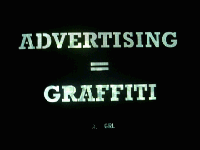
ads_graffiti200.gif

    “…Through long-term commercial saturation, it has become implicitly understood by the public that advertising has the right to own, occupy and control every inch of available space. The steady normalization of invasive advertising dulls the public”s perception of their surroundings, re-enforcing a general attitude of powerlessness toward creativity and change, thus a cycle develops enabling advertisers to slowly and consistently increase the saturation of advertising with little or no public outcry.

    The Anti-Advertising Agency co-opts the tools and structures used by the advertising and public relations industries. Our work calls into question the purpose and effects of advertising in public space. Through constructive parody and gentle humor our Agency”s campaigns will ask passers by to critically consider the role and strategies of today”s marketing media as well as alternatives for the public arena. Our work will de-normalize “out-of-home” advertising and increase awareness of the public”s power to contribute to a more democratically-based outdoor environment…”

As an example, Light Criticism is a collaboration between the Anti-Advertising Agency and the Graffiti Research Lab:

Continue reading “The Anti-Advertising Agency”

How to Make Disappearing Ink

From About:Chemistry

dis.gif

Disappearing Ink Chemistry

Disappearing ink is a water-based acid-base indicator (pH indicator) that changes from a colored to a colorless solution upon exposure to air. The most common pH indicators for the ink are thymolphthalein (blue) or phenolphthalein (red or pink). The indicators are mixed into a basic solution that becomes more acidic upon exposure to air, causing the color change. Note that in addition to disappearing ink, you could use different indicators to make color-change inks, too.

To find out how disappearing ink works, what you need to make it, and how to do it, follow this link — Continue reading “How to Make Disappearing Ink”