Joey Skaggs’ First Easter Sunday Crucifixion Event Turns 60!

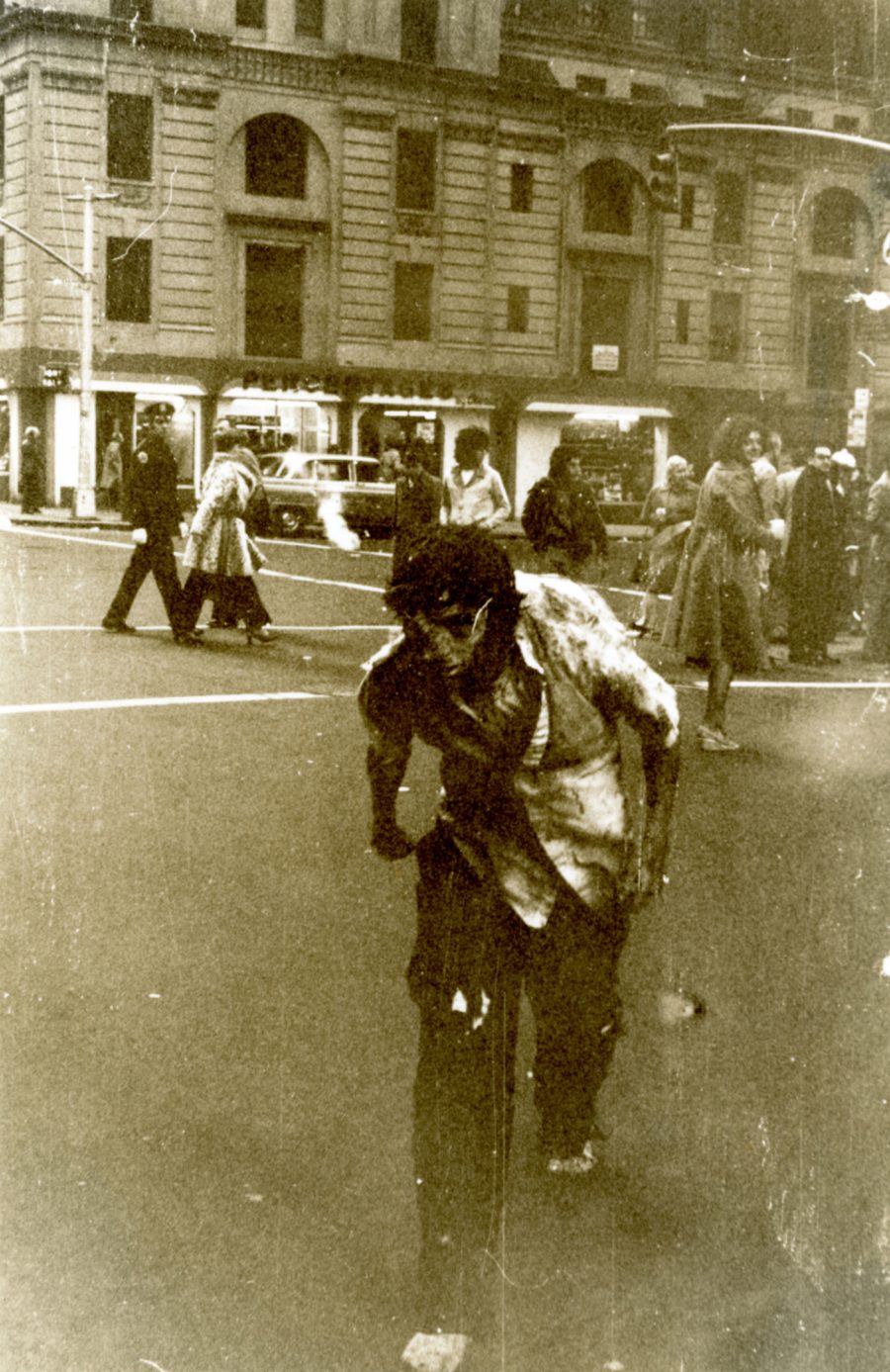
60 years ago, in 1966 on Easter Sunday, Joey Skaggs dragged his iconoclastic sculpture of a naked and decayed figure of Jesus Christ on a crucifix into Tompkins Square Park on the lower east side. It was his personal statement about the war in Vietnam and the hypocrisy of religion.

This was the beginning of Skaggs’ career as an artist who used the streets as his theater.

Gothamist covers Joey Skaggs’ 41st Annual April Fools’ Day Parade

New York City’s greatest pranks, from fantastical parades to a phony Mets star, by Samantha Max, Gothamist, April 1, 2026

Trump’s Military Parade at the 33rd Annual April Fools’ Day Parade

Artist and activist Joey Skaggs has been inviting members of the New York City media to his annual April Fools’ Day parade along Fifth Avenue since 1986.

Press releases archived on Skaggs’ website describe the event as an attempt to “bring people back in touch with their inherent foolishness” and celebrate “the public’s right to laugh in the face of authority.” Past parades have included a President Donald Trump look-alike contest and a Y2K-themed end-of-the-world party. This year’s press release invites participants to ponder “what’s real and what’s not” at a parade led by the president himself, followed by a screening of the “Melania mockumentary” and a reading of all redacted names in the Jeffrey Epstein files, other than victims.

Read the rest of the article here.

Joey Skaggs’ Cathouse for Dogs Turns 50!

50 years ago on April 1, 1976, in response to a subpoena issued by the New York State Attorney General, Joey Skaggs revealed that his Cathouse for Dogs (doggy bordello) was a satirical media performance hoax.

Curses on the Rats Who Exposed Banksy

May your dick look just like Trump’s


Guerrilla artist Banksy finally unmasked — along with the remarkable way he hid in plain sight, by Stuart A. Thompson and Anthony Blair, New York Post, March 15, 2026

The infamous graffiti artist known as Banksy has finally been unmasked — after changing his name to something so generic, he could hide in plain sight..

The notorious guerrilla street artist, whose polarizing works have sold for millions of dollars, was identified as Robin Gunningham, 51, from the English city of Bristol, in a detailed investigation by Reuters on Friday.

The report found that Gunningham changed his name to David Jones — one of the most common British male names — in 2008 to avoid identification. Read the whole article here.

More Banksy coverage here.

Excavating Society’s Ever Changing Values on Art

Spencer Pelton, the State Archeologist from Wyoming, has written a compelling history of what happens when today’s values don’t match yesterday’s intent.

h/t Beauvais Lyons


The Centaur Excavations at Volos, by Spencer, Social Stigma, March 13, 2026

Using repatriation to stage an art heist.

In 1980, archaeologists working near the shores of the Aegean Sea uncovered a remarkable find. Peeling back layers of sediment in an ancient necropolis, they first encountered the head of an ancient Grecian man, mouth agape as if surprised to have been awoken from an ancient slumber. They traced the neck further down his body, gently brushing away sediment from the convoluted contours of the vertebrae, finding arms where arms should be and shoulder blades the same. But as they continued, the man’s character changed. Where there should be a pelvis, there was more spine, and then second sets of ribs and legs, not altogether human. As the archaeologists brushed the final bits of sediment from a third set of legs, the shocking reality of their discovery came into focus. The mythical centaur of old Greece, entombed with a modest assemblage of tablets and vessels for over 3,000 years.

This is, of course, not true. But it is an accurate description of The Centaur Excavations at Volos, an art installation located until recently for 30 years in the lobby of the University of Tennessee’s (UT) Hodges Library. I visited The Centaur many times growing up around UT’s campus. As a young child, I’m pretty sure I believed it. As a teen, I scoffed at those fooled by it. And later, I came to appreciate the piece for its ability to inspire curiosity and conversation. Read the whole article here.