Remembering The Realist

I’m very happy that archivist Ethan Persoff has created The Realist Archive Project, and will be republishing all 146 issues of Paul Krassner’s “classic and uncompromising” magazine The Realist. It’s great that his work will be back in circulation and available to the public.

logo3425.jpg

I’ve known Paul since the 1960’s. He’s been a good friend and supporter of my work. He’s even been a participant. He came on my Hippie Bus Tour to Queens, was at my Vietnamese Christmas Nativity Burning in Central Park, and was kind enough to pose with my Grotesque Statues of Liberty in the East Village for the back cover of the jacket sleave of his book, How a Satirical Editor Became a Yippie Conspirator in Ten Easy Years. Paul has always been thoughtful, courageous and funny. Happily, he’s also a contributor to this site.

Four issues of The Realist will be posted every month until the archive is complete.

Thanks Mark Frauenfelder for the heads up and for the wonderful post about The Realist’s influence on Boing Boing.
Fakes and Forgeries: The Art of Deception

An exhibition at the Bruce Museum, Greenwich, Connecticut, May 12, 2007 – September 9, 2007:

100_preview.jpgBruce Museum Web site:

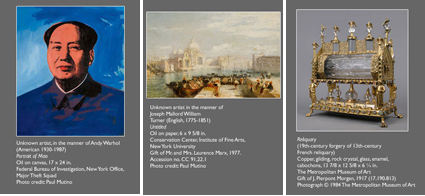
    “For its major spring/summer exhibition, the Bruce Museum explores a subject that is exceptionally topical in today”s art world. Fakes and Forgeries: The Art of Deception presents 60 examples of Western paintings, works on paper, sculpture and decorative arts that have been recognized as imposters, including examples of the rarest and most famous deceptive works. Themes of connoisseurship, authentication, and conservation, as well as the evolving scholarship of stylistic development will be examined in an exhibition organized by and exclusively on view at the Bruce Museum.

    Fakes and Forgeries: The Art of Deception reveals the strategies and techniques of the world”s most successful forgers and exposes the extraordinary lengths to which they went to produce authentic-looking artworks. It also addresses techniques used to expose these deceptions, including X-ray fluorescence, pigment analysis, spectrography, dendrochronology, and carbon dating…”

images.jpg

Here’s a New York Times review by Grace Glueck, They Are Inauthentic, Yes, but Beautiful

Here’s a New York Sun review by Maureen Mullarkey, At the Bruce, the Art of Deception

Thanks The Art of Law Blog

Coyle & Sharpe: The Imposters Podcasts, Episode 6

Coyle & Sharpe, The ImpostersHere’s Prison Camp, episode 6 of the historic Coyle & Sharpe podcast series presented by Jesse Thorn of The Sound of Young America. In this episode, Coyle & Sharpe ask a man from Montana to help them to control the laborers in their agricultural facility using guns and electrical shock.

Listen to episodes 1, 2 & 3 here, episode 4 here and episode 5 here.

These recordings are from the Sharpe family archive, tended by Mal’s daughter, Jennifer Sharpe. More about Coyle & Sharpe is available on their Website or on MySpace.

You can also listen to this podcast at The Sound of Young America or you can subscribe to the series in iTunes.

How false information creates true events

From monochrom: An article by Klaus Schoenberger — who is doing pop-culture research at the University of Hamburg, Germany — featuring the Yes Men and their Union Carbide/Bhopal hoax in 2004.


Activists use fakes and hoaxes to communicate information by speaking in the name of someone else – persons or institutions invested with power. With the spreading of Internet communication, this pattern of action and communicating has acquired additional power as a means of political and social protest. Within the framework of Guerrilla Communication, with its specific understanding of politics, faking develops into an efficient form of political articulation.

Read the entire article here.


Editor’s note: See also April Media Fools, March 30, 2005, by Rory O’Connor for MediaChannel.org