Fake FEMA Press Conference

FEMA Meets the Press, Which Happens to Be . . . FEMA
by Al Kamen
The Washington Post
October 26, 2007

FEMA has truly learned the lessons of Katrina. Even its handling of the media has improved dramatically. For example, as the California wildfires raged Tuesday, Vice Adm. Harvey E. Johnson, the deputy administrator, had a 1 p.m. news briefing.

Reporters were given only 15 minutes’ notice of the briefing, making it unlikely many could show up at FEMA’s Southwest D.C. offices.

They were given an 800 number to call in, though it was a “listen only” line, the notice said — no questions. Parts of the briefing were carried live on Fox News, MSNBC and other outlets.

Johnson stood behind a lectern and began with an overview before saying he would take a few questions. Continue reading “Fake FEMA Press Conference”
Whack Big Media

From StopBigMedia.com:

Play The Game. Then Take Action.

Rupert Murdoch’s media empire just keeps on growing. This summer, Murdoch gobbled up the Wall Street Journal, one of the country’s most respected news sources. Now Murdoch has launched the Fox Business Network. The new channel, which aims to peddle Murdoch’s brand of business news to the American public, will start in about 30 million households – a considerable reach to begin with. Continue reading “Whack Big Media”

Australian TV Show Explores Art Boundaries

Culture vulture
by Tim Elliott
The Sydney Morning Herald
October 15, 2007

Real culture, Westbury says, comes from the bottom up: it’s unruly, often illegal and frequently unloved (at least by the mainstream).

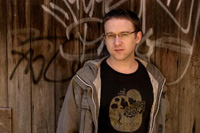
marcus_westbury_wideweb__470à—3120-200.jpgSay the word art and most people think of the Mona Lisa and long-dead Europeans such as Vincent Van Gogh. Mention art to Marcus Westbury and he thinks of weeds, graffiti and video games, plus a lot of other things that most people don’t consider to be art at all.

And in his new series, Not Quite Art, he’s trying to get us to think likewise.

Affable and articulate, Westbury has made a supple and free-ranging examination of where “art” and “culture” come from, while providing a tantalising glimpse of what’s going on away from the big city galleries. “Art excites me,” he says, “but the artists who excite me most aren’t dead and on the walls of revered cultural institutions, they are alive and making things now.”

Westbury, who describes himself as “a very lucky troublemaker”, has been putting together arts events and festivals for the past 10 years; he has worked with graffiti artists, anarchist collectives, major galleries and government policy committees. And yet his resolutely unorthodox take on the art world and a lack of formal art education that makes him perfectly qualified to host a show such as Not Quite Art. Continue reading “Australian TV Show Explores Art Boundaries”

Christof Schlingensief: Bitte Liebt Osterreich

Submitted by Peter Schlager:

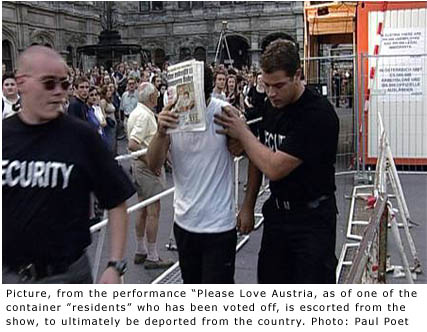
Christoph Schlingensief made his own contribution to the 2000 Vienna International Festival by organising the reality TV event Please Love Austria:

In 2000, German director and activist Christof Schlingensief created a fake public TV-show. After the formation of the Austrian right wing coalition, Schlingensief built a public “container” show called Please Love Austria so people could (similar to the Big Brother reality TV show) vote for which of the “contained” immigrants should stay and which should go. Schlingensief was then accused by the Austrian right wing party of racism. He was publicly offended with the words “You Artist!”

container4-425.jpg

For more about this performance, visit schlingensief.com, click on Works, then Performance, then select Bitte Liebt Osterreich (2000) from the pull down menu.

My Kid Could Paint That

story-200.jpgEye of the Beholder
Arts & Leisure, Movie Review
by Bruce Bennett
The New York Sun
October 5, 2007

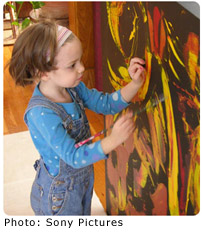
“When you’re actually getting documentary gold, it doesn’t feel like gold,” said the filmmaker Amir Bar-Lev, the director of My Kid Could Paint That, a remarkable and controversial new nonfiction film that opens today. “It feels bad.”

As his film makes its way to a couch-side conversation that yields the unforgettably heartbreaking, humane, and dramatically priceless moment that is the source of the gold Mr. Bar-Lev referred to, My Kid Could Paint That examines the ideas and feelings behind the nature of art, identity, creativity, truth, and story. It does so with such prickly, fulminating intelligence that one leaves the film abuzz with crystallized impressions, named feelings, and known beliefs that were unspecific notions before the curtain rose. Continue reading “My Kid Could Paint That”