Joline Blais on Internet Pranks by the Yes Men

Submitted by William of FORA.tv:

FORA.tv presents Joline Blais, in cooperation with the Long Now Organization, discussing the artwork of the Yes Men’s internet pranks that focus the world’s attention on big corporations and global political entities.

Joline Blais is co-author of At the Edge of Art with Jon Ippolito.

Related links:

  • Cato Institute K.O’s Yes Men Attempt
  • Yes Men: “Exxon Strikes Back!”
  • The Yes Men Strike Again
  • The Yes Men are Coming! The Yes Men are Coming!
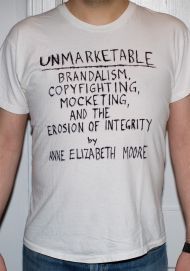
  • Unmarketable, by Anne Elizabeth Moore

    From The New Press Web site:

    Unmarketable: Brandalism, Copyfighting, Mocketing, and the Erosion of Integrity by Anne Elizabeth Moore

    Unmarketable, by Anne Elizabeth Moore

    For years the do-it-yourself (DIY)/punk underground has worked against the logic of mass production and creative uniformity, disseminating radical ideas and directly making and trading goods and services. But what happens when the underground becomes just another market? What happens when the very tools that the artists and activists have used to build word of mouth are coopted by corporate America? What happens to cultural resistance when it becomes just another marketing platform?

    Unmarketable examines the corrosive effects of corporate infiltration of the underground. Activist and author Anne Elizabeth Moore takes a critical look at the savvy advertising agencies, corporate marketing teams, and branding experts who use DIY techniques to reach a youth market””and at members of the underground who have helped forward corporate agendas through their own artistic, and occasionally activist, projects.

    Covering everything from Adbusters to Tylenol”s indie-star-studded Ouch! campaign, Unmarketable is a lively, funny, and much-needed look at what”s happening to the underground and what it means for activism, commerce, and integrity in a world dominated by corporations.

    Anne Elizabeth Moore is the co-editor of Punk Planet, the Best American Comics series editor, and the author of Hey, Kidz! Buy This Book: A Radical Primer on Corporate and Governmental Propaganda and Artistic Activism for Short People. She has written for Bitch, the Chicago Reader, In These Times, The Onion, The Progressive, and Chicago Public Radio WBEZ”s radio program 848. She lives in Chicago.


    To get more of a sense of what this book is about, check out Rob Walker’s very interesting interview with Anne Elizabeth Moore from his blog Murketing.

    Writers Strike Spawns More Exploitation TV

    First, a simple explainer as to the issues causing the Writers Strike, from the Writers Guild of America (WGA) via Ellen Sandler:

    The Writers Strike: Why We Fight


    Thanks Erin. Now, a look at the world of television without writers:

    Writers Strike Means Reality Boom Times
    by Lynn Elber
    AP Television Writer
    November 27, 2007

    Los Angeles (AP) — For five years, John Langley tried and failed to sell a cinema verite-style TV series tracking police officers on patrol. Then came the 1988 Hollywood writers strike.

    “That’s when Fox bought `Cops,’ because a series with no narrator, no host, no script, no re-enactments sounded very good to them at the time,” recalled Langley, who just marked the show’s 700th episode.

    The nearly five-month ’88 Writers Guild of America walkout that started in March didn’t unleash a flood of reality, because filming on sitcoms and dramas had largely wrapped and because alternative shows had yet to become a trend.

    But the current WGA strike fell smack during production as well as the Age of Reality, putting the brakes on scripted shows and giving networks a quick fix for schedule holes. It remains to be seen how viewers – or the reality genre itself – will withstand the onslaught.

    Networks have readied a slate of nearly 40 shows that are stacked up like jetliners over Christmas Eve runways awaiting the go-ahead to land. Continue reading “Writers Strike Spawns More Exploitation TV”

    Consuming War

    Consuming War
    An exhibition curated by Barbara Koenen
    November 4 to January 20, 2008
    Hyde Park Art Center
    5020 S. Cornell Avenue
    Chicago, IL 60615

    Proposed work by Burtonwood & Holmes, 2007Featuring works by Lynda Barry, Wafaa Bilal, Mary Brogger, Adam Brooks, Burtonwood & Holmes, Michael Hernandez de Luna, Fred Holland, Harold Mendez, Michael Rakowitz, Ellen Rothenberg, Edra Soto, Paula White and Dolores Wilber.


    Focusing on the U.S. conflict in the Middle East over the past 10 years, Consuming War addresses the ways the American media and consumer culture have manipulated and influenced our perceptions of war, often turning it into a spectacle for American consumption. While war is an underlying theme in all the works, each addresses the concept of war, and our relationship to it, from a variety of angles, creating pieces that range from political cartoons to sculptures that recreate the archeological artifacts looted from the National Museum of Iraq and large suspended papier mâché bombs made from sale advertisements. Timely in its subject matter, Consuming War offers an innovative platform in which the complex and multifarious connections between war, capitalism, American consumer culture, and our everyday lives can be re-situated and critically examined.

    Related links:

  • Listen to WBEZ”s interview with the curator about the exhibition.
  • Domestic Tension by Wafaa Bilal
  • For more information, visit the Hyde Park Art Center Web site
  • image: Proposed work by Burtonwood & Holmes, 2007
    via Art Threat

    Orson Welles: F For Fake

    A film review by Shane Lavalette /Journal, November 10, 2007:

    F For Fake, by Orson WellesOrson Welles is generally known for his 1938 radio broadcast of the science fiction novella War of the Worlds. If not for that, then for co-writing, directing, producing and starring in Citizen Kane (1941), commonly referred to as “the greatest film ever made.” Orson Welles is, however, not so known for his last major film, F For Fake (1974) – a pseudo-documentary and playful meditation on “art, experts and fakery.” Here”s a quick synopsis taken from The Criterion Collection (released the film on DVD in 2005):

    Trickery. Deceit. Magic. In Orson Welles” free-form documentary F for Fake, the legendary filmmaker (and self-described charlatan) gleefully engages the central preoccupation of his career””the tenuous line between truth and illusion, art and lies. Beginning with portraits of world-renowned art forger Elmyr de Hory and his equally devious biographer, Clifford Irving, Welles embarks on a dizzying cinematic journey that simultaneously exposes and revels in fakery and fakers of all stripes””not the least of whom is Welles himself. Charming and inventive, F for Fake is an inspired prank and a searching examination of the essential duplicity of cinema.

    Continue reading “Orson Welles: F For Fake”