
It’s a virtual minefield

http://blogs.electricsheepcompany.com/giff/wp-content/uploads/2006/10/nissan-vendor.jpgOutFront: Sex, Pranks and Reality
by Allison Fass
Forbes.com
July 2, 2007

Second Life’s virtual Web world can be a weird, chancy place for real-life brands.

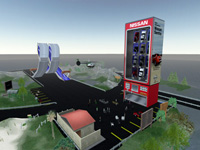
In April a helicopter crashed into a Nissan building, starting a fire that left a couple of dead bodies. The explosion took place on Altima Island in Second Life, a Web fantasy world where users create customized, cartoonlike characters called avatars. The crash, whether an accident or an intentional prank, wasn’t exactly an image-enhancing moment for a carmaker. Nissan’s online reps cleaned up the virtual mess, coffins and all.

Marketers have flocked to Second Life since it went live in 2003. Coca-Cola, H&R Block, IBM and Toyota are among 80 companies that have set up a virtual presence there to capture eyeballs–Second Life boasts a population of 7.1 million registered users–and experiment with online branding. It’s cheap: Linden Lab, the site’s creator, charges $1,675 plus $295 a month to occupy an island. Visitors pay nothing.

But this leasehold doesn’t fence out troublemakers. It turns out that avatars seem more interested in having sex and hatching pranks than spending time warming up to real-world brands. “There is nothing to do in Second Life except, pardon my bluntness, try to get laid,” blogged David Churbuck, Web-marketing vice president for computer maker Lenovo. (Lenovo isn’t represented on Second Life.) Continue reading “It’s a virtual minefield”

Burning Man burning-out?

Article from Mother Jones, May/June 2007:

burnt_by_the_man_175à—282.jpgBurnt By The Man
News: How copyrighting, capitalism, and lawsuit chaos disturbed the radical utopia of Burning Man.

By Josh Harkinson
Mother Jones
May/June 2007 Issue

They all burned the Man. The punk bicyclists, the drunk faeries, the people painted blue. So splendidly did Larry Harvey’s 40-foot wooden hominid burst into flame that he and his friend John Law burned the Man again, each and every year since 1986, until everybody involved””last year, nearly 40,000 of them””simply became known as Burners. And the Burners built a Bedouin arts community called Black Rock City in the Nevada desert: a tent metropolis with its own “gift economy” that banned all commerce and its own government complete with a Department of Public Works. In short, they made a new Man””though maybe not a better one.

“I think it’s something that needs to be skewered and mocked,” says Law, Burning Man’s cofounder. He quit running Burning Man a decade ago, but not before he and Harvey began selling expensive tickets to the event (last year they went for up to $350), trademarked and split ownership of the Burning Man name, and licensed it to Black Rock City llc, a for-profit, limited liability corporation run by Harvey. Law believes the corporation has become unaccountable, so he’s challenging Harvey’s oversight in a California court””quite literally putting the fate of Burning Man in the hands of “the Man.” Continue reading “Burning Man burning-out?”

To tag or not to tag, that is the question

www.teako170.comFrom Medill Reports Chicago: Street art has moved not just to the art world, but to the world of everyday consumption

It”s not the car, it”s the graffiti selling it
by Phillip Kaplan
May 16, 2007

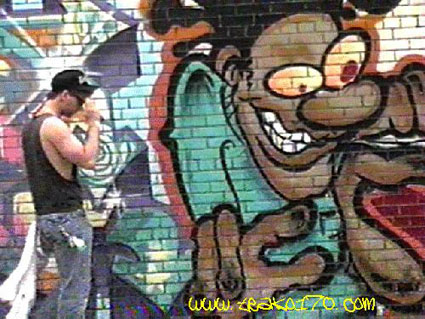
Graffiti and advertising are kind of like cops and robbers: eerily similar to each other yet at complete opposition.

Members of each group cross into the other with the each group usually condemning the other’s action, but sometimes covertly encouraging it. Each has a righteousness of rhetoric, and the perspective of which is “right” or “wrong” depends on what turns you on “” getting over authority or getting “bad” guys.

While advertising is meant to inform people, graffiti writing often addresses only those who can decode it.

But the advertising industry seems to think there are enough decoders out there to cater to, perhaps thinking if someone stares at some graffiti to find out the name of the artist who did it, what”s the difference if the name spells Honda? Continue reading “To tag or not to tag, that is the question”

Madison Avenue goes guerilla

News Analysis: Boston Bomb Hoax Scares Up More Guerrilla Business
May 14, 2007
By Becky Ebenkamp
Brandweek

A $2 million fine and Senate bill can’t cage envelope-pushing efforts.

mooninites.jpg“Now more than ever!” is the rallying cry for guerrilla marketers three months after a misunderstanding over a stealthy street stunt promoting Cartoon Network’s Aqua Teen Hunger Force brewed a Boston bomb scare.

Some marketing agencies say the headline-making hoax has actually increased business despite a bill making its way through the Senate that would impose harsher punishments should such a hoax happen again.

Early reports after the Jan. 31 hysteria had many speculating marketers would steer clear of this big-bang/small bucks school of buzz building. After all, Cartoon Network gm/evp Jim Samples resigned; parent company Turner Broadcasting and guerrilla agency Interference agreed to pay $1 million in compensation to Massachusetts and another $1 million to support federal homeland security.

“The smarter clients I spoke to [realized] that a $2 million fine equals $120 million in publicity,” said Peter Shankman, president of New York-based pr/marketing agency The Geek Factory. “They said, ‘Just get the damn permits first!'” Continue reading “Madison Avenue goes guerilla”

Verizon, AT&T and the manipulation of public opinion

Bruce Kushnick

Commentary:

by Bruce Kushnick
for Nieman Watchdog,
Nieman Foundation for Journalism
at Harvard University

April 4, 2007


Needed: Blacks, Hispanics, disabled, deaf, low-income and the elderly to support the telecoms” positions on anti-consumer FCC rulings and legislation.

DEFINITIONS:

Astroturf””An organization set up by a large corporation or corporations to put forward the corporate agenda but to look like an authentic ‘grass-roots’ group.

Co-opted””An authentic group that is given funding by a large corporation or corporations, where the group lobbies for corporate initiatives even if they are contrary to the needs of its members.

Skunkworks””A well coordinated campaign funded by large corporations (or industries) that incorporates Astroturf and co-opted groups, research think tanks, PR firms, lobbying firms, state and federal politicians to put forward the corporate agenda on a specific topic.

Over the last few weeks numerous groups have been lobbying and hyping the corporate position of AT&T and Verizon for relaxed cable franchise requirements or to stop any net neutrality legislation.

Some of these groups are working together to supply a message that blacks, Hispanics, seniors, low income, deaf or disabled persons care about these issues – and that they back the AT&T and Verizon positions. Continue reading “Verizon, AT&T and the manipulation of public opinion”