
Fear, Loathing, and Farts in Austin

Texas is at the center of the national controversy over mass shootings and gun control. And few cities have the same flair for the theatrical as does Austin.

The warring sides of the gun debate recently staged their own equally ridiculous public events in the state capital.

Fake Mass ShootingThe Huffington Post reports that “Pro-gun advocates doused fake victims with fake blood outside the University of Texas on Saturday in what they called a theatrical event to show the need for firearms on campus.

“Their ‘mock mass shooting’ was met with a much larger counter-protest and derision by many onlookers in the left-leaning city of Austin who saw the group pushing a position that could increase the danger brought by firearms at the university that saw one of the worst mass school shootings in U.S. history.

“One of the mock mass shooting organizers, the group Come and Take It Texas, said allowing gun-free zones on campuses eliminated a human right to personal protection.

“‘Our goal is to instill the importance of everyone to be able to defend themselves in any way they choose,’ the group said in a statement posted on its website.” Whole thing here.

mass farting counter-protestMeanwhile, as reported in the Austin Chronicle, “Pro-gun demonstrators staging a mock mass shooting near the University of Texas at Austin on Saturday were overwhelmed in number and ferocity by a large group of counter-protesters wielding dildos and machines that generated fart sounds.

“‘This isn’t about guns necessarily. This is about scaring our community. This is about a choice between fear and a little bit of good humor,’ Andrew Dobbs, a UT alumnus who organized the ‘mass farting’ counter-protest, told the crowd. ‘We are in a scary time right now and lots of scary things are happening, and some people want us to be more afraid.’ Whole thing here.

Providence Punks Poke Fun at Local Foodies

As marks go, culinary snobs are low-hanging pomegranates. But these anonymous Rhode Island performance artists get points for their attention to detail. (H/t to Dave Pell.)


The Hippest Cafe in Providence Was Totally Fake
By Vicky Gan
Citylab
October 27, 2015

luracafeFor a few #blessed days, Lura Cafe was the hottest new restaurant in Providence. The bright, cozy farm-to-table joint hid in plain sight next to a downtown parking lot, steps away from the Rhode Island Convention Center. Lura would be a refuge for diners in the know, serving modern takes on cafe classics””all local, all organic, all certified GMO-free. It was upscale and casual, timeless and avant-garde. It had a vaguely Nordic air of refinement.

It announced itself – as all similarly accoutred restaurants must – with a social media blitz, featuring sans serif lettering, sunny high-angle shots of brunch dishes, even a breathless write-up in the New York Times.

It was also totally fake.

When Lura Cafe “opened” on October 18, visitors were greeted not with avocado toast and bruleed carrots but with a manifesto: “‘Lura’ is a statement project targeting the rising phenomenon of the elitist subculture of foodies.” Beside it, a translation of “Lura” – “Swedish for fool, trick, deceive, lure, cheat, befool” – and a call to arms: #stopfoodies2015.

The satire wasn”t exactly subtle. In the days leading up to Lura”s grand opening, the restaurant”s Facebook page taunted followers with a surreal menu of “home-cut potatoes… wrapped in authentic New York Times newspaper,” “cold brew coffee served… over mineralized water rocks,” and “10x washed quinoa salad.” The quote attributed to Pontus Wikner, “POTS SEIDOOF,” is “FOODIES STOP” backwards. Full story here.


The Squicky Side of International Development

JadedAid, a new party game derived in style and spirit from Cards Against Humanity, satirizes the international development industry in brutal and hilarious fashion.


Cards Against Humanitarians
by Iyla Lozofsky
Foreign Policy
September 28, 2015

Needless to say, this very serious industry has its very serious critics. But few are as creative (or as hilarious) as three young development professionals who, in the last few weeks, have chosen to express their discontent by self-publishing a satirical card game. JadedAid is modeled on the popular millennial game, Cards Against Humanity, in which players compete to select the funniest (or most vulgar) answers to a set of “fill-in-the-blank” questions. Just a week since its opening, the JadedAid KickStarter campaign has collected nearly twenty thousand dollars “” far ahead of its creators” targets “” and the game is well on its way to completion. As an example of the kind of decidedly un-pc satire the game provides, here is one possible combination of cards:

Some of the card ideas were developed by the game”s inventors, who, all in their thirties, have extensive experience in the technology and communication side of the development industry. But the vast majority of the suggestions (nearly 800 at last count) were submitted by friends, colleagues, and anonymous development workers. One of the game”s co-founders, Jessica Heinzelman, 36, attributes the game”s immediate appeal to the need for development workers to “let off some steam” by subjecting their experiences in the field to mockery. Continue reading “The Squicky Side of International Development”

Inside the Center for Tactical Magic

Here’s a rare glimpse behind the enigma of the legendary Center for Tactical Magic as founder Aaron Gach shares his background, philosophy, and success stories in this interview with Regine Debatty.


“Interview with The Center for Tactical Magic”
by Regine Debatty
We Make Money Not Art
August 14, 2015

…The Center for Tactical Magic uses any craft and scheme available, from the most magical to the most pragmatic, to address issues of power relations and self-empowerment.

At the CTM we are committed to achieving the Great Work of Tactical Magic through community-based projects, daily interdiction, and the activation of latent energies toward positive social transformation.

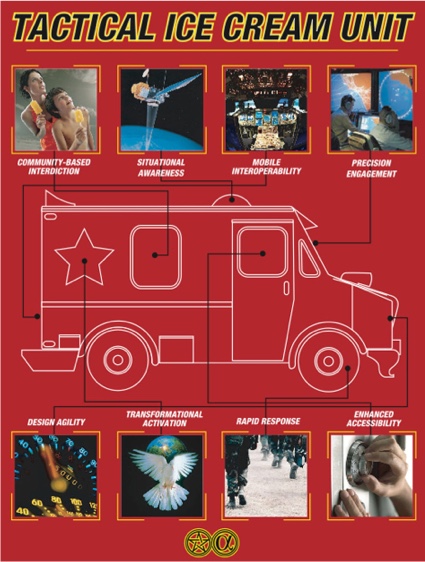
Tactical Ice Cream Unit

CTM’s work combines appealing aesthetics, humour and language with actions that invite people to think, question and reclaim their civil rights. Their most famous project is the Tactical Ice Cream Unit, a truck distributing free ice cream along with propaganda developed by local progressive groups. Another of their initiative saw them launch a bank heist contest. And a year before that, they responded to New York’s stop-and-frisk policy by screening Linking & Unlinking on a digital billboard in Manhattan. The billboard showed amateur footage demonstrating how to pick a pair of handcuffs, magicians performing a classic magic trick called “linking rings“, while a text from the American Civil Liberties Union was scrolling down and explaining passersby what their rights were if they were stopped by the police. In 2013, they set up big Witches’ Cradles that evoke the Inquisition and enveloped people into an altered state (of consciousness, or an altered political state). Most recently, Gach directed and performed a radical magic show which drew parallels between magic acts and contemporary issues such as economic manipulation, political deception, vanishing resources, and social transformation.

Read the interview here.


STEM, Social Engineering and Stealing

The Kernel delves into the hidden subculture of liars, thieves, and hackers who expose and exploit gaping loopholes in e-commerce via Jonah (not his real name), someone who’s been there and back.


“Confessions of a social engineer”
by Dell Cameron
The Kernel
August 9, 2015

serialcodegenerator…Part theater and part science, social engineering is the method by which hackers, for lack of a better term, exploit vulnerabilities in human psychology; for Jonah, it was a key to getting anything he wanted, from televisions and laptops to smartphones and expensive wines. One of his largest takes netted him around $60,000 worth of product, he says. He showed me a Rolex Daytona watch””part of a gallery of stolen goods he”d photographed in his bedroom””which retails on Amazon for around $26,000.

Whether through face-to-face interaction, by phone, or by email, the human gatekeepers of any network can be exploited””if you know how to play the game. They”re the weakest link in any company”s security.

Almost every major electronics company is vulnerable in nearly the same way: They all have warranty-based replacement systems that can be exploited. Most companies, for instance, don”t require a defective item to be returned before mailing out its replacement. It”s likewise difficult to prove that an in-warranty item has been lost or stolen.

Through repeated phone calls, social engineers develop strategies for navigating a company”s customer help line. They get a feel for which sob stories and which “yes” or “no” responses will work best toward achieving their objective. Intelligence, temperament, and even humor all come into play. The questions and responses are then mapped out, as if composing a flowchart, with the goal of expediting the con. Read the whole article.