
Terror Pranking, a Brief History

There’s a huge difference between socially revealing satirical commentary and scaring the shit out of everyone…


Inside the world of extreme ‘terror pranking’
BBC
February 11, 2018

Fake bombs, staged murders, stunts that resemble acid attacks – as competition for eyeballs on YouTube gets fiercer every day, popular vloggers are resorting to extreme pranks to get clicks.
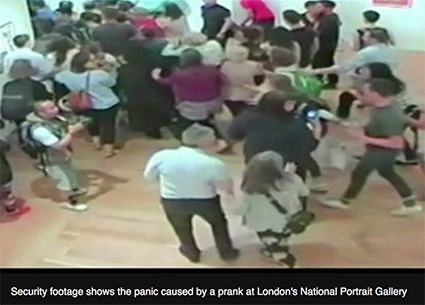
Arya Mosallah’s video channel had more than 650,000 subscribers. But his YouTube career came skidding to a halt with a video titled “Throwing Water On Peoples Faces PT. 2”. In it, he approaches several people, and after a brief conversation, throws a cup of water in their faces.

Many viewers thought the prank in the video looked like an attempt by the British social media star to mimic an acid attack – amid a recent increase in such crimes in London and across the UK.
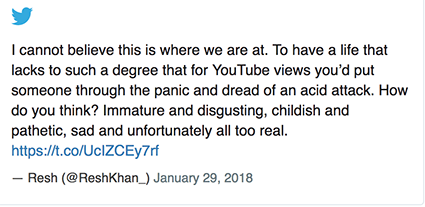
YouTube deleted Mosallah’s channel – and then a second channel he set up. He told the BBC he had not meant to reference acid attacks – but that he would continue to produce prank videos.

But Arya Mosallah is certainly not the first YouTuber to get into trouble for prank videos. His story, along with the controversy over hugely popular Youtuber Logan Paul joking about a suicide victim to his young audience, have put a spotlight on extreme content on YouTube.

But although it appears to be on the rise – and is getting more attention from news outlets – extreme pranking is not an entirely new phenomenon. For some time, vloggers have been faking bomb attacks and murders, tricking and frightening friends and members of the public in an attempt to up their view counts. Read the rest of this article here.

Joey Skaggs to the NY Daily News, “You Gotta Realize There Are Consequences”

Call us snobs, sticklers… call us the Emily Post of prankdom. But releasing a bunch of live crickets in a crowded subway car, as Brooklyn’s Zadia Pugh was recently arrested for doing, isn’t much of a prank. When there is so much groupthink and hypocrisy to expose and so many passersby thirst for wonder and delight, it’s not enough to simply scare and annoy people. That’s a sad and boring way to go viral. People are plenty scared and annoyed as it is.

Legendary prankster Joey Skaggs was asked to comment on Pugh’s stunt and to lend some guidance to cavalier young instigators of her ilk. Irreverence is just the beginning.


“Seasoned prankster Joey Skaggs chides rookie Zadia Pugh for unleashing crickets on packed D train: ‘You gotta realize there are consequences'”
by Graham Rayman
New York Daily News
September 3, 2016

crickets4n-2-webAs a prankster, Zaida Pugh “” who terrified straphangers in August when she released live crickets on a packed subway train “” is no more than a misguided rookie.

And Joey Skaggs should know.

For the past 40 years, Skaggs, 70, a New Yorker who now lives “somewhere in the south,” has conned the media into reporting fake stories as fact.

His elaborate pranks include creating a brothel for dogs and posing as a man who invented a vitamin pill made of cockroaches which supposedly would make people invulnerable to radiation.

The press bought it.

He got the press to buy that he had windsurfed from Hawaii to California. He created a Celebrity Sperm Bank, and a “Fat Squad,” made up of commandos who supposedly physically restrained people from breaking their diets.

He unrepentantly posed as a priest and pedaled a full-size confessional booth around St. Patrick”s Cathedral, and got on the news for that, too.

Author Andrea Juno once wrote that he “uses the media as a painter uses a canvas.”

crickets4n-4-webSkaggs told the Daily News on Saturday even though Pugh claimed to be making a statement about homelessness, her stunt on the Manhattan Bridge on Aug. 24 was “irresponsible and dangerous.”

“To me, the expose” is the most important part,” he said. “It’s not the “˜hahaha, I got you.” It’s the “˜Aha.” When they realize they have put aside critical thinking.

“The goal is to get people to become more media literate and more skeptical about information that’s given to them by governments and corporations. And you have to be ethical and careful in going about it.” Read more.


No Ostriches Were Harmed in the Making of This Marketing Campaign

Hate to be the bearers of bad news, but that dude riding an ostrich in rush-hour traffic was part of a viral marketing stunt. Shocker.


“Yep, That Video Of A Guy Riding An Ostrich Through Traffic Is Totally Fake”
by Lee Moran
Huffington Post
September 4, 2016

It was a brilliant idea to beat the traffic.

But sadly the viral video (above) of a man riding an ostrich to beat rush hour in Almaty, Kazakhstan, is totally fake.

The Bank of Astana claimed it was behind the hoax dash cam-style footage on Friday, after the video spread like wildfire across the web.

“What possessed us when creating this idea? The thought that many of us live bored and pragmatic lives,” the bank posted on Facebook.

“Team Bank of Astana believes that we need to stop just daydreaming “• and we must act to embody our wildest dreams, here and now,” it added. Read more.

Step 1: Crack a Raw Egg Open into a Glass; Step 2: Hatch a Chick?

Thanks Andrea Marini (director of Art of the Prank, the movie) for this tip.


“Did Japanese students really hatch a chick outside a shell?”
by Robert Ferris
CNBC Science
June 8, 2016

103700352-maxresdefault.530x298A video making the rounds on the internet depicts a group of Japanese students cracking an egg, dropping it into a plastic pouch, and incubating it until a baby chick emerges several days later.

The video has received about 50 million views on Facebook, and other versions have popped up on YouTube and other platforms.

A video making the rounds on the internet depicts a group of Japanese students cracking an egg, dropping it into a plastic pouch, and incubating it until a baby chick emerges several days later.

The video has received about 50 million views on Facebook, and other versions have popped up on YouTube and other platforms.

Though questions remain surrounding the video’s authenticity, the process is possible, according to E. David Peebles, a professor of poultry science at Mississippi State University. In fact, this is not the first time such a thing has been attempted.

“I remember seeing a similar kind of thing when I was in a lab North Carolina State University,” Peebles told CNBC in an interview. “They had relatively limited success with it, but they did have some success.” Read more here and watch the video below.

YouTube Pranksters Jailed

The rise of YouTube has shifted the way people think about media, fame, and, definitely, pranks.

YouTube’s “user-created content” has always been conspicuously subject to Sturgeon’s Law, but over time, its most popular and influential celebrities have concentrated their power while newcomers have found it harder and harder to break through.

“YouTube pranksters” generally perform “social experiments” (read: wacky stunts) in public, preferably for unwitting audiences. As their attention economy becomes more stratified, certain performers have become increasingly confrontational and occasionally felonious.

The UK-based channel TrollStation operates on the genre’s outer fringes. TrollStation affiliates have violently broken the law and alienated some in the YouTube community before, but achieved peak notoriety with two fake museum heists on July 5, 2015, that just landed three (more) of them behind bars. Their sentences were light – 20 weeks is nothing for genuine art theft or violent B&E – and their case was complicated by the fact that, although they definitely horrified innocent bystanders, they didn’t actually steal anything.

Upon release, they can doubtless expect increased viewership.

For the details, read Katie Rogers’ May 19, 2016 article in The New York Times, “When YouTube Pranks Break the Law”.