Occupy Détournement

Occupy pop culture: A lesson in détournement
by Natasha Lennard
Salon.com
March 8, 2012

Borrowing from the French, occupiers turn figures from the cultural mainstream into symbols of dissent


Credit: nycgeneralstrike

TV-show writers, pop culture purveyors and peddlers of general stuff-we-don”t-need didn”t take long to latch onto the Occupy brand. The language of the 99 percent is popping up in sitcoms and terrible pop songs; the word “Occupy” now adorns a neon green Swatch. It”s probably beside the point to mention that revolutionaries in Egypt and Greece are fighting on without the help of branded watches; this is America, after all “” what did you expect?

But Occupy supporters are taking from pop culture too. Not in the obvious sense of message amplification and popularization, but by helping themselves to items from the cultural mainstream and flipping them on their heads for propaganda purposes. To see what I mean, check out this video attributed to “nycgeneralstrike”:

Continue reading “Occupy Détournement”

Putin on Trial [English & Russian]

Putin fake arrest video resonates with Russians
by Elizabeth Flock
Washington Post
February 17, 2012

The prime minister of Russia stood in handcuffs inside a cage, looking downcast, as a judge questioned him.

Watch Vladi­mir Putin in “jail”. Click on “cc” for English subtitles

The video showing Vladimir Putin on trial for corruption and terrorism was clearly a fake, but it went viral anyway “” attracting millions of viewers since it was posted on YouTube several days ago, the Associated Press reports.

Called “The Arrest of Vladimir Putin,” the video comes a week after thousands of Russians protested in Moscow against the prime minister, who will run for a third term as president March 4. Putin was president from 2000 to 2008, and has been prime minister ever since. He is widely expected to win the presidential election, despite the public”s discontent, which peaked with widespread protests in December.

Continue reading “Putin on Trial [English & Russian]”

How a Protest Became a Movement

Reawakening The Radical Imagination: The Origins Of Occupy Wall Street
Huffington Post
November 10, 2011

Three months ago, a loosely organized group of activists concerned about growing income inequality, corporate greed and the global influence of powerful financial institutions decided to make Lower Manhattan its home, setting in motion a movement known as Occupy Wall Street.

Since then, tens of thousands of people who share Occupy Wall Street’s concerns have taken to the streets throughout the United States and around the globe, shifting the national discourse away from the federal deficit and toward financial woes of a more personal nature, like student debt.

Now Occupy Wall Street is much larger than its initial small group of organizers. President Barack Obama and Federal Reserve Chairman Ben Bernanke have given it a nod. Many among its now-broad base of supporters hold conventional political views. Some 64 percent call themselves Democrats, according to a recent AP-GfK poll.

The movement didn’t get that big simply because AdBusters, a Canadian magazine, sent out a flashy email promoting it, or because the hacker collective Anonymous flicked out a few tweets. Instead, it took a group of about 200 committed activists 47 days to outline the ground rules that have allowed the protest to flourish. Continue reading “How a Protest Became a Movement”

Protest as Carnival: Using Humor to Confound Authoritarianism

Gandhi Meets Monty Python at Occupy Wall Street: The Comedic Turn in Nonviolent Tactics
by Wayne Grytting
Truth-out.org
28 October 2011

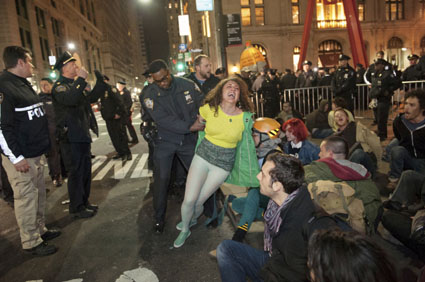
On October 3rd, protesters at Occupy Wall Street failed to march. Instead they clumsily lurched. With white painted faces, glazed looks and dollar bills hanging out of some mouths, protesters chanted “I smell money, I smell money”¦” It was Corporate Zombie Day. Scenes like this and the sight of Guy Fawkes masks, clown suits, drumming circles and surrealistic posters all over the country have left many commentators scratching their heads. Is this protest or carnival? Maybe we should tell them. There”s been a sea change in the protest industry.

“A worldwide shift in revolutionary tactics is underway right now that bodes well for the future,” proclaims Adbusters, the initiators of Occupy Wall Street. A key part of this re-channeling of tactics has been a move away from both angry protests or passive waiting-to-be-clubbed-by-police-batons to age old carnival-style antics. A festive atmosphere has reigned supreme in all of the successful pro-democracy uprisings of the past two decades. In Poland, Serbia, Georgia, Ukraine, Tunisia and Egypt, music and humor were everywhere. Why? Continue reading “Protest as Carnival: Using Humor to Confound Authoritarianism”