How a Protest Became a Movement

Reawakening The Radical Imagination: The Origins Of Occupy Wall Street
Huffington Post
November 10, 2011
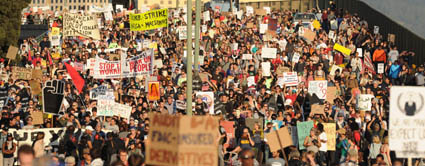
Three months ago, a loosely organized group of activists concerned about growing income inequality, corporate greed and the global influence of powerful financial institutions decided to make Lower Manhattan its home, setting in motion a movement known as Occupy Wall Street.

Since then, tens of thousands of people who share Occupy Wall Street’s concerns have taken to the streets throughout the United States and around the globe, shifting the national discourse away from the federal deficit and toward financial woes of a more personal nature, like student debt.

Now Occupy Wall Street is much larger than its initial small group of organizers. President Barack Obama and Federal Reserve Chairman Ben Bernanke have given it a nod. Many among its now-broad base of supporters hold conventional political views. Some 64 percent call themselves Democrats, according to a recent AP-GfK poll.

The movement didn’t get that big simply because AdBusters, a Canadian magazine, sent out a flashy email promoting it, or because the hacker collective Anonymous flicked out a few tweets. Instead, it took a group of about 200 committed activists 47 days to outline the ground rules that have allowed the protest to flourish. Continue reading “How a Protest Became a Movement”
Protest as Carnival: Using Humor to Confound Authoritarianism

Gandhi Meets Monty Python at Occupy Wall Street: The Comedic Turn in Nonviolent Tactics
by Wayne Grytting
Truth-out.org
28 October 2011

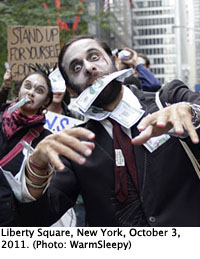
On October 3rd, protesters at Occupy Wall Street failed to march. Instead they clumsily lurched. With white painted faces, glazed looks and dollar bills hanging out of some mouths, protesters chanted “I smell money, I smell money”¦” It was Corporate Zombie Day. Scenes like this and the sight of Guy Fawkes masks, clown suits, drumming circles and surrealistic posters all over the country have left many commentators scratching their heads. Is this protest or carnival? Maybe we should tell them. There”s been a sea change in the protest industry.

“A worldwide shift in revolutionary tactics is underway right now that bodes well for the future,” proclaims Adbusters, the initiators of Occupy Wall Street. A key part of this re-channeling of tactics has been a move away from both angry protests or passive waiting-to-be-clubbed-by-police-batons to age old carnival-style antics. A festive atmosphere has reigned supreme in all of the successful pro-democracy uprisings of the past two decades. In Poland, Serbia, Georgia, Ukraine, Tunisia and Egypt, music and humor were everywhere. Why? Continue reading “Protest as Carnival: Using Humor to Confound Authoritarianism”

How Much Does Protest Matter?

How Much Do Protests Matter? A Freakonomics Quorum
by Stephen J. Dubner
freakonomics.blogs.nytimes.com
August 20, 2009

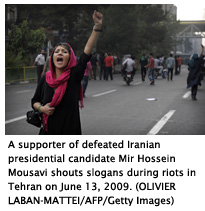
tehranprotestorIran”s citizens take to the streets en masse after a disputed election. Gay men in Salt Lake City hold a kissing protest. Members of the Westboro Baptist Church voice their anti-just-about-everything views to military funerals and elsewhere.

Beyond the media attention they inevitably garner, what do protests actually accomplish?

We rounded up a few people who have thought a lot about this topic “” Chester Crocker, Bernardine Dohrn, Donna Lieberman, Juan E. Méndez, David S. Meyer, and Howard Zinn “” and asked them how much protest matters in this day and age, and why.

Here are their answers. Continue reading “How Much Does Protest Matter?”