The Great Modernist Poetry Prank

The Futility Closet podcast investigates two Australian army officers whose antipathy for the arts establishment inspired them to create a fake writer and receive embarrassing critical acclaim. Take some time to pore over the copious background materials and keep in mind that this predates the Sokal Hoax by almost five decades.


“The Great Australian Poetry Hoax”
by Greg Ross
Futility Closet
October 17, 2016
2016-10-17-podcast-episode-126-ern-malleyIn 1943, fed up with modernist poetry, two Australian servicemen invented a fake poet and submitted a collection of deliberately senseless verses to a Melbourne arts magazine. To their delight, they were accepted and their author hailed as “one of the most remarkable and important poetic figures of this country.” In this week”s episode of the Futility Closet podcast we”ll tell the story of the Ern Malley hoax, its perpetrators, and its surprising legacy in Australian literature.

We”ll also hear a mechanized Radiohead and puzzle over a railroad standstill. Read more.

R.I.P. Tom Hayden (1939-2016)

Yippie activist, Chicago 7 defendant, California State Assemblyman, author, publisher, rabble-rouser, and Los Angeles legend Tom Hayden has passed away at the age of 76.


“Prominent Antiwar Activist and Member of the ‘Chicago 7’ Tom Hayden Dead at 76”
by Reuters Staff
The Huffington Post
October 24, 2016

aotptomhaydenVeteran social activist and politician Tom Hayden, a stalwart of America”s New Left who served 18 years in California”s state legislature and gained a dash of Hollywood glamour by marrying actress Jane Fonda, has died at age 76, according to media reports.

Hayden died in Santa Monica, California, after a lengthy illness, The Los Angeles Times reported on its website.

“A political giant and dear friend has passed,” Los Angeles Mayor Eric Garcetti wrote on Twitter, adding “Tom Hayden fought harder for what he believed than just about anyone I have known.”

Hayden, who forged his political activism as a founding member of Students for a Democratic Society, which stood at the core of the 1960s anti-war and civil rights movements, was principal author of the group”s revolutionary manifesto, the Port Huron Statement.

The University of Michigan student ventured into the Deep South, where he joined voter registration campaigns and was arrested and beaten while taking part in the “freedom rider” protests against racial segregation.

Hayden, however, became perhaps best known as one of the “Chicago Seven” activists tried on conspiracy and incitement charges following protests at the turbulent 1968 Democratic National Convention. He was ultimately acquitted of all charges. Read more.

Harvard Toasts the Lampoon

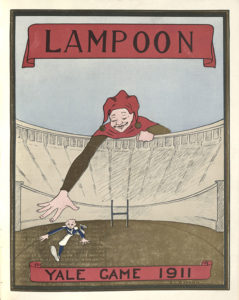
An exhibit in Harvard’s Pusey Library pays playful tribute to the Harvard Lampoon, one of the most influential satirical magazines in American history.


“Pranks at Pusey Library”
by Aidan Langston
Harvard Magazine
August 6, 2016

AOTPLampoonVisitors to Pusey Library this summer have been greeted by a large cardboard cutout of a cow””part of an exhibit celebrating The Harvard Lampoon and the role it has played in Harvard”s comedic history. The exhibition, “Remorseless Irony and Sarcastic Pens: The Story of the Harvard Lampoon,” showcases photographs, drawings and other artifacts collected over the course of the Lampoon”s 140 years.

The cow is an homage to the Lampoon”s custom of unleashing farm animals on campus for comedic effect. William Randolph Hearst, a member of the Lampoon and the class of 1886″”although his pranks resulted in his expulsion””is suspected of having sparked the tradition by releasing roosters in Harvard Yard. Lampoon members were also blamed for the appearance of a cow in the Yard sometime in the 1930s, which was “forcibly ejected” from the premises by Harvard police.

The exhibit contains an array of memorabilia from the magazine”s earliest days, ranging from photographs of the seven students who founded it in 1876 to a copy of its first issue. Continue reading “Harvard Toasts the Lampoon”

Long May Your Refrigerator Run

Gadgetary advances be damned, phone pranks endure in both old- and new-school iterations and seem to be intertwined with the human drive to communicate.

The Atlantic publishes a thinkpiece on the history and uncertain future of the artform.


“Do People Still Make Prank Phone Calls?”
By Julie Beck
The Atlantic
April 1, 2016

phonepranksOnly a rube or possibly an alien would pick up an unknown phone call, hear the question “Is your refrigerator running?” and answer in the affirmative. And so only the luckiest of amateur mischief-makers would get the satisfaction of getting to drop the “Well, you better go catch it!” before cackling away into the sunset.
And yet, amazingly, this doesn”t seem to be the oldest trick in the book when it comes to telephone pranks. In her 1976 paper “Telephone Pranks: A Thriving Pastime,” Trudier Harris reports that people “over 50 years old” remembered the old refrigerator gag, which, if they pulled it as teens, means it could”ve been around in the 1930s or earlier.

But other corny jokes were also around before the “˜30s, according to another paper, ones like:

“This is May.”
“May who?”
“May-onnaise.”

Most middle-class families had home phones by the 1920s or so, according to Claude Fischer, a professor of sociology at the University of California, Berkeley. And in the early days of the residential telephone, it was taken very seriously, as a tool for serious business, and so “children could trick unsuspecting adults fairly easily,” writes Marilyn Jorgensen in her paper “A Social-Interactional Analysis of Phone Pranks.” Read more.


Inside the Center for Tactical Magic

Here’s a rare glimpse behind the enigma of the legendary Center for Tactical Magic as founder Aaron Gach shares his background, philosophy, and success stories in this interview with Regine Debatty.


“Interview with The Center for Tactical Magic”
by Regine Debatty
We Make Money Not Art
August 14, 2015

The Center for Tactical Magic uses any craft and scheme available, from the most magical to the most pragmatic, to address issues of power relations and self-empowerment.

At the CTM we are committed to achieving the Great Work of Tactical Magic through community-based projects, daily interdiction, and the activation of latent energies toward positive social transformation.

Tactical Ice Cream Unit

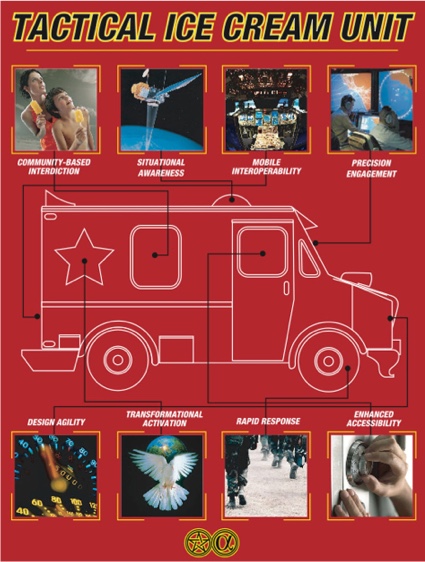
CTM’s work combines appealing aesthetics, humour and language with actions that invite people to think, question and reclaim their civil rights. Their most famous project is the Tactical Ice Cream Unit, a truck distributing free ice cream along with propaganda developed by local progressive groups. Another of their initiative saw them launch a bank heist contest. And a year before that, they responded to New York’s stop-and-frisk policy by screening Linking & Unlinking on a digital billboard in Manhattan. The billboard showed amateur footage demonstrating how to pick a pair of handcuffs, magicians performing a classic magic trick called “linking rings“, while a text from the American Civil Liberties Union was scrolling down and explaining passersby what their rights were if they were stopped by the police. In 2013, they set up big Witches’ Cradles that evoke the Inquisition and enveloped people into an altered state (of consciousness, or an altered political state). Most recently, Gach directed and performed a radical magic show which drew parallels between magic acts and contemporary issues such as economic manipulation, political deception, vanishing resources, and social transformation.

Read the interview here.