
A clever and controversial Burger King TV ad stokes fears about the internet of things and our accelerating rate of information exchange.
“Burger King”s new ad forces Google Home to advertise the Whopper”
by Jacob Kastrenakes
The Verge
April 12, 2017
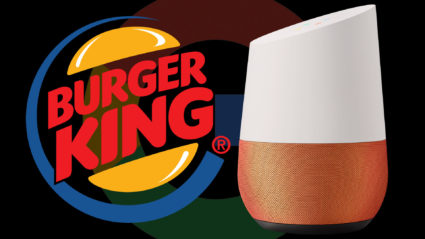 Burger King is unveiling a horrible, genius, infuriating, hilarious, and maybe very poorly thought-out ad today that”s designed to intentionally set off Google Homes and Android phones.
The 15-second ad features someone in a Burger King uniform leaning into the camera before saying, “OK Google, what is the Whopper burger?”
For anyone with a Google Home near their TV, that strangely phrased request will prompt the speaker to begin reading the Wikipedia entry for the Whopper. It”s a clever way of getting viewers” attention, but it”s also a really quick way of getting on viewers” nerves “” just look at the reactions people had when ads accidentally triggered voice assistants in the past.
“Burger King”s ad relies on Wikipedia, which is maybe not a good idea”
While Burger King is far from the first to recognize that it”s possible to mess with someone else”s smart speaker, it”s certainly the first to put it into a widely run ad campaign. The spot is supposed to begin running in prime-time slots across the US today on networks including History, Spike, Comedy Central, MTV, E!, and Bravo, and it will air during Adult Swim, The Tonight Show, and Jimmy Kimmel Live.
Google wasn”t involved in the ad”s creation. That means this isn”t an expansion of Google”s ad tests (people weren”t happy when Google built a Beauty and the Beast ad into the speaker), but it also leads to some real issues for Burger King. For one, it has to use weird phrasing “” “What is the Whopper burger?” “” because that”s the query that actually gets the result it wants. Asking “What is a Whopper?” gets you the definition of the word “whopper.”
And then there”s the bigger problem: Google gets its explanation of the Whopper from Wikipedia. And as we all know, anyone”s free to edit Wikipedia. Read more.
 Subway bosses in Mexico City have fitted plastic penises onto seats in a bizarre campaign to raise awareness of sexual assault.
 It”s that time of year again! The time when a massive chunk of the tech industry drops what it”s doing and puts all of its collective effort into getting a few laughs. As we do every year, we”re gathering up the best/worse/most cringe-tastic efforts in one place for your perusal. We”ll be updating this list as the day goes on, so check back in later!
  Some of the biggest names in marketing, including Ford Motor, General Motors, Hyundai Motor, Reebok and PepsiCo, have been forced recently to apologize to consumers who mounted loud public outcries against ads that hinged on subjects like race, rape and suicide.