Coyle & Sharpe: The Imposters, Episode 4

Coyle & Sharpe, The ImpostersHere’s The Druggist, episode 4 of the historic Coyle & Sharpe podcast series presented by Jesse Thorn of The Sound of Young America.

Listen to episodes 1, 2 & 3 here. New episodes will be posted each Wednesday as they are released by The Sound of Young America.

These recordings are from the Sharpe family archive, tended by Mal’s daughter, Jennifer Sharpe. More about Coyle & Sharpe is available on their Website or on MySpace.

You can also listen to this podcast at The Sound of Young America or you can subscribe to the series in iTunes.

Coyle & Sharpe: The Imposters Podcasts, Episodes 1, 2 & 3

Here are the first 3 episodes of a series of podcasts of historic Coyle & Sharpe satire presented by Jesse Thorn of The Sound of Young America.

Each podcast is 5 to 7 minutes long. We’ll put up new episodes every Wednesday as they are released.

Here’s a little history from Jesse’s blog at maximumfun.org:

Coyle & Sharpe, The ImpostersIn the early 1960s, James P. Coyle and Mal Sharpe roamed the streets of San Francisco, microphone in hand, roping strangers into bizarre schemes and surreal stunts. Today, their humor is a cultural touchstone for artists as varied as Henry Rollins and The Upright Citizens Brigade.

These recordings are from the Sharpe family archive, which is tended by Mal’s daughter, Jennifer Sharpe. You can learn more about Coyle & Sharpe on their Website or on MySpace.

You can also listen to these podcasts at The Sound of Young America or you can subscribe to them in iTunes.

Kurt Vonnegut, author, social critic, satirist dead at 84

Obituary From the Associated Press
April 12, 2007

Kurt VonnegutNew York (AP) – Kurt Vonnegut, the satirical novelist who captured the absurdity of war and questioned the advances of science in darkly humorous works such as “Slaughterhouse-Five” and “Cat’s Cradle,” has died. He was 84.

Vonnegut died Wednesday. He often marveled that he had lived so long despite his life-long smoking habit, had suffered brain injuries after a fall at his Manhattan home weeks ago, said his wife, photographer Jill Krementz.

The author of at least 19 novels, many of them best-sellers, as well as dozens of short stories, essays and plays, Vonnegut relished the role of a social critic. Indianapolis, his hometown, declared 2007 as “The Year of Vonnegut” — an announcement he said left him “thunderstruck.”

He lectured regularly, exhorting audiences to think for themselves and delighting in barbed commentary against the institutions he felt were dehumanizing people.

“I will say anything to be funny, often in the most horrible situations,” Continue reading “Kurt Vonnegut, author, social critic, satirist dead at 84”

Saul Steinberg: Illuminations

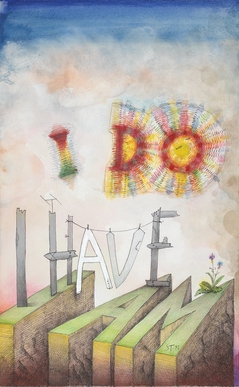
I Do, I Have, I AmHere’s a review of the Saul Steinberg: Illuminations retrospective currently at the Smithsonian American Art Museum, on exhibit April 6 through June 24, 2007 posted by Heather Goss in the DCist. Steinberg (1914-1999) was an incisive satirist and artist who’s illustrations and drawings were featured in dozens of books and in countless New Yorker magazines. -JS


Saul Steinberg @ Smithsonian American Art Museum
By DCist contributor Sriram Gopal

An exhibit designed as career retrospective must be a daunting proposition, especially when focused on a prolific artist whose output ranged over sixty years. Too many pieces, and the exhibit becomes bloated. Too few, and the audience does not get an accurate cross section of the artist”s work. Thankfully, the curators of Saul Steinberg: Illuminations, on display at the Smithsonian American Art Museum, threaded this needle. In doing so, they have mounted a captivating and wholly satisfying exhibition of one of the most insightful American artists of the 20th century.

Steinberg (1914-1999) is best known for his illustrations that appeared in The New Yorker, many of which are included in this collection. The exhibit includes over 100 drawings as well as collages and sculptural assemblages. A native of Romania who became a U.S. citizen in 1942, he described his work as occupying the space “between perception and understanding.” His proclamation that the 20th century was “an immense prank” sums up his somewhat cynical outlook. Continue reading “Saul Steinberg: Illuminations”