Literary Hoaxes: Irresistible Storytelling

This Column Is Real, But Not All Authors Stick to the Truth
Deja Vu, by Cynthia Crossen
Wall Street Journal
April 7, 2008
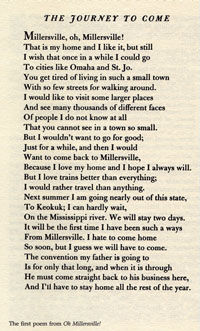
harrison2-200.jpgA popular choice for ladies’ book clubs in the early 1940s was a slim volume of poetry by a 10-year-old girl named Fern Gravel. Fern had written the poems about her Iowa hometown in 1900 and passed them along to someone who had preserved them. In 1940, Fern Gravel decided to publish her nostalgic rhymes under the title, “Oh Millersville!”

Two snippets: “My Sunday-school teacher/Is Miss Minnie King./She is not of any use as a teacher/But I love to hear her sing.” “The soap they use in the Commercial hotel/Is awful; it has a horrible smell./Sometimes we have our Sunday dinner there/And the smell of their soap I can hardly bear.”

Critics were enchanted. The Des Moines Register praised the poems’ “warm feeling of validity.” Time magazine called the author a “precocity in pigtails.” The St. Paul Dispatch said “Oh Millersville!” was marked “for immortality.” And the book became the profit center for its small Iowa publisher, Prairie Press.

Six years later, Fern Gravel confessed: She was really James Norman Hall, co-author of the “Bounty” trilogy. In a 1946 article in the Atlantic Monthly magazine, Mr. Hall described himself as “shame-faced and apologetic,” but claimed that Fern had come to him in a dream and dictated her poems to him.

Literary hoaxes are almost as old as literature. Some have been inspired by poverty, others are simply pranks. Continue reading “Literary Hoaxes: Irresistible Storytelling”

Reproductive Health Censorship

Submitted by Allyn Harstein:

U.S. Funded Health Search Engine Blocks ‘Abortion’
by Sarah Lai Stirland
Wired.com
April 3, 2008

dn6485-1_250-200.jpgA U.S. government-funded medical information site that bills itself as the world’s largest database on reproductive health has quietly begun to block searches on the word “abortion,” concealing nearly 25,000 search results.

Called Popline, the search site is run by the Johns Hopkins Bloomberg School of Public Health in Maryland. It’s funded by the U.S. Agency for International Development, or USAID, the federal office in charge of providing foreign aid, including health care funding, to developing nations.

The massive database indexes a broad range of reproductive health literature, including titles like “Previous abortion and the risk of low birth weight and preterm births,” and “Abortion in the United States: Incidence and access to services, 2005.”

But on Thursday, a search on “abortion” was producing only the message “No records found by latest query.” Continue reading “Reproductive Health Censorship”

Fictional Memoir: Faux Suffering Strikes Again

A Family Tree of Literary Fakers
by Motoko Rich
New York Times
March 8, 2008

From top, the writers and their books: Margaret Seltzer, last month; Clifford Irving, left, in 1972; Laura Albert leaving federal court in Manhattan in 2007; and James Frey in an interview on "Larry King Live" in 2006.When the news emerged this week that Margaret Seltzer had fabricated her gang memoir, “Love and Consequences,” under the pseudonym Margaret B. Jones, many in the publishing industry and beyond thought: Here we go again.

The most immediate examples that came to mind were, of course, James Frey, the author of the best-selling “Million Little Pieces,” in which he embellished details of his experiences as a drug addict, and J T LeRoy, the novelist thought to be a young West Virginia male prostitute who was actually the fictive alter ego of Laura Albert, a woman now living in San Francisco.

But the history of literary fakers stretches far, far back, at least to the 19th century, when a slave narrative published in 1863 by Archy Moore was revealed as a novel written by a white historian, Richard Hildreth, and into the early 20th, when Joan Lowell wrote a popular autobiography, “Cradle of the Deep,” about her colorful childhood aboard a four-masted ship sailing the South Seas; in fact, she had grown up almost entirely in Berkeley, Calif.

Here follows a lineup of some of the past few decades” most notorious fakes, with proof that in some cases, there are second acts in American lives. Continue reading “Fictional Memoir: Faux Suffering Strikes Again”

The New Media

The Whole Truthiness
by John Capone
MediaPost Publications
March 2008

Has the fake nightly news opened up a surrealistic media realm?

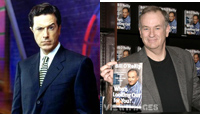
colbertoreilly.jpgNothing you are about to read is true, but it”s exactly the way things are. Trust me.

Who knows who Stephen Colbert really is? Who really cares? Certainly not Colbert himself. He was once a kid from Charleston, S.C., who grew up Irish-Catholic and graduated from Northwestern University with artistic pretensions. He is now such a muddle of refracted irony “” a paradox of self-reference and false sincerity “” and the work of teams of writers, that the actor has disappeared completely into the surrealistic world he”s created.

The persona is a media barrage. And this barrage has been embraced by millions “” The Colbert Nation. This Nation is comprised of the people who watch his show, bought his book, made him a best seller on iTunes, read magazines (like this one) with profiles of their iconically ironic savior, and those who receive the news and advertising messages accompanying all of these media.

When Colbert addresses his audience on The Colbert Report, he”ll often begin with the salutation “Nation,” as if he were an earnest Cronkitian figure, but it is this Nation of fans he really means. Especially when he calls on them to vote to name a bridge in Hungary after him (which they did), change the Wikipedia definition of reality to read: “Reality has become a commodity” (which they did), or get him on both the Republican and Democratic presidential ballots in South Carolina (which they very nearly did).

Does all this add up to truthiness in journalism, canny social criticism, infotainment, pure entertainment or is it the high- (but ultimately unfocused) comedic art of an Andy Kaufman prank? The Colbert-cum-Tony Clifton–divisions run deeper than an actor simply taking on a role. Continue reading “The New Media”

Pranks, Pranksters, Trickster & Tricks: Class is in Session!

Editor’s note: Artist and ArtofthePrank.com editor Joey Skaggs will be joining the online class the week of February 18. Check it out!


course-trickster.jpg
Tricksters and Pranks with R.U. Sirius – February 11 – March 23, 2008

Pranks and Pranksters, Tricksters & Tricks — the brilliant ones open up a space in the world for magic(k), ambiguity, and novelty. They encourage us to Question Authority and better still, they cause us to Question Reality.

In this course, we will discuss the history of pranks and pranksterism in the contemporary world. We will examine mythical and world historic tricksters like Coyote, Bugs Bunny, Crowley, Puck, Heyoka, Papa Legba, Lucifer, and more. And we’ll explore and discuss the role pranksters and tricksters play in cultures. I will also discuss some of my own pranks and tricks and legendary pranksters Mark Hosler of Negativland and Joey Skaggs will be dropping in on the course to answer questions.

Finally, we will plan pranks, make pranks, and maybe even leave the course with a dedicated prankster cabal. No fooling.

For more information visit the Maybe Logic Institute. If that link doesn’t work, go here.

Related links:

  • Destiny Interviews RU Sirius
  • Pranks, Pranksters, Tricksters & Tricks: An Online Class by RU Sirius