Don’t Look in the Bag!

PETA isn’t known to shy away from aggressive and theatrical tactics. Its recent campaigns include a fake pop-up shop worthy of Edgar Allan Poe, created in partnership with ad agency Ogilvy & Mather.


“PETA Gives Leather Shoppers A Grisly Surprise”

by Landress Kearns
The Huffington Post
May 16, 2016

The animal-rights group People for the Ethical Treatment of Animals doesn”t appear to consider subtlety a virtue in its fight against animal products.

In the graphic PETA Asia video below, unsuspecting shoppers are shown browsing leather goods. But within every purse, glove and jacket is a grisly surprise.

PETA produced the video by setting up a fake storefront called “The Leather Work” in a mall in Bangkok. The animal rights activists then affixed artificial skin and fake organs “” including beating hearts “” inside wallets, jackets, purses, belts and other leather goods. They also put fake blood inside gloves and shoes, allowing unsuspecting shoppers to try them on.

Everything looks scarily real, and the shoppers were understandably horrified. The video is hard to watch, but PETA says drastic times in Southeast Asia call for drastic measures. Read more.
Art Project Causes Outrage and Reflection

University at Buffalo student hangs “˜White Only” signs on campus, sparks outrage
by Melissa Chan
New York Daily News
September 18, 2015

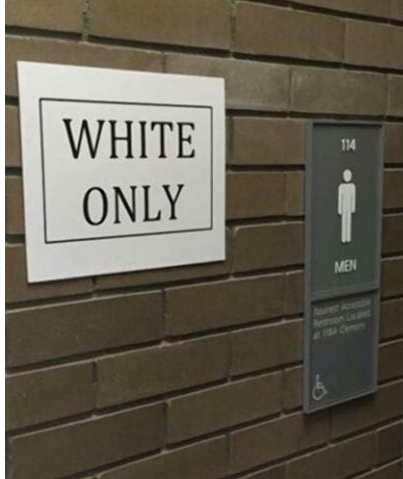
Ashley Powell White Only sign art project
These “White Only” signs were hung near bathrooms at the University at Buffalo this week. Ashley Powell, a graduate art student, admitted to hanging the signs for a class art project. UBSPECTRUM.COM

Ashley Powell, 25, who is black, admitted to plastering the Jim Crow-esque signs near several bathrooms and water fountains in a dorm as an art project to express her struggles with being a minority in the U.S. and to “expose white privilege.”

“I am in pain,” the graduate student wrote in a lengthy explanation posted on Facebook and published by the UB student newspaper. “My art practice is a remnant of my suffering. White privilege and compliance only exacerbate my symptoms.”

Powell said she hung up the signs to see how many white people would see the signs and do something about it, although she claims it was not a “social experiment.”

“Today these signs may no longer exist, but the system that they once reinforced still does,” she wrote. “Any white person who would walk past these signs without ripping them down shows a disturbing compliance with this system.”

The signs, which Powell said were created with support from her professor and colleagues, caused a firestorm of controversy on campus. Students denounced the project as racist and a hate crime, ABC 27 reported. Read the whole story here.

Can Art Still Shock?

Is Grayson Perry right – can we no longer be outraged by art and literature? From Manet”s Olympia to Pussy Riot and Houellebecq, Adam Thirlwell presents a short history of shock


Can art still shock?
by Adam Thirlwell
The Guardian
23 January 2015

Olympia by à‰douard Manet. Photograph: Corbis

For a long time, I”ve been nostalgic for the era of shock. It”s with a certain fondness that I reflect on the crazed year of 1857, which began with Gustave Flaubert in court for his first novel, Madame Bovary (in the presence of a stenographer, hired by Flaubert, for the benefit of an incredulous posterity), followed, six months later, by Charles Baudelaire, on trial for his first book of poems, Les Fleurs du Mal. On both occasions, the unlucky prosecutor was Ernest Pinard, who lamented “this unhealthy fever which induces writers to portray everything, to describe everything, to say everything”. The era of grand trials! Or if not trials, then scandales: like the first night of Stravinsky”s Rite of Spring in 1913, with its catcalling audience; or Duchamp”s impish Fountain – his notorious urinal, signed by R Mutt, submitted to the exhibition of the Society of Independent Artists in New York in 1917, but rejected by its committee.

I was nostalgic because it seemed to me that shock was no longer possible. Or, perhaps more precisely, shock was no longer admissible. We are all, pronounced Grayson Perry, bohemians now – and therefore unshockable by art. And if this is true, it signals a grand and maybe melancholy shift in the nature of art, and in the relation of art to society. It also appears to me – considering, let”s say, Pussy Riot and Ai Weiwei – a slightly provincial argument. And then came the attack on Charlie Hebdo. Continue reading “Can Art Still Shock?”