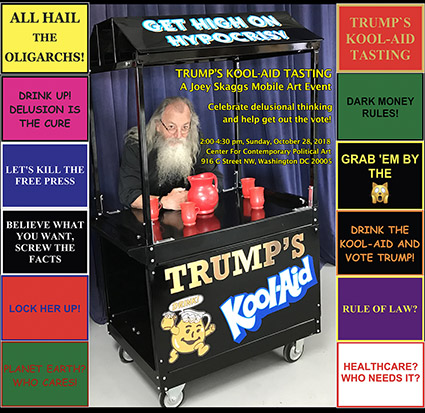
October 28, 2018, at 2:00 pm, join Joey Skaggs for “Trump’s Kool-Aid Tasting,” a mobile art event, starting at the new Center for Contemporary Political Art at 916 G Street NW. Trump look-alikes will parade with Skaggs’ “Trump Kool-Aid Stand”.
This is a faux Pro-Trump parade, illustrating and satirizing what Trump represents to the American People. The performance aims to counter voter apathy and motivate people to turn out for the 2018 midterm election. Signs and Trump masks will be available.
At 5:00 pm, following the art event, there will be a special screening of ART OF THE PRANK back at the Center for Contemporary Political Art followed by a Q&A with Skaggs. Space is limited so an RSVP is required. Please contact us here to reserve a space.
A good prank attempts to shed light on issues to change perceptions or awareness by jolting sensibilities. MutualArt pays homage to Joey Skaggs’ April Fools’ Day Parade. In 2017, it became real with Trump’s Golden Throne.
Pretty-much-anonymous street artist Banksy was back in the headlines this weekend thanks to his self-shredding picture. We take a look at other classic art-world pranks that have confounded and delighted through history.
.
As a street artist and activist, Banksy’s career has consisted almost exclusively of anti-establishment pranks and stunts. On Friday evening, at Sotheby’s Contemporary Art auction, the hammer fell on a print of his Balloon Girl image at a price of $1.1 million. Seconds later, an alarm sounded through the room and the print began feeding through the bottom of its own frame, inside which was a hidden shredder, leaving half of the work in ribbons.
Promptly, the piece’s value doubled. Commodification appears to move as quickly as protest in the contemporary market-place.
Speculation already abounds as to how far Banksy collaborated with Sotheby’s in setting up the stunt. It certainly seems far-fetched that the auction house’s handlers wouldn’t have noticed the machinery in the frame.
But the impact of the prank has been huge, bringing Banksy his biggest burst of media-attention since Dismaland closed. His market-value has increased. Haters have been won over. The search for his true identity is back on. All in all, it’s been a successful prank.
As a space in which publicity, politics, and aesthetics can meet, ‘the prank’ is an established mode within the art world. Here are some of the more prominent and successful examples from art history.
Joey Skaggs is the maybe the most prolific prankster out there. Over the years, the performance artist and writer has staged the thieving of celebrity sperm, “attempted” to “windsurf across the Pacific”, and exposed Western racism by fooling people into thinking that a Chinese businessman was buying dogs to make into soup.
Every April Fools’ Day since 1986, Skaggs has held a Parade with floats, banners, streamers extensive press coverage and pertinent contemporary themes. Except that the Parade doesn’t ever actually take place, existing purely within the press-hype. Fake News.
Until last year, that is. In a neat reversal of his own prank, Skaggs actually did hold a real-life parade on April 1st, 2017 after 31 years of pretending. The march functioned as a protest against Donald Trump’s presidency and was also the largest gathering of Trump-look-alikes in history. The imposters marched to Trump Tower and sat tweeting on golden thrones. Maybe Joey Skaggs’ greatest prank was to make Fake News real.
Instructors in the Visual Arts department at Interlochen Center for the Arts stole the spotlight at the Great Lakes Children’s Museum A-Ha! Fundraiser this weekend with a prank on one of their colleagues – a stunt that went viral on the Internet.
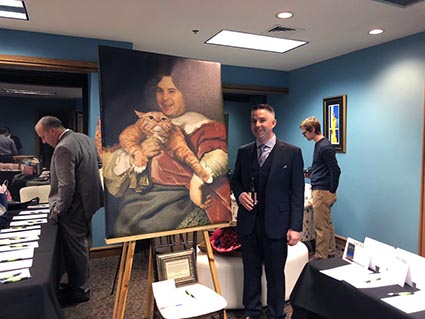
Mindy Ronayne and Megan Hildebrandt, both Interlochen instructors and members of the Great Lakes Children’s Museum board, snuck a last-minute addition into the fundraiser’s silent auction Saturday. The duo submitted a parody painting inspired by a famous portrait of Gerard Andriesz Bicker, painted by the Dutch artist Bartholomeus Van Der Helst in the 17th century and exhibited at the Rijksmuseum in Amsterdam. The head on the parody painting was of Andy Schmitt, director of information technology at Interlochen. The bid card for the painting read:
Portrait of Andrea D. Schmitty: First President of the Grand Traverse Feline Association and sister-in-law of Ann, the wife of lumber baron and Father of Traverse City, Perry Hannah. Andrea was also a successful game hunter and lifelong advocate in the fight to stop the cat skinning trade. Widely known as a tinkering enthusiast.
As traits go, honesty is not really the best policy for a magician’s assistant.
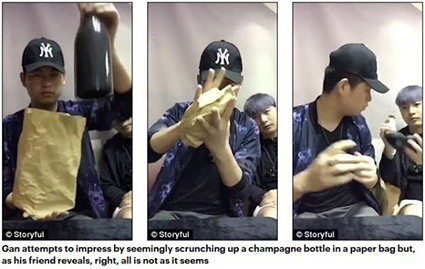
This amusing video shows a prankster revealing all his budding sorcerer friend’s best tricks.
The series of clips filmed by Chinese internet star A Gan shows him attempting a few illusions which are intended to show floating hands, bending bottles and levitating taps.
But each time he tries, the mood is instantly broken by his purple-haired pal, who steps in to reveal the hoax. Read the whole article here.
 .
.