
Submitted by John Lundberg from circlemakers.org (England’s crop circle makers):
Pac Man, starring Remi Gaillard of nimportequi.com
posted on dailymotion.com by nqtv
From blog.wired.com: Pac-Man Meets Reality, Chaos Ensues, by Earnest Cavalli, April 16, 2009:
French prankster Remi Gaillard strikes again, this time bringing the dot-chomping, ghost-fleeing action of arcade classic Pac-Man to the real world, much to the confusion and shock of bystanders.
You may recall Gaillard from his previous effort to bring Mario Kart to the streets of France. Like that prank, his newest is a deceptively high-concept gag that elegantly portrays the utterly ridiculous plots and settings of the gaming industry’s most beloved titles.
While the concept is nothing new — how many of you didn’t re-enact Super Mario Bros. as children? — the effort Gaillard puts into his pitch perfect costumes and surprisingly adept recreations of Pac-Man staples is very impressive. He certainly puts Hollywood’s myriad efforts to recreate gaming classics to shame.
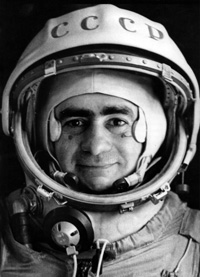 For this Project (1997), Fontcuberta fabricated a story about an evidence for a “Soyuz 2” mission involving cosmonaut Ivan Istochnikov. Soyuz 1, an actual Soviet space mission in 1967, had ended with the death of cosmonaut Vladimir Komarov when the spacecraft crashed on landing. In 1968, according to the fabricated story, “Istochnikov and his canine companion Kloka mysteriously vanished after leaving the [Soyuz 2] capsule for a routine space walk. When the Soyuz 3 arrived for a docking maneuver, it found only a vodka bottle containing a note, floating in orbit outside the empty, meteorite damaged ship.” To avoid embarrassment, Soviet officials deleted Istochnikov from official Soviet history; however, the “Sputnik Foundation” discovered Istochnikov’s “voice transcriptions, videos, original annotations, some of his personal effects, and photographs taken throughout his lifetime.” The exhibition of artifacts (e.g., photographs) related to “Soyuz 2” was shown in many countries, including Spain, France, Portugal, Italy, Mexico, Japan, and the United States. Among other reactions to the exhibition, a Russian ambassador “got extremely angry because [Fontcuberta] was insulting the glorious Russian past and threatened to present a diplomatic complaint.”
  and the
  It is quite possible that the name “Joseph Mulhattan” does not set bells ringing and lights flashing in the minds of modern readers, even if those readers seriously appreciate pranks and hoaxes. Keven McQueen may correct that regrettable state of affairs one day, when he finalizes his book on one of the master pranksters in journalism history.