Artist Zefrey Throwall Loses His Shirt on Wall Street

From Tim Jackson: “Putting it all on the line – a fine performance!”


A Bare Market Lasts One Morning
by Melena Ryzik
The New York Times
August 1, 2011

It was an early Monday morning like any other on Wall Street. Before most of the blue-shirted financiers descended, there came an army of helpers: the custodians and coffee fetchers, personal trainers and headsetted assistants who make the money street run smoothly. They marched along the sidewalks, in a hurry to start their workweek.

Zefrey Throwell, who devised the project, speaking with a police officer on Wall Street. Mr. Throwell also participated in “Ocularpation,” playing the part of a hot dog vendor.

Here and there, though, a few people were slowing down, like the trader barking into his cellphone in the calm before the market opened. He paused to loosen his tie. Unbutton his shirt. Take off his pants.

“He”s buck-naked “” Lord have mercy!” a woman said, stopping to gawk at, loudly judge and then photograph a sudden expanse of flesh. Continue reading “Artist Zefrey Throwall Loses His Shirt on Wall Street”

Chain World Videogame – Holy Performance Art

Bigger Than Jesus
by Jason Fagone
Wired
July 15, 2011

When Jason Rohrer created his Chain World videogame, he intended it to be a religion. He just didn’t expect a hold war.

Jason Rohrer is known as much for his eccentric lifestyle as for the brilliant, unusual games he designs. He lives mostly off the grid in the desert town of Las Cruces, New Mexico. He doesn”t own a car or believe in vaccination. The 33-year-old works out of a home office, typing code in a duct-taped chair. He takes his son Mez to gymnastics and acting class on his lime-green recumbent bicycle, and on weekends he paints with his son Ayza. (He got Mez”s name from a license plate, and Ayza”s by mixing up Scrabble tiles.)

On the morning of February 24, Rohrer took a break from coding and pedaled to the local Best Buy. He paid $19.99 for a 4-gigabyte USB memory stick sheathed in black plastic. The next day he sanded off the memory stick”s logos, giving it a brushed-metal texture that reminded him of something out of Mad Max. Then, using his kids” acrylics, he painted a unique pattern on both sides, a chain of dots that resembled a piece of Aboriginal art he had seen.

The stick would soon hold a videogame unlike any other ever created. It would exist on the memory stick and nowhere else. According to a set of rules defined by Rohrer, only one person on earth could play the game at a time. The player would modify the game”s environment as they moved through it. Then, after the player died in the game, they would pass the memory stick to the next person, who would play in the digital terrain altered by their predecessor””and on and on for years, decades, generations, epochs. In Rohrer”s mind, his game would share many qualities with religion””a holy ark, a set of commandments, a sense of secrecy and mortality and mystical anticipation. This was the idea, anyway, before things started to get weird. Before Chain World, like religion itself, mutated out of control. Continue reading “Chain World Videogame – Holy Performance Art”

Tabloid Performance Art

10 Celebrities Branded “Performance Artists”
Huffington Post
June 24, 2011

“Performance artist” has become a common slur against celebrities who thrive on tastelessness. There’s no way these people could be for real, the argument goes, so it must all be an elaborate ruse. But whether it’s from James Franco, who openly admits this act, or Joaquin Phoenix, who kept it going long enough to make a documentary about it, performance art is becoming a viable career option for established entertainers.

It’s not just that these celebrities’ personas have infiltrated their lives. That’s gone on for decades, from The Beatles and Bob Dylan, who liked to manipulate and mock their interviewers, to Samuel L. Jackson, who became typecast for his enthusiastic use of profanity. But recently, with the likes of Snooki, Soulja Boy and, lest we forget, Sarah Palin, tabloid performance art has thrived. With the entertainment media’s hyper-short attention span, famous people who can continually make a spectacle of themselves can also usually make headlines. [Here’s a] slideshow… of ten celebrities who have been accused of performance art, with varying degrees of truth behind the allegations.


Visit here for more…

If You Could See Me Now… Oh, You Can!

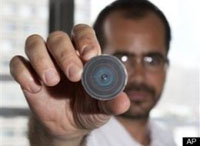
Wafaa Bilal, NYU Artist, Gets Camera Implanted In Head
by Ula Ilnytzky
Huffington Post
November 23, 2010

New York “” A New York University arts professor might not have eyes on the back of his head, but he’s coming pretty close. Wafaa Bilal, a visual artist widely recognized for his interactive and performance pieces, had a small digital camera implanted in the back of his head – all in the name of art.

Bilal said Tuesday that he underwent the procedure for an art project that was commissioned by a new museum in Doha, Qatar, in the Arab Gulf.

Titled “The 3rd I,” it is one of 23 contemporary works commissioned for the opening of the Mathaf: Arab Museum of Modern Art on Dec. 30. The exhibition is entitled “Told/Untold/Retold.”

“I am going about my daily life as I did before the procedure,” the Iraqi-born artist said in a statement.

Bilal, who is teaching three courses this semester at NYU’s Tisch School of the Arts, will wear the camera for one year. It is 2 inches in diameter and less than an inch thick.

The project will raise “important social, aesthetic, political, technological and artistic questions,” he said.

He declined to say when the camera was implanted or other details of the art installation, saying it “will be revealed to the public as part of the museum preview on Dec. 15” and on a website to be launched on the same day, http://www.3rdi.me.

He said he chose to have it put in the back of the head as an allegorical statement about the things we don’t see and leave behind. Continue reading “If You Could See Me Now… Oh, You Can!”

Joaquin Phoenix & Casey Affleck Expose Themselves

Update from news.softpedia.com, September 21, 2010: David Letterman Was In on the Joaquin Phoenix Hoax


Documentary? Better Call It Performance Art
by Michael Cieply
The New York Times
September 16, 2010

Casey Affleck wants to come clean.

South Pasadena, Calif. His new movie, “I”m Still Here,” was performance. Almost every bit of it. Including Joaquin Phoenix”s disturbing appearance on David Letterman”s late-night show in 2009, Mr. Affleck said in a candid interview at a cafe here on Thursday morning.

“It”s a terrific performance, it”s the performance of his career,” Mr. Affleck said. He was speaking of Mr. Phoenix”s two-year portrayal of himself “” on screen and off “” as a bearded, drug-addled aspiring rap star, who, as Mr. Affleck tells it, put his professional life on the line to star in a bit of “gonzo filmmaking” modeled on the reality-bending journalism of Hunter S. Thompson.

“I”m Still Here” was released last week by Magnolia Pictures to scathing reviews by a number of critics, including Roger Ebert, who wrote that the film was “a sad and painful documentary that serves little useful purpose other than to pound another nail into the coffin.”

“The reviews were so angry,” said Mr. Affleck, who attributed much of the hostility to his own long silence about a film that left more than a few viewers wondering what was real “” The drugs? The hookers? The childhood home-movie sequences in the beginning? “” and what was not. Continue reading “Joaquin Phoenix & Casey Affleck Expose Themselves”