“Liked” to the Max

What can happen if you open your floodgates (and those of your friends) to Facebook’s marketing machine?


I Liked Everything I Saw on Facebook for Two Days.
Here”s What It Did to Me

by Mat Honan
Wired
August 11, 2014

thumbs-up-425

…I like everything. Or at least I did, for 48 hours. Literally everything Facebook sent my way, I liked””even if I hated it. I decided to embark on a campaign of conscious liking, to see how it would affect what Facebook showed me. I know this sounds like a stunt (and it was) but it was also genuinely just an open-ended experiment. I wasn”t sure how long I”d keep it up (48 hours was all I could stand) or what I”d learn (possibly nothing.)

Read the whole article here.


Viral Videos: Fact or Fiction?

From Joe King:


Social Media Detectives: Is That Viral Video For Real?
Delmarva Public Radio
October 2, 2013

Listen (4:50)

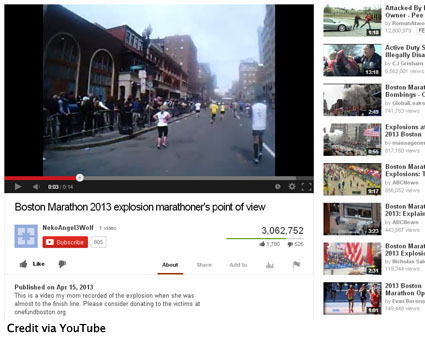
Whether it’s an uprising in Egypt or a video of a fake twerking session gone awry, news outlets need to know everything they can about a video before they run with it. That’s where Storyful steps in. The company helps journalists figure out what’s real, and what’s not.

“We use the same forensic process of discovery and verification for Syria as we do for hoax videos,” says Executive Editor David Clinch.

boston-maration

Since 2010, Storyful has worked with companies like The Wall Street Journal, The New York Times, ABC and others to make YouTube videos, tweets and cellphone snapshots a major part of the news cycle.

“When a story breaks, there is no shortage of content that exists,” Clinch says, “but the problems are finding it in the first place [and,] most importantly, verifying that it’s real.”

Read the rest of the story here.

Freedom of the Press vs. The Truth

Submitted by W.J. Elvin III: British Journalism 101: Don’t let facts stand in the way of a good story…


British Newspapers Make Things Up
by Satoshi Kanazawa
Psychology Today
January 24, 2010

In April 2008, I wrote that British journalists interpret “freedom of the press” to mean that they can make up anything they want and publish it as fact in British newspapers. Now another evolutionary psychologist has learned the lesson the hard way.

In the earlier post, I explain that, by the American standards, all British newspapers are tabloids because they don”t distinguish between what is true and what they make up. I knew this from my own experiences of dealing with British journalists, but, as it turns out, even the British government admits, in an official government publication, that British newspapers make things up and report them as facts.

Most British people consider the Times of London to be the most respectable “broadsheet” newspaper (as opposed to “tabloid” newspapers) in the UK, despite the fact that the Times, along with most British “broadsheet” newspapers, is now published in the tabloid size to make it easier for people to read it in crowded London subways. Last week, the Sunday Times published an article with the headline “Blonde women born to be warrior princesses.” The article reported that “Researchers claim that blondes are more likely to display a “warlike” streak because they attract more attention than other women and are used to getting their own way – the so-called “princess effect.”” The Times article quotes the evolutionary psychologist at the University of California – Santa Barbara, Aaron Sell, and his findings are purportedly published in his article in the Proceedings of the National Academy of Sciences, written with the two Deans of Modern Evolutionary Psychology, Leda Cosmides and John Tooby.

As it turns out, however, none of this is true, as Sell explains in his angry letter to the Times. He and his coauthors do not mention blondes at all in their paper and they don”t even have hair color in their data. The supplementary analyses that Sell performed after the publication of the paper, as a personal favor to the Times reporter, show the exact opposite of what the Times article claims. After he presumably listened to Sell explain all of this on the phone, the Times reporter nonetheless made up the whole thing, and attributed it to Sell. Continue reading “Freedom of the Press vs. The Truth”


LiteratEye #40: And Death Shall Have No Dominion, Particularly If You’re a Best-Selling Author

Here’s the fortieth installment of LiteratEye, a series found only on The Art of the Prank Blog, by W.J. Elvin III, editor and publisher of FIONA: Mysteries & Curiosities of Literary Fraud & Folly and the LitFraud blog.


LiteratEye #40: And Death Shall Have No Dominion, Particularly If You’re a Best-Selling Author
By W.J. Elvin III
November 20, 2009

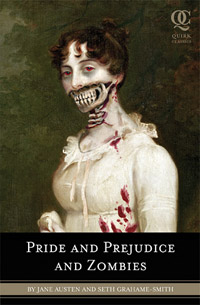
pride, prejudice, zombies200It seems a sad thing that writers who keep on pumping out books after they are dead aren’t around to enjoy the benefits. Maybe there are literary awards passed out in heaven? “Best Book By A Recently-Deceased Author.”

I got to thinking about that after learning that mystery writer and outdoor expert William G. Tapply, who had become just plain “Bill” over the course of our correspondence last year, died recently. He left several books still to be published.

What that leads into is the issue of after-death publishing, not the posthumous publication of completed works as in Tapply’s case but works produced under an author’s name but actually involving other writers.

Sometimes such books are based on partially completed manuscripts, or even derived from ideas jotted on a cocktail napkin. If that.

The issue takes some odd turns. Continue reading “LiteratEye #40: And Death Shall Have No Dominion, Particularly If You’re a Best-Selling Author”

Public Service Ads That Sell

New Advertising Trend: Fake “Public Service” Ads
PRWatch.org / Center for Media and Democracy
May 14, 2009

Consumer Reports’ AdWatch video for Chantix:
Source: Consumer Reports/Health.org, February 17, 2009
http://c.brightcove.com/services/viewer/federated_f8/1078549944

Pfizer has produced a great example of stealth advertising with its commercial promoting a Web site called MyTimeToQuit.com. The ad has the look and feel of a public service announcement, and mentions neither Pfizer, nor the popular smoking cessation drug it promotes — Chantix (varenicline). The ad represents a growing trend in drug advertising called “help-seeking ads,” which don’t mention a drug by name, but instead address the condition the drug is meant to treat, and then drive viewers to a toll-free 800 number or a Web site that offers an option to learn more about a prescription drug meant to treat the condition. It is a sneaky, but legal way to advertise drugs that have particularly bad side effects, since avoiding mentioning the drug by name lets the company off the hook for listing its bad side effects in the ad, too, according to the U.S. Food and Drug Administration (FDA) rules. Chantix has some serious side effects, according to an alert the agency issued on Chantix, including “serious neuropsychiatric symptoms,” like changes in behavior, depressed mood, suicidal ideation and completed suicide.