
The Story of Snopes

Turbulent times have brought increased attention for Snopes, the long-running, cred-heavy fact-checking website. This longform feature weaves a compelling tapestry of research, analysis, and narrative, including a raw and revealing interview with the site’s embattled cofounder David Mikkelson.


“Snopes and the Search for Facts in a Post-fact World”
by Michelle Dean
Wired
September 20, 2017

“It was early March, not yet two months into the Trump administration, and the new Not-Normal was setting in: It continued to be the administration”s position, as enunciated by Sean Spicer, that the inauguration had attracted the “largest audience ever”; barely a month had passed since Kellyanne Conway brought the fictitious “Bowling Green massacre” to national attention; and just for kicks, on March 4, the president alerted the nation by tweet, “Obama had my “˜wires tapped” in Trump Tower.”

If the administration had tossed the customs and niceties of American politics to the wind, there was one clearly identifiable constant: mendacity. “Fake news” accusations flew back and forth every day, like so many spitballs in a third-grade classroom.

Feeling depressed about the conflation of fiction and fact in the first few months of 2017, I steered a car into the hills of Calabasas to meet with one person whom many rely on to set things straight. This is an area near Los Angeles best known for its production of Kardashians, but there were no McMansions on the street where I was headed, only old, gnarled trees and a few modest houses. I spotted the one I was looking for””a ramshackle bungalow””because the car in the driveway gave it away. Its license plate read SNOPES.” Read more.

White People Take On Facebook Racists

As most celebrities know, there are advantages to letting other people handle your social media. Significantly, you don’t have to spend hours of your day engaging with strangers who hate you for no good reason. Now, a volunteer Facebook group gives non-famous people of color the same advantage.


“These White People Will Respond To Your Racist Trolls So You Don”t Have To”
by Sara Ruiz-Grossman
The Huffington Post
September 19, 2017

“If a white person is filling your social media with white nonsense “• anything from overt racism to well-intentioned problematic statements, tag us and a white person will come roundup our own,” the group”s Facebook post reads.

The volunteer-run Facebook group, founded last year by friends Layla Tromble and Terri Kompton in Washington state, has white people respond to racist trolls online at the request of people of color.

At a time of deep political divides and tensions around racism and white supremacy, the group exists to support people of color, who are all too often the targets of online hate but are also often asked by white people to explain everyday race-related issues, from why NFL player Colin Kaepernick took a knee during the national anthem to why you can”t just touch a black woman”s hair.

“It”s the responsibility of us white folks to do the emotional labor that”s required to educate other white folks “• and it shouldn”t be required of people of color again and again,” Tromble told HuffPost. “One of the goals of the service is to do some of that labor for people. Let them go have a drink and not worry about nonsense going on on their Facebook.” Read more.


Comedian Lee Camp Deconstructs New York Times Hatchet Job

Lee Camp, comedian, writer and creator, host, and head writer of the comedy news show Redacted Tonight gives a propaganda tutorial based on the hatchet job The New York Times did on him. H/T to Boris.


Lee Camp: How to Write Propaganda for the NY Times””As Demonstrated in an Article About Me
by Lee Camp
Alternet.org
June 13, 2017

The comedian debunks the lies and distortions spread about him in the New York Times.

On June 7, the New York Times vomited up a hit piece on little ol” me – a guy who has been doing stand-up comedy for nearly 20 years and thought maybe that comedy could be used to inform and inspire audiences, rather than just make fun of the differences between men and women.

At first when you”re the center of a smear job, you”re annoyed and frustrated. But as I read further through the piece, I realized it was a master class in how to write propaganda for one of the most “respected” news outlets in our country. I”m actually grateful it was written about me because now I can see with my own eyes exactly how the glorious chicanery is done. I count no less than 15 lies, manipulations, and false implications in this short article, a score that even our fearless prevaricator-in-chief Donald Trump would envy.

So here now is a “How To” for writing propaganda for the New York Times, using the smear piece against me as an example. Read the full article here.

First Responders to BS: Fact-Checkers are Heroes for Our Times

Like at Snopes, the team at Politifact has its work cut out for it. Here’s a rousing rant from editor Aaron Sharockman.


“PolitiFact: The Power of Fact Checking in a Post-Truth World”
by Aaron Sharockman
Tampa Bay Times
June 7, 2017
Here’s a quick test: Think about how Donald Trump announced he was running for president. Now, do the same for Hillary Clinton.
I think most of you probably got one but not the other. We remember Trump and his wife Melania gliding down the Trump Tower escalator in June 2015. And we remember some of the things Trump said that day.

“When Mexico sends its people, they’re not sending their best. They’re not sending you. They’re not sending you,” Trump said. “They’re sending people that have lots of problems, and they’re bringing those problems with us. They’re bringing drugs. They’re bringing crime. They’re rapists. And some, I assume, are good people.”

As for Clinton? Continue reading “First Responders to BS: Fact-Checkers are Heroes for Our Times”

From Russian Satire to Serious (but Fake) News–a Flowchart

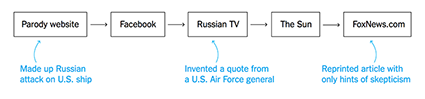
The NYT tracks an item from a Russian satirist to FOX News.


How Russian Propaganda Spread From a Parody Website to FOX News
by Neil MacFarquhar and Andrew Rossback
The New York Times
June 7, 2017

Born in the shadowy reaches of the internet, most fake news stories prove impossible to trace to their origin. But researchers at the Atlantic Council, a think tank, excavated the root of one such fake story, involving an incident in the Black Sea in which a Russian warplane repeatedly buzzed a United States Navy destroyer, the Donald Cook.

Like much fake news, the story was based on a kernel of truth. The brief, tense confrontation happened on April 12, 2014, and the Pentagon issued a statement. Then in April, three years later, the story resurfaced, completely twisted, on one of Russia”s main state-run TV news programs.

The new version gloated that the warplane had deployed an electronic weapon to disable all operating systems aboard the Cook. That was false, but it soon spread, showing that even with all the global attention on combating fake news, it could still circulate with alarming speed and ease.

In the days after the incident in the Black Sea, a Russian writer named Dmitri Sedov wrote an opinion piece, apparently meant to be satirical, that imagined the incident as an electronic warfare attack and described the panicked reaction of one crew member. Read the rest of the story here.