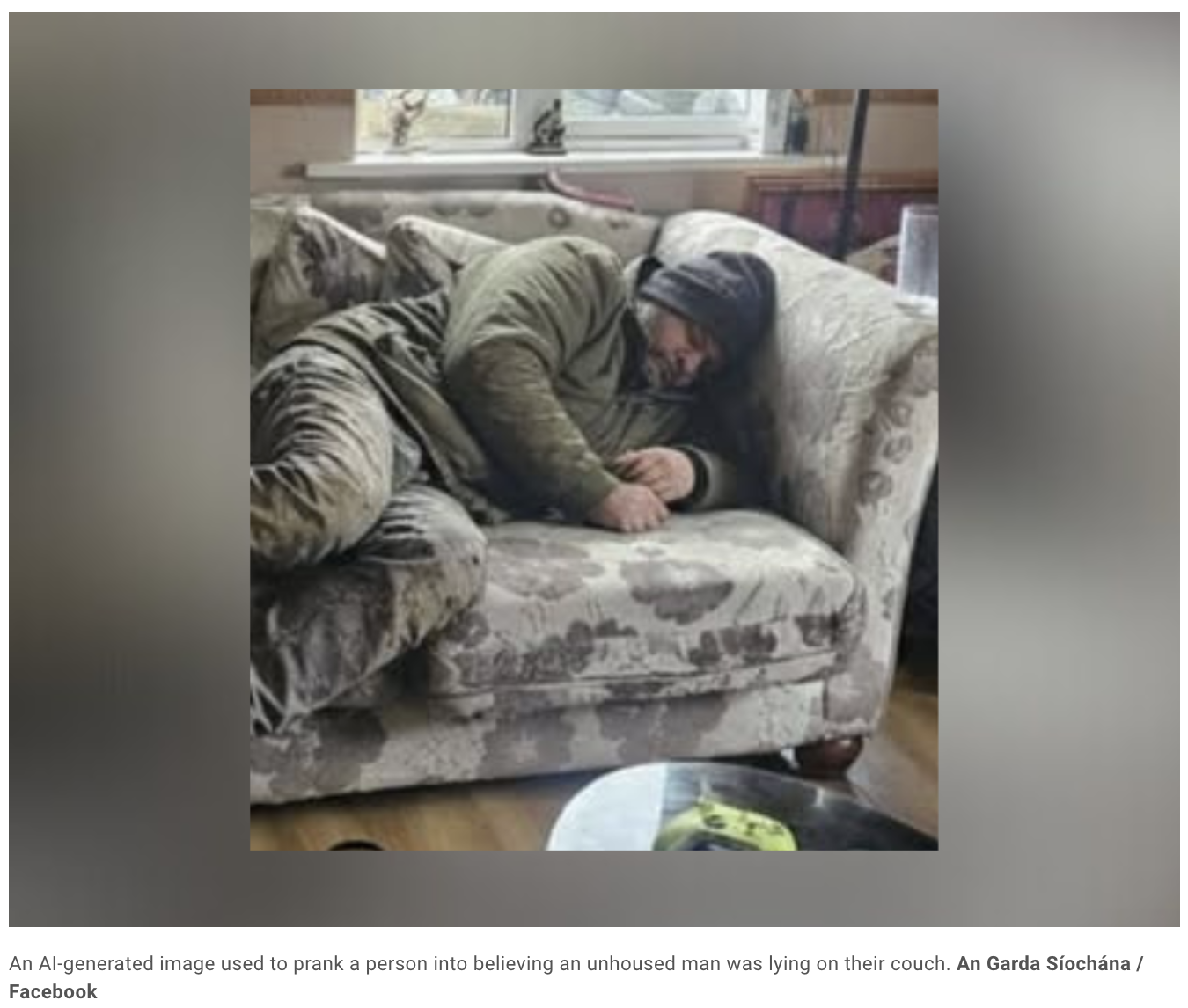
The new TikTok trend “AI Homeless Man Prank” has sparked a wave of outrage and police responses in the United States and beyond.
The prank involves using AI image generators to create realistic photos depicting fake homeless people appearing to be at someone’s door or inside their home. Learning to distinguish between truth and falsehood is not the only challenge society faces in the AI era. We must also reflect on the human consequences of what we create.
As professors of educational technology at Laval University and education and innovation at Concordia University, we study how to strengthen human agency — the ability to consciously understand, question and transform environments shaped by artificial intelligence and synthetic media — to counter disinformation. Read the whole article here.
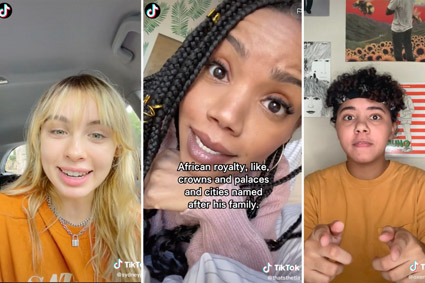
Each day, the actors upload new videos to the respective TikTok accounts, detailing their characters’ latest fictional exploits for hundreds of thousands of followers.
Collectively, the characters have amassed a whopping 281 million video views, Insider reports, with FourFront creating a new frontier in scripted storytelling on the social media app.
A mystery tour with fake websites, fake audiences, fake interviews, fake music label, fake management, fake video production company and at least one really good musician.
As Jered Threatin (if that’s his real name) says… “What is Fake News? I turned an empty room into an international headline. If you are reading this, you are part of the illusion.”
A rock band went on tour in the U.K. and nobody came. Then it got weird.
In April, Jered Threatin began to hold auditions for a backing band. He chose three musicians and told them they would embark on an all-expenses paid European tour with his band, Threatin.
The first stop was The Underworld in London. Someone representing Threatin had paid £780 (roughly $1,010) to book it for the night of Nov. 1 and told Patrice Lovelace, an in-house promoter at the club, that the band had sold 291 tickets for the show.
But when the band went on, there were only three people in the audience.
“It was only on show day when no customer list for the 291 customers was produced that we realized we’d been duped,” Ms. Lovelace said. “The show went ahead with only the supports, staff and crew in attendance. The bar made almost zero money, and it was all extremely bizarre. And empty, obviously.”
The next few gigs were similarly barren. After a show at The Exchange in Bristol on Nov. 5, for which a promoter claimed to have sold 182 tickets, staff at the venue decided to investigate the band. After all, someone had paid more than $500 to book the venue.
Nearly everything associated with Threatin, it would turn out, was an illusion. Iwan Best, a venue manager at The Exchange, said they found that each of the websites associated with Threatin — the band’s “label” Superlative Music Recordings; its management company, Aligned Artist Management; and the video production company that directed the band’s video — were all registered to the same GoDaddy account. (The pages were built under a parent site seemingly associated with Superlative Music, the fake label.)