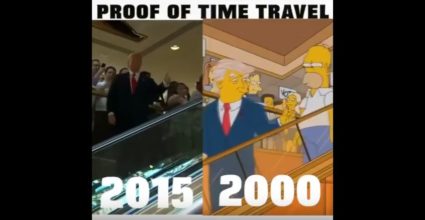
The beloved, long-running animated satirical program’s eerie track record of anticipating the future. h/t Andrea!
…Exploring the role of the prankster as artist, activist and social observer and the significance of the prank in society.
The beloved, long-running animated satirical program’s eerie track record of anticipating the future. h/t Andrea!
Fake internet comments may be the only thing worse than real internet comments.
“Fake Comments on Trump Administration Website are Trying to Take Down an Obama-era Rule”
By Greg Price
Newsweek
December 27, 2018
 Critical fake comments, attributed to a real person, were reportedly posted against a controversial fiduciary rule to the Department of Labor”s website, presumably to convince the department to do away with the rule altogether.
Altogether, 40 percent of people who responded to a survey conducted for The Wall Street Journal stated they did not write the negative comments against the rule first implemented under former President Barack Obama to protect investors and avoid conflicts of interest at brokerage firms and other financial institutions.
The survey was conducted by research firm Mercury Analytics for The Journal. It was sent to 345 people out of the 3,100 comments posted to the Labor Department”s site about the fiduciary rule. Most of the 345 comments were critical of the rule, but of the 50 people to respond to the survey, 20 told The Journal they did not author the critical post.
As the year-end recaps gather on the horizon, many will attempt to make sense of Donald Trump’s ascent to the Presidency. Kurt Andersen’s book Fantasyland: How America Went Haywire provides a fascinating road-map.
The Atlantic posted a long excerpt. This is from Delancey Place about the roots of our inbred susceptibility to advertising.
“Are Americans More Willing to Believe in Advertising?”
Delancey Place
December 4, 2017
 From the earliest days, and continuing for decades and even centuries, promoters of the New World enticed colonizers with the promise of riches, causing the historian Daniel Boorstin to suggest that ‘American civilization [has] been shaped by the fact that there was a kind of natural selection here of those people who were willing to believe in advertising’:
“Although [Sir Walter] Raleigh never visited North America himself, he believed that in addition to its gold deposits, his realm might somehow be the biblical Garden of Eden. … A large fraction of the first settlers dispatched by Raleigh became sick and died. He dispatched a second expedition of gold-hunters. It also failed, and all those colonists died. But Sir Walter continued believing the dream of gold.
“In 1606 the new English king, James, despite Raleigh’s colonization disasters, gave a franchise to two new private enterprises, the Virginia Company of London and the Virginia Company of Plymouth, to start colonies. The southern one, under the auspices of London, they named Jamestown after the monarch. Their royal charter was clear about the main mission: ‘to dig, mine, and search for all Manner of Mines of Gold … And to HAVE and enjoy the Gold.’ As Tocqueville wrote in his history two centuries later, ‘It was … gold-seekers who were sent to Virginia. No noble thought or conception above gain presided over the foundation of the new settlements.’ Two-thirds of those first hundred gold-seekers promptly died. But the captain of the expedition returned to England claiming to have found ‘gold showing mountains.’ … In fact, Jamestown ore they dug and refined and shipped to England turned out to be iron pyrite, fool’s gold….” Read more.
Gizmodo investigates confusing robocalls warning people to stop criticizing President Trump. Some of the recipients are harsh Trump critics, some aren’t. Some known political provocateurs may or may not be involved, and no one really gets it.
“People Are Getting Robocalls About Their ‘Derogatory’ Trump Posts”
by Kashmir Hill
Gizmodo
November 29, 2017
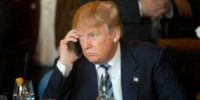 Brett Vanderbrook was driving for Uber last week when he got a call from an unfamiliar number. He let it go to voicemail and when he listened to it later, he got a shock: It was a recorded message telling him to stop making “negative and derogatory posts about President Trump.”
“It was kind of threatening. I was dumbfounded at first and then creeped out,” Vanderbrook, who lives in Dallas, Texas, said in a phone interview. “Then I was angry and that”s when I decided to share it.”
Vanderbrook makes progressive political posts on Facebook, voicing support for gun control, LGBTQ rights, and immigrant rights. None of his public posts mention President Trump or come across as “derogatory.”
Vanderbrook is not alone, though. Across the country, and even in Canada, people have reported on social media that they”ve received the same robocall. The earliest complaint dates back to July. The intensity of the calling campaign is hard to gauge; a search of complaints turned up 10 reports scattered across different platforms.
The reports, though, are all consistent. When the call goes to voicemail, as it did for Vanderbrook, the beginning of the recording gets cut off, but people describing the calls on Twitter, Facebook, and the telemarketer-reporting site ShouldIAnswer.com have said that the recording claims to come from “Citizens for Trump.” Read more.
In what has become an annual American holiday tradition, the creative team behind the party game Cards Against Humanity is pulling a satirical marketing stunt. (In 2014, we talked with ringleader Max Temkin about the “Box of Bullshit” and his reverence for Abbie Hoffman.) This time, their gimmick carries a fresh and righteous political charge.
“Cards Against Humanity is the undisputed champion of holiday promotions”
by Lindsey Quinn
The Hustle
November 16, 2017
 The world”s raunchiest card game has purchased a plot of vacant land along the Mexico-US border and has hired an eminent domain lawyer to make it “as time-consuming and expensive as possible” for the Trump administration to build its proposed wall.
To fund their effort, CAH offered a package of “six surprises” for $15 “” all of which are now sold out.
Since the game was launched by 8 high school friends in 2011, it”s gained a reputation for pulling incredibly on-point PR stunts. Read more.