
Behold Instagram’s Digital Conmen

Money, money, money… money.

“Oyefeso is one of the most high-profile figures of an internet subculture that reveres Jordan Belfort and has taken his Wolf of Wall Street persona to social media. Posing as ultra-wealthy kids and posting internet memes taken from the movie, its followers aggressively sign up young people to what looks like an international pyramid scheme that has helped to generate billions of pounds for large companies selling highly risky financial trading products.” -Symeon Brown


Fake it till you make it: meet the wolves of Instagram
by Symeon Brown
The Guardian
April 19, 2018

Their hero is Jordan Belfort, their social media feeds display super-rich lifestyles. But what are these self-styled traders really selling?

The original Wolf of Wall Street, Jordan Belfort, was a rogue trader convicted of fraudulently selling worthless penny stocks to naive investors. His biopic, starring Leonardo DiCaprio as the ostentatious, money-obsessed huckster, was a box-office hit in 2013. Although it may have been intended as a cautionary tale, to thousands of young millennials from humble backgrounds, Belfort’s story became a blueprint for how to escape an unremarkable life on low pay.

Within months of the Wolf of Wall Street’s UK premiere in January 2014, a stocky 21-year-old named Elijah Oyefeso from a south London housing estate, began broadcasting on social media how much money he was making as a stock-market whizzkid. His thousands of young followers were desperate to do the same. As Oyefeso’s online fame grew, he caught the attention of TV producers. In January 2016, Oyefeso was featured in the Channel 4 show Rich Kids Go Shopping, in which he bought expensive jumpers to give to homeless people and showed viewers how easy it was to make stock trades online.

Even before Oyefeso’s appearance on mainstream TV, his story had already gone viral. British tabloids, including the Daily Mail, the Evening Standard and the Mirror, as well as a host of online magazines targeted at young men, all ran pieces about his success. The Mail headline described him as a university dropout who supposedly used his student loan to start trading financial products online and “now claims he earns £30,000 on a BAD month – by working just ONE HOUR a day”.

It’s an image of self-made wealth and ridiculous luxury, and one that Oyefeso has intensively cultivated online. The videos on his almost comedic YouTube channel, which have hundreds of thousands of views, feature him buying £250,000 cars and boarding private jets as nonchalantly as others his age might hail an Uber. His Instagram, which regularly shows him posing next to a blue and silver Rolls-Royce, describes him as the founder of DCT, his trading firm. DCT stands for “Dreams Come True”.

“I’m never going to work for someone,” Oyefeso says in one of his videos, in a somewhat cartoonish, nasal voice, while he drives his Rolls dressed in a bathrobe. “Look what I’ve built: a foundation. A brand.” Read more
A Novel Approach to Money Laundering

What do you get when a fake author using a stolen identity publishes a gibberish-ridden novel on demand and then buys scads of them at high prices with dirty money? Clean money. h/t BoingBoing


Money Laundering Via Author Impersonation on Amazon?
Krebs on Security
February 20, 2018

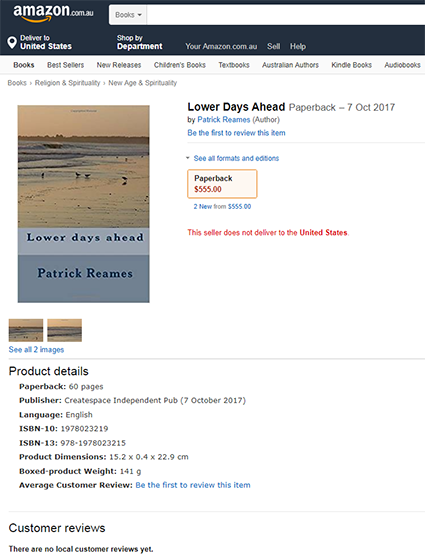
Patrick Reames had no idea why Amazon.com sent him a 1099 form saying he’d made almost $24,000 selling books via Createspace, the company’s on-demand publishing arm. That is, until he searched the site for his name and discovered someone has been using it to peddle a $555 book that’s full of nothing but gibberish.

Reames is a credited author on Amazon by way of several commodity industry books, although none of them made anywhere near the amount Amazon is reporting to the Internal Revenue Service. Nor does he have a personal account with Createspace.

But that didn’t stop someone from publishing a “novel” under his name. That word is in quotations because the publication appears to be little more than computer-generated text, almost like the gibberish one might find in a spam email.

“Based on what I could see from the ‘sneak peak’ function, the book was nothing more than a computer generated ‘story’ with no structure, chapters or paragraphs — only lines of text with a carriage return after each sentence,” Reames said in an interview with KrebsOnSecurity.

The impersonator priced the book at $555 and it was posted to multiple Amazon sites in different countries. The book — which as been removed from most Amazon country pages as of a few days ago – is titled “Lower Days Ahead,” and was published on Oct 7, 2017.

Reames said he suspects someone has been buying the book using stolen credit and/or debit cards, and pocketing the 60 percent that Amazon gives to authors. At $555 a pop, it would only take approximately 70 sales over three months to rack up the earnings that Amazon said he made. Continue reading “A Novel Approach to Money Laundering”

Fake Newsmaker Cameron Harris: Lying for Profit

Cameron Harris, a man without shame, fesses up to how he lied, cheated and stole when he created and published fake news that helped sway the national election. He had no reason to do it other than greed and he has no remorse.


From Headline to Photograph, a Fake News Masterpiece, by Scott Shane, The New York Times, January 18, 2017

Cameron Harris

Joey Skaggs on Fake News (and he should know)

A master of fake news speaks. Published earlier today in Huffington Post, Joey muses on media literacy and the need for vigilant skepticism.


Fake News: The Relentless Pursuit of Mind Control
by Joey Skaggs
Huffington Post
November 29, 2016

Jojo, King of the New York Gypsies (a.k.a. Joey Skaggs), protesting to rename the Gypsy Moth in 1982

Jojo, King of the New York Gypsies (a.k.a. Joey Skaggs), protesting to rename the Gypsy Moth in 1982

The news media is all a-flutter with headlines about the rise and proliferation of fake news media: “Did Russia Install Donald Trump As the Next U.S. President?” “It”s About To Get Worse!” “Living in a Media Bubble” “Can American Democracy Survive?” Excuse me? Wait a minute”¦

Propaganda and disinformation have been an integral part of our daily dose of information forever. In essence, everywhere you look, whether it”s the allegedly trustworthy mainstream media or the not-so-trustworthy social media alt-right or left-trending news stories, someone is always peddling influence.

It wasn”t just the Russians who supposedly engaged in influencing election results by hacking emails and proliferating fake news that damaged the Democrats” pursuit of the White House. Americans can”t play the innocent victims here. We”re all using the same propaganda techniques. Now, because of warp-speed Internet and social media delivery systems, we have a perpetual game of Propaganda Pong, and the onslaught is much more ruthless and, at the same time, highly profitable financially.

That”s what life is like these days. You”re either the provider or the recipient””or more likely both””of propaganda and disinformation.

Read the whole article here.


TV Viewers Disappointed to Not See Host Eaten Alive

Promotional materials for the Discovery Channel program Eaten Alive led some viewers to expect that they would see host Paul Rosolie devoured by a wild anaconda. When he wasn’t, animal-rights activists and passive sadists alike expressed dismay.


‘Eaten Alive’ Watched by 4.1 Million Viewers
by Lynn Elber
ABCNews
December 8, 2014

eaten aliveLOS ANGELES (AP) – Discovery Channel’s “Eaten Alive” special that pitted snake against man drew more than 4 million viewers, but not all considered it time well spent.

Although the title and a promotional video indicated that naturalist Paul Rosolie would be swallowed by a giant anaconda, Sunday’s pre-taped special didn’t go that far.

Rosolie, described by Discovery as a snake researcher and conservationist, ended his Amazon jungle encounter with the snake after it encircled his body and began squeezing. Wearing bulky protective gear, Rosolie escaped with a sore arm but uneaten.

Online, some viewers jeered the show for falling short of its promise. One posting showed a photo of a mild-looking dog nibbling on a person’s finger, accompanied by a request for their own Discovery show. Continue reading “TV Viewers Disappointed to Not See Host Eaten Alive”