Italian Art Pranks Remembered


From Modigliani Fakes To Michelangelo The Forger: Italy’s Most Ingenious Art Pranks, by Emanuela Minucci, LA STAMPA, ENGLISH EDITION WORLDCRUNCH, May 06, 2023

TURIN — Summer, 1984. Three sculptures are found in a canal in Livorno, Italy.

Experts and art critics Giulio Carlo Argan and Cesare Brandi agree that the sculptures are the work of famous Italian artist Amedeo Modigliani, who had written that he threw some sculptures that didn’t turn out as he’d wanted into the river.

But the sculptures were all fake. It was one of the greatest art hoaxes of all time. The prank of Modigliani’s False Heads is the story of three university students and an artist from Livorno who didn’t know each other, but all had the same idea: on the year of the centenary of Modigliani’s birth, as the city of Livorno dredged a nearby river to find the lost sculptures Modigliani had written about, defied the art world. It was courageous, and reckless.

After the four made the sculptures and threw them into the river at night, they waited for critics and experts to comment on their authenticity and quality. Then, they went on television and revealed the hoax — for the students, a prank, and for the artist, a performance.

Even the art world is not immune to pranks, and some of those who indulged in these hoaxes were later remembered as some of the most important and influential artists of all time.

Michelangelo, the forger
The mastermind of one of the most famous scams in art history was none other than Michelangelo Buonarroti. At just over 20 years old, the Renaissance art genius created a Sleeping Cupid that, through various tricks, looked like a piece of ancient artwork. Continue reading “Italian Art Pranks Remembered”
Harvard Toasts the Lampoon

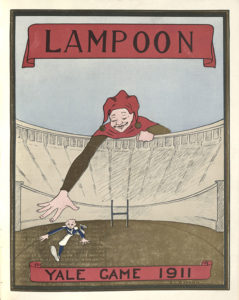
An exhibit in Harvard’s Pusey Library pays playful tribute to the Harvard Lampoon, one of the most influential satirical magazines in American history.


“Pranks at Pusey Library”
by Aidan Langston
Harvard Magazine
August 6, 2016

AOTPLampoonVisitors to Pusey Library this summer have been greeted by a large cardboard cutout of a cow””part of an exhibit celebrating The Harvard Lampoon and the role it has played in Harvard”s comedic history. The exhibition, “Remorseless Irony and Sarcastic Pens: The Story of the Harvard Lampoon,” showcases photographs, drawings and other artifacts collected over the course of the Lampoon”s 140 years.
The cow is an homage to the Lampoon”s custom of unleashing farm animals on campus for comedic effect. William Randolph Hearst, a member of the Lampoon and the class of 1886″”although his pranks resulted in his expulsion””is suspected of having sparked the tradition by releasing roosters in Harvard Yard. Lampoon members were also blamed for the appearance of a cow in the Yard sometime in the 1930s, which was “forcibly ejected” from the premises by Harvard police.

The exhibit contains an array of memorabilia from the magazine”s earliest days, ranging from photographs of the seven students who founded it in 1876 to a copy of its first issue. Continue reading “Harvard Toasts the Lampoon”

Nares Craig, Infamous Cambridge Night Climber, RIP

Cantab ‘Original Prankster’ Dies, Aged 94
by Harry Shukman
CambridgeTab.co.uk
11th February 2012

One of the oldest former members of the infamous Cambridge Night Climbers has died, aged 94.

Nares Craig, who studied at Trinity in the 1930s, was well-known for his activity in the elusive Night Climbers.

This small and select group of daredevils ran, jumped and swang over the rooftops of Cambridge under the cover of darkness, just for kicks.

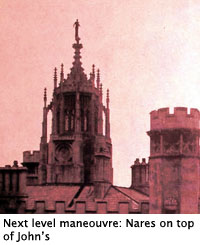
Back in the day, Nares made his name by climbing King”s Chapel to hang an effigy of King George VI just before his coronation.

Writing in his memoirs, Nares remembered “˜a rash of bunting and union jacks” appearing all over Cambridge.

“˜It prompted me,” he said, “˜to think of some appropriate way of mocking the whole pantomime of royalty.” Continue reading “Nares Craig, Infamous Cambridge Night Climber, RIP”

Haggis To Go

Student prank sees giant haggis travel to Inverness
Deadlinenews.co.uk
January 26th, 2012

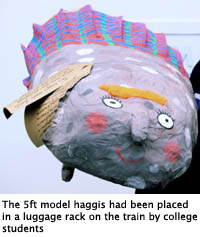
College students caused a Burns Night stir after putting a 5ft model haggis on a train.

The madcap students put the papier mache haggis on the 2pm Kirkcaldy to Inverness service yesterday, hoping an amused passenger might collect it at the other end for a Burns Night supper.

Sure enough, the haggis – complete with a pink kilt – was rescued by a businessman in the Highlands capital and whisked away to a celebration of the Scottish Bard”s life.

The haggis, made by students at Adam Smith college, Kirkcaldy, Fife, even sported a Paddington Bear-style tag with contact information for the college, in case he got lost.

The 5ft model was placed in the luggage department in the last compartment of the busy train.

A businessman, named by local press as Kit Fraser, collected the haggis from the station to be his guest of honour at a Burns Night supper for an accountancy firm. Continue reading “Haggis To Go”

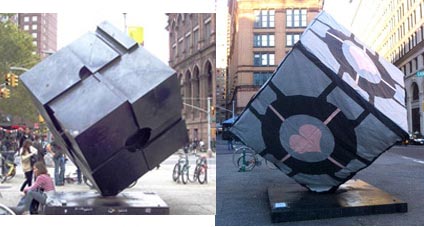
New York’s Astor Place Sculpture Pranked… Again!

Pranksters Plant Giant Companion Cube in NYC
by Marshall Honorof
The Escapist
14 December 2011

The California Institute of Technology invited your best friend, the Companion Cube, to Astor Place in New York City.

You can bet that the California Institute of Technology is making a note here: “huge success.” A group of students from CalTech traveled all the way across the country to pull off one of its nerdiest pranks to date – transforming the recognizable Alamo sculpture in Astor Place, New York City from a modern masterpiece into a supersized piece of gaming iconography. This morning, city dwellers between Astor Place and Lafayette Street found the rotating cube covered in a Companion Cube sleeve, accompanied by a note from Aperture Science (appropriate for the Portal theme). By the time the news began to spread, the pranksters had already disappeared, presumably by way of portal gun.

In keeping with the Prank Club’s tradition of good-natured shenanigans, the Alamo sculpture remained totally unharmed. The Companion Cube skin is simple cloth, and the students attached it with non-adhesive fasteners. The note detailed how to remove the Companion Cube skin, claimed full responsibility, and even provided the group’s e-mail address. It did warn, however, that “premature euthanization of your companion cube can interfere with your ability to complete the test.”

The Alamo has been the target of a few pranks before, so GLADoS probably ordered city officials to deal with the Compaion Cube fairly quickly. At this time, the CalTech pranksters do not appear to be in any trouble, although Mayor Bloomberg is not exactly congratulating them for interfering with a public work of art, either. If this incident has made anything clear, it’s this: New York City is in desperate need of a more permanent giant Companion Cube. Someone ought to get working on that, as soon as they finish baking that cake we were promised four years ago.

source: MTV Geek!, Alamo image: wapedia.mobi