
Assembly line news for a digital age
by Edward Wasserman
Miami Herald
July 16, 2012
 However droopy the rest of the news business might be, dishonesty has become a growth industry, with a steady churn of mini-scandals involving theft, pillage, and fiction. The latest flap over media fakery concerns Journatic, a six-year-old company that sells news organizations what”s called hyperlocal coverage, once known as community news.
Journatic”s approach to journalism is unusual, and it came to light in a recent report on This American Life (TAL), the public radio magazine. TAL”s chief informant was a cheerful but disgruntled Journatic employee named Ryan Smith.
The Journatic that Smith described is a globalized, Internet-based informational assembly line: U.S. data sources are scraped for micro-news of appeal to neighborhood-sized audiences “” home sales, death notices, Little League scores, police blotter entries, honor rolls, school lunch menus, company press releases.
Sometimes raw items are shipped overseas (to the Philippines, for instance) and shaped by low-paid freelancers, then polished by various stateside editors, and finally channeled to client publications, which print them in neighborhood news sections or post them online.
Other times source materials are handed off to piecework U.S. journalists who are told to make a call or two, add live quotes, and re-file for clients far away. Continue reading “The Journatic Model: Faking the News”
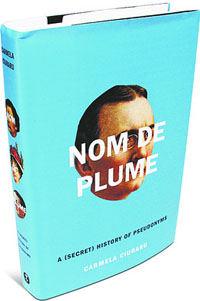
 her “secret history” of pseudonyms, there is nothing new about literary masquerades.
 ,” published in 1962, was generally well reviewed and became a best-seller. It remains in print, regarded by some as a classic of American travel writing. Almost from the beginning, though, a few readers pointed out that many of the conversations in the book had a stagey, wooden quality, not unlike the dialogue in Steinbeck”s fiction.

 was released in 2004 it received overwhelmingly positive reviews. Dylan”s recollections came off as disarmingly personal; the use of language in his prose was said to be as distinctive and captivating as it is in his songs. But over the past several years, in loose collaboration with Edward Cook, of Washington, DC, I have been giving Chronicles a closer look. Ed is, among other things, an editor of The Dead Sea Scrolls: A New Translation“”deciphering and translating are his business””but he is also a Bob Dylan fan and blogger. In 2006, he first posted about borrowings in Chronicles: Volume One from Mark Twain, Marcel Proust, and jazzman Mezz Mezzrow”s 1946 autobiography Really the Blues; later he posted about borrowings from Jack London and even Sax Rohmer, creator of Dr. Fu Manchu. And together Ed and I have found in Chronicles an author, Bob Dylan, who has embraced camouflage to an astounding degree, in a book that is meticulously fabricated, with one surface concealing another, from cover to cover.