Spreading Fear for Profit

Fake news sites are using Facebook to spread Ebola panic
by Josh Dzieza
The Verge
October 22, 2014

They call themselves satire sites, but they’re really spreading scary rumors for profit

There”s a scary story bouncing around Facebook, accruing hundreds of thousands of likes: the small town of Purdon, Texas, has been quarantined after a family of five was diagnosed with Ebola. The story is a total hoax, put out by a deeply cynical site called the National Report. But to the 340,000 people who saw it pop up in their news feed, it looked real enough to share.

“We”ve seen stories on satire sites “” fake news sites “” getting tremendous traction because they feed on people”s fears,” says Craig Silverman, the founder of Emergent.Info. “It”s really becoming an epidemic now.” Silverman launched Emergent with Columbia”s Tow Center for Digital Journalism last month to track the spread of rumors online in real time. Many of the stories he”s seen have been organic rumors, things like the pumpkin spice condom or the 50-foot crab that begin life as jokes, get taken out of context, are written up in news stories, and take off on Facebook before anyone bothers to verify them. But he”s finding that a surprising number, especially when it comes to Ebola, are deliberate attempts to deceive. “I’ve had people emailing me about the Purdon story, very scared, asking if it was true,” says Silverman.

Emergent's chart of the spreading Purdon hoax. Green represents shares linking to the hoax, red represents shares debunking it.
Emergent’s chart of the spreading Purdon hoax. Green represents shares linking to the hoax, red represents shares debunking it.

Continue reading “Spreading Fear for Profit”

Fame on a Budget

From Mark Borkowski:


How to become internet famous for $68
by Kevin Ashton
Medium.com

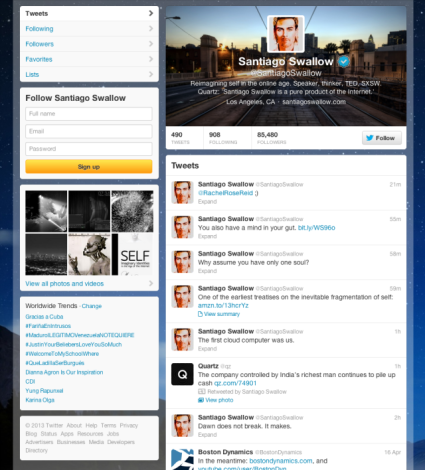
The secret of online celebrity Santiago Swallow.

1-bW2OsYaSSmgVV9TObfFCQA

Santiago Swallow may be one of the most famous people no one has heard of.

His eyes fume from his Twitter profile: he is Hollywood-handsome with high cheekbones and dirty blond, collar-length hair. Next to his name is one of social media”s most prized possessions, Twitter”s blue “verified account” checkmark. Beneath it are numbers to make many in the online world jealous: Santiago Swallow has tens of thousands of followers. The tweets Swallow sends them are cryptic nuggets of wisdom that unroll like scrolls from digital fortune cookies: “Before you lose weight, find hope,” says one. Another: “To write is to live endlessly.”

His Wikipedia biography explains why: Continue reading “Fame on a Budget”

Fake Marketing Company Announces Fake Naked Photos

Hoax instructional: How to deceive, deflect and scam the scandal hungry media and the all-believing public. Why? Just because.


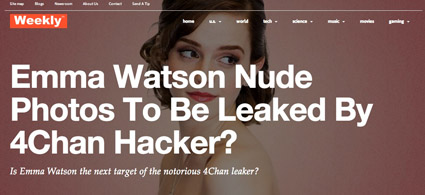
The Emma Watson Naked Photo Countdown Was The Work Of Serial Internet Hoaxers
by James Cook
Business Insider
September 24, 2014

A mysterious countdown website emerged on Monday that hinted at the imminent reveal of naked photographs of the actress Emma Watson, stolen using the same iCloud vulnerability that hackers used to steal photographs of stars like Kate Upton and Jennifer Lawrence.

emma-watson-fake-leak-425

As Business Insider reported on Monday, it’s highly unlikely that anyone has naked photographs of Emma Watson (we probably would have seen them by now, because she’s a top target for iCloud hackers). Instead the site seemed like an obvious prank designed to discredit 4chan users.

Sure enough, when the countdown came to an end, the site redirected to the website of a company named Rantic Marketing, which appears to be a viral marketing agency. But here’s where this gets really interesting: Rantic Marketing doesn’t exist. This wasn’t a marketing stunt at all, but a social experiment run by the most notorious gang of pranksters on the internet.

Continue reading “Fake Marketing Company Announces Fake Naked Photos”

Flappybird Photo Hijack

In case you think the risque photos on your Android phone are secure…


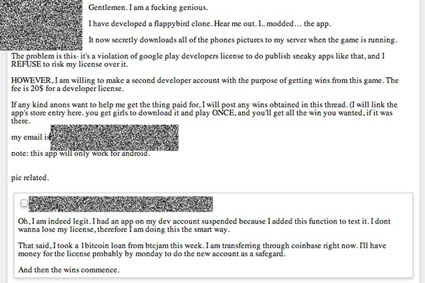
Hackers plotted fake Flappy Bird app to steal girls” photos from Android phones
by Graham Cluley
September 6, 2014

Next time you install an app on your phone, you”d best think twice if it asks permission to access your photos.

As The Guardian reports, following a tweet from security researcher Nik Cubrilovic, the very same hackers who merrily collected naked photos of more than 100 female celebrities, including Oscar-winning actress Jennifer Lawrence, had plotted a variety of dirty tricks to increase their haul.

At least one hacker openly posted on the AnonIB image board, proposing what he called a “genious” idea: Continue reading “Flappybird Photo Hijack”

“Perfect” Fake

Over 7M views for “29 Celebrity Impressions, 1 Original Song”, by Rob Cantor. Only .5M checked out how the other 6.5M got faked out.


The Guy Perfectly Impersonating 29 Celebrities While Singing An Original Song Is A Fake
by Liat Kornowski
The Huffington Post
July 10, 2014

Remember this incredibly impressive video that popped up all over your Facebook feed earlier this month? You know the one, where one guy does 29 celebrity impressions while singing his original song, “Perfect.” The one that amassed nearly seven million views in under two weeks.

Watch the videos:

Well, this guy, with all his mighty talent and Billie Holiday imitation, is a fake… Rob Cantor, the man behind this well-orchestrated Internet hoax, posted yet another YouTube video Wednesday, July 9, explaining the workings behind the scenes. Read more here.