LiteratEye #3: Really Great Sermon, Sir; Could I Have Your Autograph?

Here’s the third installment of LiteratEye, a new series, only on The Art of the Prank Blog, by W.J. Elvin III, editor and publisher of FIONA: Mysteries & Curiosities of Literary Fraud & Folly and the LitFraud blog.

And, as an added treat, here’s an article about author, W.J. Elvin III, from the Cumberland Times-News that appeared this week.


LiteratEye #3: Really Great Sermon, Sir; Could I Have Your Autograph?
By W.J. Elvin III
February 27, 2009
jesus-autograph-200

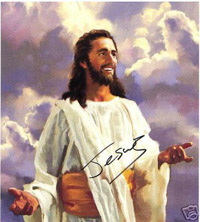
It began with an innocent question posed on one of the “ask the expert” sites. Someone wanted to know the value of a Superman autograph. The kindly expert explained that Superman was a fictitious character, and that there might be some value to autographs of persons who had played the role.

That got me thinking about fictitious autographs. Not fake autographs of real people but those of, say, Sherlock Holmes or Paul Bunyon or Nancy Drew. I wondered if anyone had tried to sell such a thing.

I asked around. Oddly, the name that came up most often from dealers was “Jesus.”

Now, that poses a dilemma. Continue reading “LiteratEye #3: Really Great Sermon, Sir; Could I Have Your Autograph?”

Amen to the First Amendment

Missing atheist sign found in Washington state
by Mallory Simon
CNN
December 5, 2008

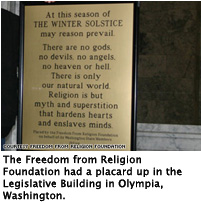
An atheist sign criticizing Christianity that was erected alongside a Nativity scene was taken from the Legislative Building in Olympia, Washington, on Friday and later found in a ditch.

An employee from country radio station KMPS-FM in Seattle told CNN the sign was dropped off at the station by someone who found it in a ditch.

“I thought it would be safe,” Freedom From Religion Foundation co-founder Annie Laurie Gaylor told CNN earlier Friday. “It’s always a shock when your sign is censored or stolen or mutilated. It’s not something you get used to.”

The sign, which celebrates the winter solstice, has had some residents and Christian organizations calling atheists Scrooges because they said it was attacking the celebration of Jesus Christ’s birth.

“Religion is but myth and superstition that hardens hearts and enslaves minds,” the sign from the Freedom From Religion Foundation says in part.

The sign, which was at the Legislative Building at 6:30 a.m. PT, was gone by 7:30 a.m., Gaylor said. Continue reading “Amen to the First Amendment”

This Bud’s For You

Flower Getting Plenty of Attention in Queens
1010WINS
October 22, 2008

New York — There’s plenty of attention being paid to a purple flower growing in the backyard of a house in Jamaica, Queens.

Homeowner Sam Lal said he believes the nearly 4-foot tall flower, shaped like an elephant’s head, is the incarnation of the Hindu God Ganesh.

Since the flower sprouted in June, Lal said he’s gotten relief from neck and back pain. Lal says word has spread in the Hindu community and the faithful have been showing up at his home.

Experts at the Queens Botanical Garden say the plant is native to India, Africa, and Southern Central America. Horticulturalists at the garden said they’ve never seen an amaranth take an elephant-like shape.

Friends and neighbors have already streamed to his 90th Ave. home to see the flower, and Lal said he’d welcome pilgrimages by Hindu faithful.

Prosperity Gospel: Be Careful What You Pray For

Foreclosures: Did God Want You to Get That Mortgage?
by David Van Biema
Time.com
October 3, 2008

Has the so-called Prosperity gospel turned its followers into some of the most willing participants “” and hence, victims “” of the current financial crisis? That’s what a scholar of the fast-growing brand of Pentecostal Christianity believes. While researching a book on black televangelism, says Jonathan Walton, a religion professor at the University of California at Riverside, he realized that Prosperity’s central promise “” that God will “make a way” for poor people to enjoy the better things in life “” had developed an additional, dangerous expression during the subprime-lending boom. Walton says that this encouraged congregants who got dicey mortgages to believe “God caused the bank to ignore my credit score and blessed me with my first house.” The results, he says, “were disastrous, because they pretty much turned parishioners into prey for greedy brokers.”

Others think he may be right. Says Anthea Butler, an expert in Pentecostalism at the University of Rochester in New York: “The pastor’s not gonna say, ‘Go down to Wachovia and get a loan,’ but I have heard, ‘Even if you have a poor credit rating, God can still bless you “” if you put some faith out there [that is, make a big donation to the church], you’ll get that house or that car or that apartment.’ ” Adds J. Lee Grady, editor of the magazine Charisma: “It definitely goes on, that a preacher might say, ‘If you give this offering, God will give you a house.’ And if they did get the house, people did think that it was an answer to prayer, when in fact it was really bad banking policy.” If so, the situation offers a look at how a native-born faith built partially on American economic optimism entered into a toxic symbiosis with a pathological market. Continue reading “Prosperity Gospel: Be Careful What You Pray For”

Randy Pausch, Pioneer of Virtual Reality Research, R.I.P.

Editor’s note: A video of Randy Pausch’s last lecture Really Achieving Your Childhood Dreams, at Carnegie Mellon, given September 18, 2007 before a packed McConomy Auditorium, is embedded below.


Randy Pausch Inspired Millions
Carnegie Mellon University
July 25, 2008

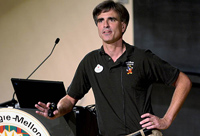
Randy PauschPittsburgh (AP) — Randy Pausch, the professor at Carnegie Mellon University who inspired countless students in the classroom and others worldwide through his highly acclaimed last lecture, has died of complications from pancreatic cancer. He was 47.

Also a Carnegie Mellon alumnus, Pausch co-founded the Entertainment Technology Center and led researchers who created Alice, a revolutionary way to teach computer programming. He was widely respected in academic circles for a unique interdisciplinary approach, bringing together artists, dramatists and designers to break new ground by working in collaboration with computer scientists.

Outside the classroom, he gained public fame for delivering what would come to be known as “The Last Lecture.” On Sept. 18, 2007, only a month after doctors told him that he had three-to-six months to live following a recurrence of pancreatic cancer, he presented a lecture called “Really Achieving Your Childhood Dreams” to a packed auditorium at Carnegie Mellon. Continue reading “Randy Pausch, Pioneer of Virtual Reality Research, R.I.P.”