Comedian Lee Camp Deconstructs New York Times Hatchet Job

Lee Camp, comedian, writer and creator, host, and head writer of the comedy news show Redacted Tonight gives a propaganda tutorial based on the hatchet job The New York Times did on him. H/T to Boris.


Lee Camp: How to Write Propaganda for the NY Times””As Demonstrated in an Article About Me
by Lee Camp
Alternet.org
June 13, 2017

The comedian debunks the lies and distortions spread about him in the New York Times.

On June 7, the New York Times vomited up a hit piece on little ol” me – a guy who has been doing stand-up comedy for nearly 20 years and thought maybe that comedy could be used to inform and inspire audiences, rather than just make fun of the differences between men and women.

At first when you”re the center of a smear job, you”re annoyed and frustrated. But as I read further through the piece, I realized it was a master class in how to write propaganda for one of the most “respected” news outlets in our country. I”m actually grateful it was written about me because now I can see with my own eyes exactly how the glorious chicanery is done. I count no less than 15 lies, manipulations, and false implications in this short article, a score that even our fearless prevaricator-in-chief Donald Trump would envy.

So here now is a “How To” for writing propaganda for the New York Times, using the smear piece against me as an example. Read the full article here.

First Responders to BS: Fact-Checkers are Heroes for Our Times

Like at Snopes, the team at Politifact has its work cut out for it. Here’s a rousing rant from editor Aaron Sharockman.


“PolitiFact: The Power of Fact Checking in a Post-Truth World”
by Aaron Sharockman
Tampa Bay Times
June 7, 2017
Here’s a quick test: Think about how Donald Trump announced he was running for president. Now, do the same for Hillary Clinton.
I think most of you probably got one but not the other. We remember Trump and his wife Melania gliding down the Trump Tower escalator in June 2015. And we remember some of the things Trump said that day.

“When Mexico sends its people, they’re not sending their best. They’re not sending you. They’re not sending you,” Trump said. “They’re sending people that have lots of problems, and they’re bringing those problems with us. They’re bringing drugs. They’re bringing crime. They’re rapists. And some, I assume, are good people.”

As for Clinton? Continue reading “First Responders to BS: Fact-Checkers are Heroes for Our Times”

From Russian Satire to Serious (but Fake) News–a Flowchart

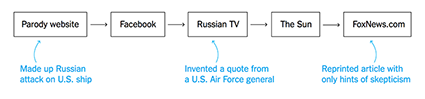
The NYT tracks an item from a Russian satirist to FOX News.


How Russian Propaganda Spread From a Parody Website to FOX News
by Neil MacFarquhar and Andrew Rossback
The New York Times
June 7, 2017

Born in the shadowy reaches of the internet, most fake news stories prove impossible to trace to their origin. But researchers at the Atlantic Council, a think tank, excavated the root of one such fake story, involving an incident in the Black Sea in which a Russian warplane repeatedly buzzed a United States Navy destroyer, the Donald Cook.

Like much fake news, the story was based on a kernel of truth. The brief, tense confrontation happened on April 12, 2014, and the Pentagon issued a statement. Then in April, three years later, the story resurfaced, completely twisted, on one of Russia”s main state-run TV news programs.

The new version gloated that the warplane had deployed an electronic weapon to disable all operating systems aboard the Cook. That was false, but it soon spread, showing that even with all the global attention on combating fake news, it could still circulate with alarming speed and ease.

In the days after the incident in the Black Sea, a Russian writer named Dmitri Sedov wrote an opinion piece, apparently meant to be satirical, that imagined the incident as an electronic warfare attack and described the panicked reaction of one crew member. Read the rest of the story here.


Not #FakeNews, But an Incredible Simulation

A new video game brings your republic-wrecking fantasies to life.


If you were for some reason dying to play a video game about fake news, it’s here now
by Marissa Wenzke
Mashable
March 27, 2017

This fake news simulator is the depressing video game America deserves

It’s something that’s come to be reviled, the very thing that may have cost America a presidential election “” fake news.

And the horrible phenomenon that’s been called out by everyone from former President Barack Obama to Apple CEO Tim Cook now has a video game all about it.

Yes, you can actually climb inside the minds of real-life humans who distribute lies for money. Fake It to Make It describes itself as “a social impact game about fake news.”

By that definition, it’s less a celebration of fake news and more a socially conscious dissection of it. Well, that’s at least what it’s intended to be, as its creator Amanda Warner explains.

“I think that better understanding how and why we are manipulated by others, for profit or power, is worthwhile knowledge to have,” she told The Verge.

The game takes you through a journey that mirrors the stories of real-life fake news creators. For instance, it starts by asking you to choose a purchase you want to make, like a $1,000 used car or $400 for a deposit on an apartment (deals we think questionably exist IRL). Read more.


The Full Dossier on the Right’s New Radical Kingmakers

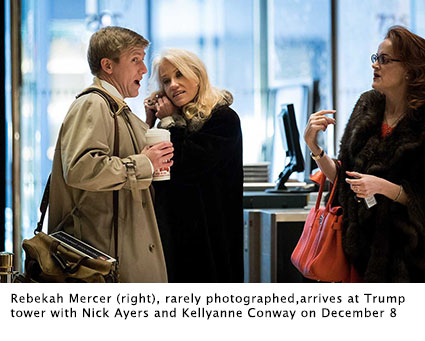
Donald Trump rose to power as a candidate in service to the people. Specifically, two of them: eccentric billionaire Robert Mercer and his daughter Rebekah. This essential long read goes deep into their background, motivations, and historically destructive power.


“The Blow-it-all-up Billionaires”
by Vicky Ward
The Huffington Post Highline
March 17, 2017

Last December, about a month before Donald Trump”s inauguration, Rebekah Mercer arrived at Stephen Bannon”s office in Trump Tower, wearing a cape over a fur-trimmed dress and her distinctive diamond-studded glasses. Tall and imposing, Rebekah, known to close friends as Bekah, is the 43-year-old daughter of the reclusive billionaire Robert Mercer. If Trump was an unexpected victor, the Mercers were unexpected kingmakers. More established names in Republican politics, such as the Kochs and Paul Singer, had sat out the general election. But the Mercers had committed millions of dollars to a campaign that often seemed beyond salvaging.

That support partly explains how Rebekah secured a spot on the executive committee of the Trump transition team. She was the only megadonor to frequent Bannon”s sanctum, a characteristically bare-bones space containing little more than a whiteboard, a refrigerator and a conference table. Unlike the other offices, it also had a curtain so no one could see what was happening inside. Before this point, Rebekah”s resume had consisted of a brief run trading stocks and bonds (including at her father”s hedge fund), a longer stint running her family”s foundation and, along with her two sisters, the management of an online gourmet cookie shop called Ruby et Violette. Now, she was compiling lists of potential candidates for a host of official positions, the foot soldiers who would remake (or unmake) the United States government in Trump”s image. Read more.