More from Moore

From CommonDreams.org, July 6, 2007:

sicko-poster-425200.jpgBlueCross Secret Memo Re: ‘Sicko’
by Michael Moore

Friends,

An employee who works at Capital BlueCross has sent us a confidential memo written and circulated by its Vice President of Corporate Communications, Barclay Fitzpatrick. His job, it seems, was to go and watch “Sicko,” observe the audience’s reaction, and then suggest a plan of action for how to deal with the movie. [Ed: You can watch a “Sicko” movie trailer at the end of this post.]

The memo, which I am releasing publicly in this email, is a fascinating look at how one health care company views “Sicko” – and what it fears its larger impact will be on the public. The industry’s only hope, the memo seems to indicate, is if the movie “flops.” Continue reading “More from Moore”

Wild over Wilde

When six original Oscar Wilde manuscripts surfaced in New York in April, they were expected to fetch hundreds of thousands of dollars. But soon doubts were cast on their authenticity “” and a dark tale emerged of greed, forgery and foul play stretching back to the 1920s. Anthony Gardner reports

www.nndb.com/people/459/000022393/

The Oscar sinners
by Anthony Gardner
The Sunday Times
July 8, 2007

The New York Antiquarian Book Fair is the most exciting event of its kind in the world. This year”s, held in a hall on Park Avenue, drew a particularly glamorous crowd, following a pronouncement in American Vogue that book-collecting was the fashionable hobby of the moment. Among the works for sale were a fourth folio of Shakespeare”s plays and a first edition of Frankenstein; but for curiosity, little could compete with the three leather-bound volumes being touted in that last week of April by the owner of a small shop in Greenwich Village.

Doing the rounds of the dealers” stalls, Kim Herzinger explained that the volumes contained six Oscar Wilde manuscripts recently inherited by one of his clients. Here in the Irish genius”s own hand were the opening of A Woman of No Importance; a fragment of another play, never published or produced; a letter; a poem; the essay The Tomb of Keats. Most exciting of all, the cache included the manuscript of one of Wilde”s best-loved stories, The Happy Prince, which even if sold separately could be expected to fetch £200,000 or more – provided it was genuine. Continue reading “Wild over Wilde”

Beware. Don’t go from pearly whites to the pearly gates

Bogus Toothpaste Now in 6 States, Canada
by Andrew Bridges
Associated Press

http://doctoranonymous.blogspot.com/2007_05_01_archive.htmlWashington (AP) — Counterfeit Colgate toothpaste has now turned up in Canada, where testing has found dangerous bacteria but not the poisonous chemical previously detected in four states, a health official said Saturday.

In addition, store owners and police say they have discovered that the bogus Colgate was sold in Michigan and Virginia.

The FDA warned earlier in June that fake Colgate distributed in Maryland, New York, New Jersey and Pennsylvania may contain a poisonous chemical called diethylene glycol, or DEG, that typically is used in antifreeze. That toothpaste was the subject of a June 13 recall by a New Jersey distributor… Continue reading “Beware. Don’t go from pearly whites to the pearly gates”

It takes a thief…

Book review:

Art of Deception: Controlling the Human Element of Security
A Tour De Force Of Social Engineering Know How
With a forward by Steve Wozniak
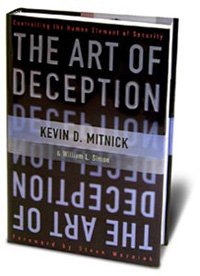
deception-mitnick200.jpgKevin Mitnick’s exploits as a cyber-desperado and fugitive from one of the most exhaustive FBI manhunts in history have spawned dozens of articles, books, films, and documentaries. Since his release from federal prison in 2000, Mitnick has turned his life around and established himself as one of the most sought-after computer security experts worldwide. Now, in The Art Of Deception, the world’s most famous hacker gives new meaning to the old adage, “It takes a thief to catch a thief.”

Inviting you into the complex mind of the hacker, Mitnick provides realistic scenarios of cons, swindles, and social engineering attacks on business – and the consequences. Focusing on the human factors involved with information security, Mitnick explains why all the firewalls and encryption protocols in the world will never be enough to stop a savvy grifter intent on rifling a corporate database or an irate employee determined to crash a system. He illustrates just how susceptible even the most locked-down information systems are to a determined con artist impersonating an IRS agent or any other seemingly innocent character. Narrated from the points of view of both the attacker and the victim, The Art Of Deception explores why each attack was so successful – and how it could have been averted – in an engaging and highly readable manner reminiscent of a true-crime novel.

Most importantly, Mitnick redeems his former life of crime by providing specific guidelines for developing protocols, training programs, and manuals to ensure that a company’s sophisticated technical security investment will not be for naught. He shares his advice for preventing security vulnerability in the hope that people will be mindfully on guard for an attack from the gravest risk of all – human nature.

From ThinkGeek
From Salt Shaker to Salt Peter

What not to do:

cellinis-saltcellar-small200.jpg‘Gentleman burglar’ jailed for art theft
June 26, 2007

Vienna – A man charged with the theft of a priceless 500-year-old baroque Saliera salt-cellar was sentenced to five years imprisonment on Tuesday in Austria’s most spectacular art-theft.

Robert Mang, a 51-year-old “gentleman burglar” had stolen the gold and enamel sculpture by Benvenuto Cellini from Vienna’s Fine Arts Museum in May 2003.

A Vienna court had handed down a four-year sentence to Mang, who became an instant celebrity in Austrian media. But in September 2006, Austria’s Supreme Court ruled the trial had to be repeated due to formal reasons.

The court took into account that Mang had no previous criminal history as well his confession when coming to a relatively lenient sentence for breaking and entering, burglary and attempted blackmail, the head judge said.

The Viennese security expert always maintained he had broken into the museum and stolen the inadequately guarded sculpture as a prank while drunk after a night partying in Vienna’s clubs. Continue reading “From Salt Shaker to Salt Peter”