
White House Email Prankster In His Own Words

Here’s a playful and illuminating interview with the anonymous prankster who humiliated Donald Trump’s powerful son-in-law Jared Kushner and ex-Communications Director Anthony Scaramucci with duplicitous emails. It touches on the literary merits of email pranks, the repercussions of sending them, and pointers for engaging recipients in high places.


“How to Prank the Rich and Powerful Without Really Trying”
by Adrianne Jeffries
The Outline
August 4, 2017

On Tuesday, a bright spot appeared in this dark, cruel world when CNN first reported that an anonymous mischief maker had tricked multiple White House officials into responding to prank emails.

The Email Prankster, as he”s branded himself, isn”t worried about getting in legal trouble, he told The Outline in an interview Thursday. He duped several high profile targets earlier this year, including Barclay”s CEO Jes Staley, Goldman Sachs CEO Lloyd Blankfein, and Citigroup CEO Michael Corbat, and was not contacted by law enforcement.

He was, however, suspended from his job this morning. His company, which knew about the banker pranks, suspected he was involved in this latest round of hoaxes and opened an investigation. “I think they’ll get me on misuse of IT,” the prankster said. “I did send an email to the White House from my work email address because I forgot to switch the email account over in the drop down.”

It”s unclear if the prankster did anything illegal. He did no spoofing or hacking, and lawyers we spoke to in the U.S. and U.K. said it would be difficult to make a criminal case against him. The prankster merely registered addresses that looked semi-legitimate, such as reince.priebus@mail.com and jonhunstmanjr45@gmail.com, made sure his character”s name would show up in the “From” field, and thought up an intriguing subject line. He registered email addresses in the names of senior advisor Jared Kushner, Ambassador-to-Russia designate Jon Huntsman, former Chief of Staff Reince Priebus, Donald Trump Jr., and Eric Trump, and had them email various White House staff.

The highlight of these pranks was an exchange between the fake Reince Priebus, whose real counterpart had just been ousted, and then-White House Communications Director Anthony Scaramucci. The exchange, a testy back-and-forth that played on the real rivalry between the two men, ended with Scaramucci telling the person he thought was Priebus to, “Read Shakespeare. Particularly Othello.” Scaramucci was ousted the next day, and The Washington Post called the prank “a final indignity.” Read more.
Spectacle TV Without the Spectacle…

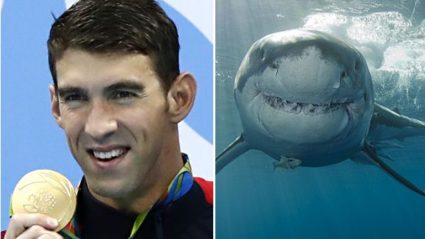
Olympian Michael Phelps unsurprisingly lost his Sunday race against a simulated great white shark.


“Twitter users blast Michael Phelps for not racing a real shark”
by Chris Perez
New York Post
July 24, 2017

Can you blame him?

Social media users were tearing Michael Phelps to shreds for his “race” against a Great White shark on Sunday night “” calling it a “scam” “” after he chose to swim side-by-side with a simulation, instead of the real thing.
“Don”t say Phelps is racing a shark if you”re not going to put him against an actual shark,”
tweeted Breyanna Davis, who was one of countless viewers to get confused over the way the televised swimming competition went down.

“So you mean to tell me Michael Phelps didn”t even race a real shark? It was just a simulation. I”m mad. More like Shark WEAK!” said Frank Costa.

User @M_Frosti added, “smh Michael Phelps isn”t actually racing a shark. He”s just racing a simulation of a shark. Biggest scam of 2017.” Read more.

“‘Right-wing news’ is oxymoronic”

With interesting clarity, Terry Heaton shows how he and other producers of Evangelical television used propaganda to seed the false narrative of the liberal “elite” news media and in the process created right-wing news and, ultimately, the Republican religious right. Now he wants to take it all back.


How The Religious Right Pioneered Propaganda As News
by Terry Heaton
HuffPost
June 16, 2017

Before Fox News, there was Pat Robertson”s “˜700 Club,” where I was an executive producer.

Television evangelist and conservative political activist Pat Robertson poses in the control room for his 700 Club TV show. (Photo by © Wally McNamee/CORBIS/Corbis via Getty Images)

So-called “fake news” took center stage on several occasions during former FBI Director James Comey”s testimony before the Senate Intelligence Committee last week. More than once, Comey pointed to specific articles by the New York Times as not true or completely false. However, he did validate others, including one in which he himself had been the Times” source. The fake news meme has become one of the most troubling arguments in the history of contemporary journalism, ever since Donald Trump used the term to describe CNN at his first press conference as president.

Americans find themselves drowning in this unseemly and childish battle for the soul of news and information purveyance, and the undiscussed problem is that the entire mess is built on the false narrative of “the liberal (elite) press.” I know, because I was among the people who advanced the concept and shaped the discussion in the early “˜80s, as senior and executive producer of Pat Robertson”s flagship television program The 700 Club.

Before Fox News, there was The 700 Club with CBN News and “TV Journalism With A Different Spirit.” We knew what we were doing in the exploitation of the word “liberal,” and truth-telling demands its deconstruction today. The all-or-nothing split between conflicting political narratives has reached its pinnacle with the election of Donald Trump, and it needs to be hacked into a million pieces.

William F. Buckley was among the first to give the word “liberal” a pejorative interpretation, but it was the wordsmith William Safire writing for Spiro Agnew who in 1969 elevated it to a political talking point in his famous speech that opened the war against the press during Richard Nixon”s secret battles in Vietnam. The word became the central weapon in a strategy that involved attacking the messenger instead of changing the message.

That political strategy has been so effective to date that it has given birth to the idea that mainstream news is actually “fake news” and not to be believed in the administration of President Donald Trump. The number of people who now believe this falsehood is staggering, and it poses a real threat to our democracy. Continue reading ““‘Right-wing news’ is oxymoronic””

First Responders to BS: Fact-Checkers are Heroes for Our Times

Like at Snopes, the team at Politifact has its work cut out for it. Here’s a rousing rant from editor Aaron Sharockman.


“PolitiFact: The Power of Fact Checking in a Post-Truth World”
by Aaron Sharockman
Tampa Bay Times
June 7, 2017
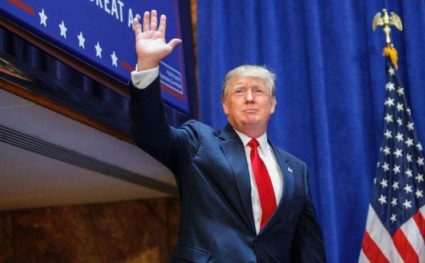
Here’s a quick test: Think about how Donald Trump announced he was running for president. Now, do the same for Hillary Clinton.
I think most of you probably got one but not the other. We remember Trump and his wife Melania gliding down the Trump Tower escalator in June 2015. And we remember some of the things Trump said that day.

“When Mexico sends its people, they’re not sending their best. They’re not sending you. They’re not sending you,” Trump said. “They’re sending people that have lots of problems, and they’re bringing those problems with us. They’re bringing drugs. They’re bringing crime. They’re rapists. And some, I assume, are good people.”

As for Clinton? Continue reading “First Responders to BS: Fact-Checkers are Heroes for Our Times”

From Russian Satire to Serious (but Fake) News–a Flowchart

The NYT tracks an item from a Russian satirist to FOX News.


How Russian Propaganda Spread From a Parody Website to FOX News
by Neil MacFarquhar and Andrew Rossback
The New York Times
June 7, 2017

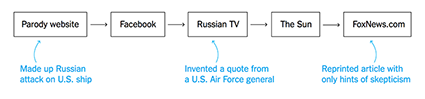
Born in the shadowy reaches of the internet, most fake news stories prove impossible to trace to their origin. But researchers at the Atlantic Council, a think tank, excavated the root of one such fake story, involving an incident in the Black Sea in which a Russian warplane repeatedly buzzed a United States Navy destroyer, the Donald Cook.

Like much fake news, the story was based on a kernel of truth. The brief, tense confrontation happened on April 12, 2014, and the Pentagon issued a statement. Then in April, three years later, the story resurfaced, completely twisted, on one of Russia”s main state-run TV news programs.

The new version gloated that the warplane had deployed an electronic weapon to disable all operating systems aboard the Cook. That was false, but it soon spread, showing that even with all the global attention on combating fake news, it could still circulate with alarming speed and ease.

In the days after the incident in the Black Sea, a Russian writer named Dmitri Sedov wrote an opinion piece, apparently meant to be satirical, that imagined the incident as an electronic warfare attack and described the panicked reaction of one crew member. Read the rest of the story here.