Here’s the twenty first installment of LiteratEye, a series found only on The Art of the Prank Blog, by W.J. Elvin III, editor and publisher of FIONA: Mysteries & Curiosities of Literary Fraud & Folly
LiteratEye #21: Crusading British Journalist Combats Stupidity
By W.J. Elvin III
July 10, 2009
 David Aaronovitch calls his new book “my war on stupidity.” Before dashing into the fray, it seemed prudent to figure which side I’m on. So I ordered the book.
“Voodoo Histories: The Role of the Conspiracy Theory in Shaping Modern History
So, over to the UK, where it was published. By golly, the outfit I ordered from there suddenly pulled out of the deal. Conspiracy, or what?
I finally got a copy, shipped from “¦ France?
Aaronovitch is a popular media heavy in Britain and has lots of admirers and friends who write or talk for money, so his book will probably sell well. Some of the reviews are so positive you’d think the reviewer wanted to cuddle up and kiss the guy.
He’s a former Communist who doesn’t seem to mind when described by his media mates as a hawkish leftist intellectual.
Aaronovitch explains that the reason some of us qualify as stupid is that we assume conspiracy when an event is really the result of accident or chance. Such beliefs are harmful because they distort reality and lead to “disastrous decisions.” Continue reading “LiteratEye #21: Crusading British Journalist Combats Stupidity”
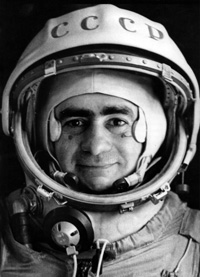 For this Project (1997), Fontcuberta fabricated a story about an evidence for a “Soyuz 2” mission involving cosmonaut Ivan Istochnikov. Soyuz 1, an actual Soviet space mission in 1967, had ended with the death of cosmonaut Vladimir Komarov when the spacecraft crashed on landing. In 1968, according to the fabricated story, “Istochnikov and his canine companion Kloka mysteriously vanished after leaving the [Soyuz 2] capsule for a routine space walk. When the Soyuz 3 arrived for a docking maneuver, it found only a vodka bottle containing a note, floating in orbit outside the empty, meteorite damaged ship.” To avoid embarrassment, Soviet officials deleted Istochnikov from official Soviet history; however, the “Sputnik Foundation” discovered Istochnikov’s “voice transcriptions, videos, original annotations, some of his personal effects, and photographs taken throughout his lifetime.” The exhibition of artifacts (e.g., photographs) related to “Soyuz 2” was shown in many countries, including Spain, France, Portugal, Italy, Mexico, Japan, and the United States. Among other reactions to the exhibition, a Russian ambassador “got extremely angry because [Fontcuberta] was insulting the glorious Russian past and threatened to present a diplomatic complaint.”
  San Francisco (AP) — The fast-moving Conficker computer worm, a scourge of the Internet that has infected at least 3 million PCs, is set to spring to life in a new way on Wednesday – April Fools’ Day.
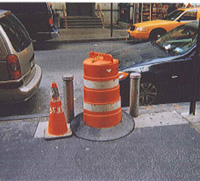 New York — A man who claimed a construction barrel was used to cover a New York City fire hydrant subjecting him to a $115 ticket has won his appeal and will get his fine refunded by the city.