
At a time of unspeakable tragedy, Russian propagandists and right wing conspiracy theorists work together to neutralize a rational, well-spoken high school student pleading for safe schools.
How the Florida school shooting conspiracies sprouted and spread
by Paul P. Murphy and Gianluca Mezzofiore
CNN
February 22, 2018
(CNN)Conspiracy theories after mass shootings follow a familiar thread and the Florida school shooting is no exception.
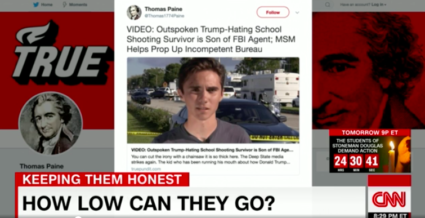
They originate in the dark corners of the internet — often from the 4chan “politically incorrect” board (abbreviated as /pol/) — and migrate onto social media platforms like Twitter, YouTube and Facebook from conservative pages, alt-right personalities, nationalist blogs and far-right pundits.
What drives hoaxes and conspiracy theorists is unclear. But their faith in the conspiracies they spread seems to be unwavering.
Less than an hour after the shooting at Marjory Stoneman Douglas High School in Parkland on February 14, Twitter accounts were claiming that eyewitnesses were “crisis actors.” The term refers to people who are paid to play disaster victims in emergency drills. More recently, though, the phrase has been co-opted by conspiracy theorists who claim mass shootings are events staged to achieve a political goal.
A CNN investigation into 4chan’s /pol/ archive counted at least 121 times that school shooting survivor David Hogg was mentioned on the board. Read the rest of this article here.
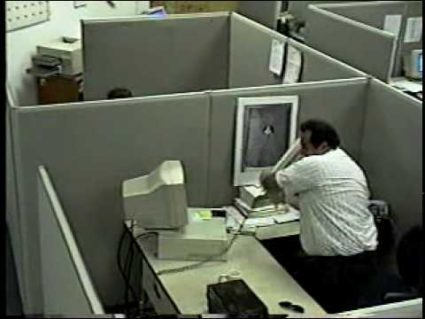 You’ve seen the video. Everyone on the internet has. A man sits in a cubicle and pounds his keyboard in frustration. A few seconds later, the Angry Man picks up the keyboard and swings it like a baseball bat at his screen””it”s an old PC from the ’90s, with a big CRT monitor””whacking it off the desk. A frightened coworker”s head pops up over the cubicle wall, just in time to watch the Angry Man get up and kick the monitor across the floor. Cut to black.
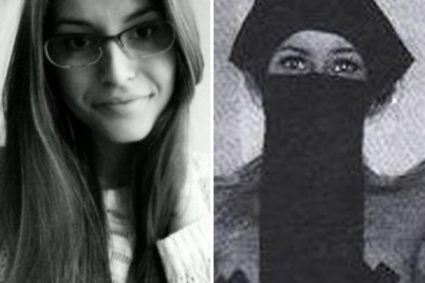 Jenna Abrams was a popular figure in right-wing social media circles. Boasting nearly 70,000 followers, Abrams was featured in numerous news articles during the 2016 election, spotlighted by outlets as varied as USA Today, the Washington Post, the BBC, and Yahoo! Sports. Her tweet about CNN airing porn during Anthony Bourdain”s show (it didn”t) was reported by numerous outlets.
 Anyone can be anybody from the other side of a screen: a Nigerian prince pleading for money; a lonely housewife “catfishing” a romantic interest; or a 14-year-old girl posing as just about anyone. From the “bonsai kitten” scandal of 2000 to the Lonelygirl15 “vlogs,” the internet has proved itself to be fertile ground for hoax-makers, scam artists, and digital charlatans.