Jumping the Snark
by Dave Gilson
Mother Jones
November/December 2009
In an age of Yes Men, flash mobs, birthers, and fake pundits, is the prank dead?
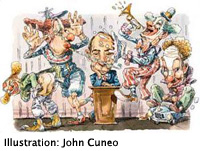 What’s a good prank worth? How about $2 billion? That’s how much Dow Chemical’s stock value dipped in just 23 minutes on the morning of December 3, 2004, after its spokesman went on the BBC to announce that the company would make amends for the 1984 Bhopal toxic-gas disaster “simply because it’s the right thing to do.” (Dow had acquired Union Carbide, the original owner of the Bhopal chemical plant, in 1999.) Within the hour, the flack was exposed as one of the Yes Men, a duo that’s spent the past decade perfecting the art of anti-corporate trickery. The feat cemented their reputation as the world’s preeminent political pranksters (a reputation they recently reaffirmed by pranking the US Chamber of Commerce). It also proved that a punch line can occasionally pack a real punch.
The Bhopal stunt kicks off the pair’s new film, The Yes Men Fix the World, the follow-up to their self-titled 2004 movie. But don’t let the puffed-up title fool you into thinking that the Yes Men believe their hijinks are actually making the world a better place. A better title would have been The Prank Is Dead. Continue reading “Jumping the Snark”
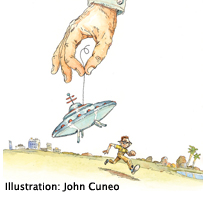 Here’s what you’ve been told: “There’s a sucker born every minute.” “Take or be taken.” “Believe none of what you hear and half of what you see.” These aphorisms are so ingrained in American life, they’re practically commandments. And for good reason: We are a credulous people. For proof, open your spam folder and count the chain emails from 1998 that are still coming in, dutifully forwarded by friends and relatives. Or consider that new Facebook pal whose name seemed familiar enough when you hit Confirm. We are, today, the same easy marks who ran screaming from Orson Welles’ made-up Martians and flocked to see the Cardiff Giant. So we’re defensive. A hoax, we are taught, is an invasive, aggressive stratagem””a nefarious short-circuiting of our natural social instincts, a hack of Trust itself, a deterministic, zero-sum shell game with a clear winner (the prankster) and loser (the gull).