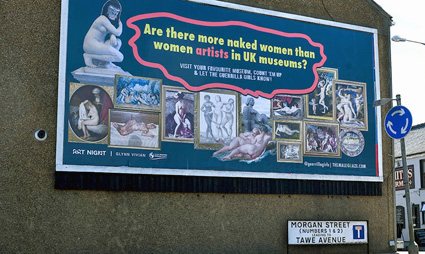
That’s the question posed by no-holds-barred activists The Guerrilla Girls in their latest assault on male behaviour in the arts
Pic credit: Rob Melen, Glynn Vivian Art Gallery, Swansea
GUERRILLA GIRLS, the anonymous group of US feminist female artists devoted to fighting sexism and racism within the art world, are bringing their unique form of “culture jamming” to billboard displays across Britain.
They formed in New York City in 1985 with the mission of highlighting gender and racial inequality in the visual arts community and, to remain anonymous, members don gorilla masks and use pseudonyms referencing deceased female artists.
Their latest project involves large-scale billboards across Britain in iconic locations from Glasgow Barrowlands to London Bridge, countryside locations and seaside towns until July 18.
They are part of The Male Graze which explores bad male behaviour through the lens of art history.
“What art historians call the male gaze, the masculine, heterosexual perspective in European and American art, mostly by white men, that depicts women as sexual objects for the pleasure of the male viewer, we call The Male Graze,” The Guerrilla Girls said.
“Lots of women are naked in post-colonial Western art. Some are idle: sleeping, splayed out on beds and couches, lounging around with their friends, bathing and maybe even dancing.
“When active, there is usually a sexual element present — voyeurism, seduction, harassment, assault, rape and sometimes murder.
When media literacy and critical thinking are absent, the world becomes a much more dangerous place. Check out this very illuminating Buzzfeed link as well (in the 2nd paragraph below).
An anonymous left-wing art group known in the 1990s as Luther Blissett are wondering what they have unwittingly helped create
Q, the 1999 novel by the anonymous Italian art collective Luther Blissett, has notable similarities with the workings of QAnon
As the US Capitol was overwhelmed by Donald Trump supporters in early January, one figure stood out: with his painted face, bare chest, fur hat and American flag-draped spear, Jake Angeli became one of the most photographed rioters of the day. He is also known as the “QAnon Shaman” and has been seen waving a “Q sent me” placard in other protests.
QAnon is America’s most dangerous conspiracy theory, and if you pull hard enough on its threads, the whole tangled mess lands, somehow, at the feet of a group of Italian artists. It might sound like a conspiracy within a conspiracy, but, as Buzzfeed first reported in 2018, chances are that QAnon, at the start at least, took inspiration from an amorphous organisation of leftist artists who, for most of the mid-1990s, called themselves Luther Blissett after the 1980s English footballer.
They used the Watford and England striker’s name as a nom de plume, perpetrating countless media hoaxes, pranks and art interventions. They started raves on trams that turned into riots, they released albums, wrote books and manifestos, they mocked, questioned and undermined the mainstream, and they grew and grew until hundreds of people around the world were calling themselves Luther Blissett.
In the process, with their media-jamming hoaxes, they helped lay the groundwork for QAnon, a conspiracy theory about a secret satanic cabal of child abusers which controls the world. During the 2016 presidential elections, it famously gave rise to the rumour that Hillary Clinton ran a paedophile ring in a pizza parlour, Comet Ping Pong. More recently, QAnon has become a mainstay of far-right protests and riots, including the US Capitol insurrection. Continue reading “A Look at the Probable Genesis of QAnon”
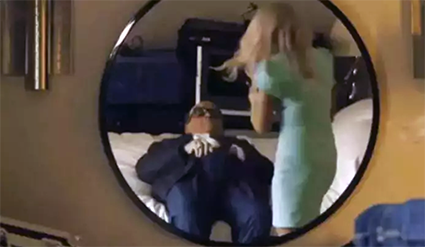
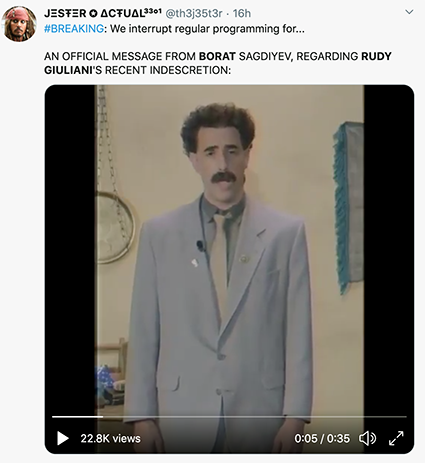
A scene in Sacha Baron Cohen’s news movie “Borat Subsequent Moviefilm” exposes Rudy Giuliani, ex-Mayor of New York and Donald Trump’s personal attorney, in a compromising position. He makes a play for a sexy young journalist who is interviewing him and gets caught on film appearing to put his hand down his pants. Rudy says he was just tucking in his shirt.
Homo Velamine: The increase of fake news in the media in recent years makes us feel that the limits between fact and fiction are more unclear than ever. In the documentary Art of the Prank (2015), you let the viewer peek into the creative process behind one of your hoaxes. The trickiest part seems to be deciding how far you can take it, without crossing the limits of plausibility and creating something that is impossible to believe. After all these years, does it still surprise you how far this limit can actually be pushed? Which of your performances would you say has pushed this limit the farthest and still has been successful?
Joey Skaggs: Pushing the limits of plausibility is the fun part for me. I create the problem and I create the solution. I take a gamble that what I’m doing is so ridiculous that no one’s going to believe it. I want it to be totally absurd because if the news media does fall for it, it will be even funnier and more effective in revealing their gullibility and/or hypocrisy. Continue reading “Homo Velamine Interviews Joey Skaggs “Maestro of the Farce” [Spanish and English]”