Spencer Pelton, the State Archeologist from Wyoming, has written a compelling history of what happens when today’s values don’t match yesterday’s intent.
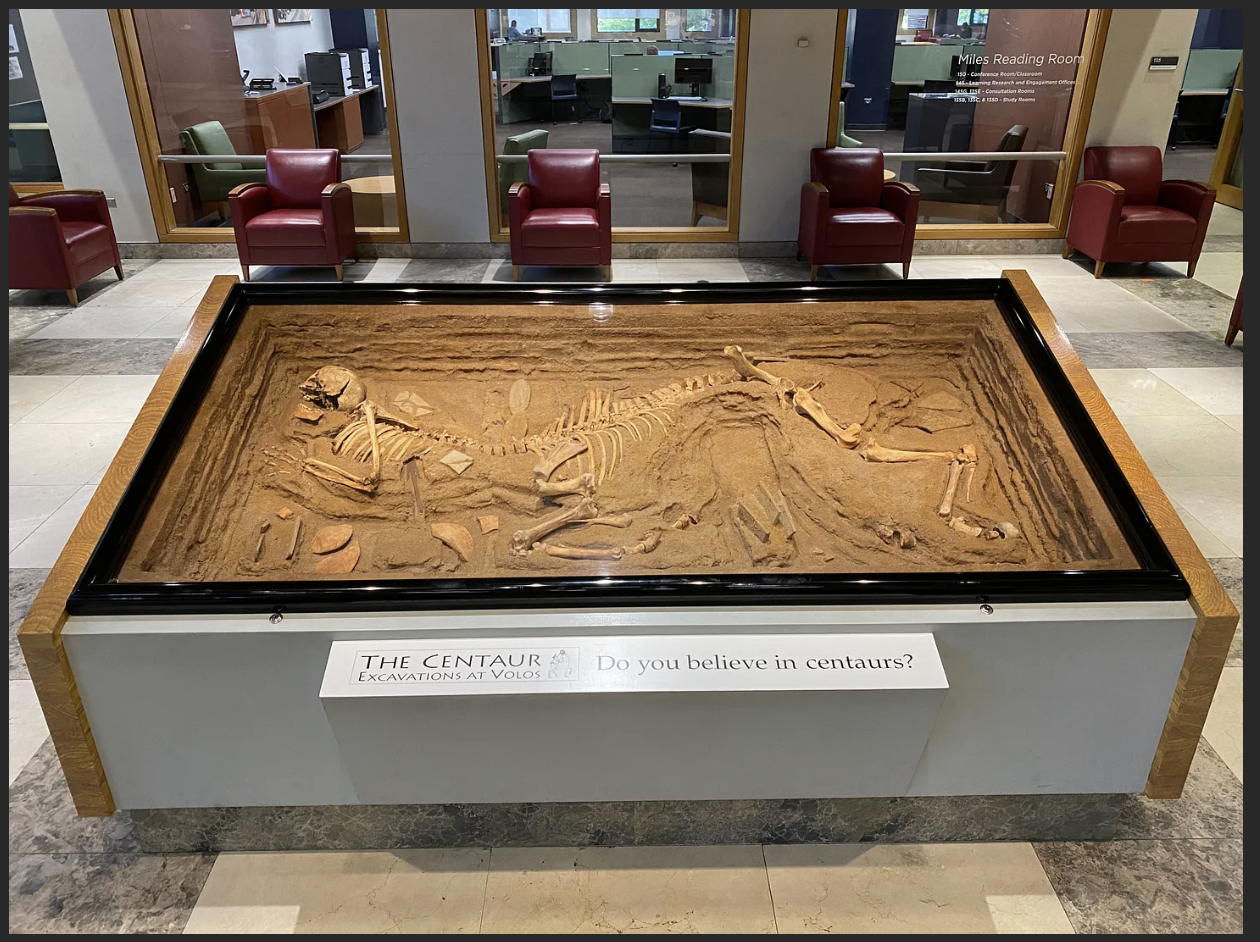
In 1980, archaeologists working near the shores of the Aegean Sea uncovered a remarkable find. Peeling back layers of sediment in an ancient necropolis, they first encountered the head of an ancient Grecian man, mouth agape as if surprised to have been awoken from an ancient slumber. They traced the neck further down his body, gently brushing away sediment from the convoluted contours of the vertebrae, finding arms where arms should be and shoulder blades the same. But as they continued, the man’s character changed. Where there should be a pelvis, there was more spine, and then second sets of ribs and legs, not altogether human. As the archaeologists brushed the final bits of sediment from a third set of legs, the shocking reality of their discovery came into focus. The mythical centaur of old Greece, entombed with a modest assemblage of tablets and vessels for over 3,000 years.
This is, of course, not true. But it is an accurate description of The Centaur Excavations at Volos, an art installation located until recently for 30 years in the lobby of the University of Tennessee’s (UT) Hodges Library. I visited The Centaur many times growing up around UT’s campus. As a young child, I’m pretty sure I believed it. As a teen, I scoffed at those fooled by it. And later, I came to appreciate the piece for its ability to inspire curiosity and conversation. Read the whole article here.
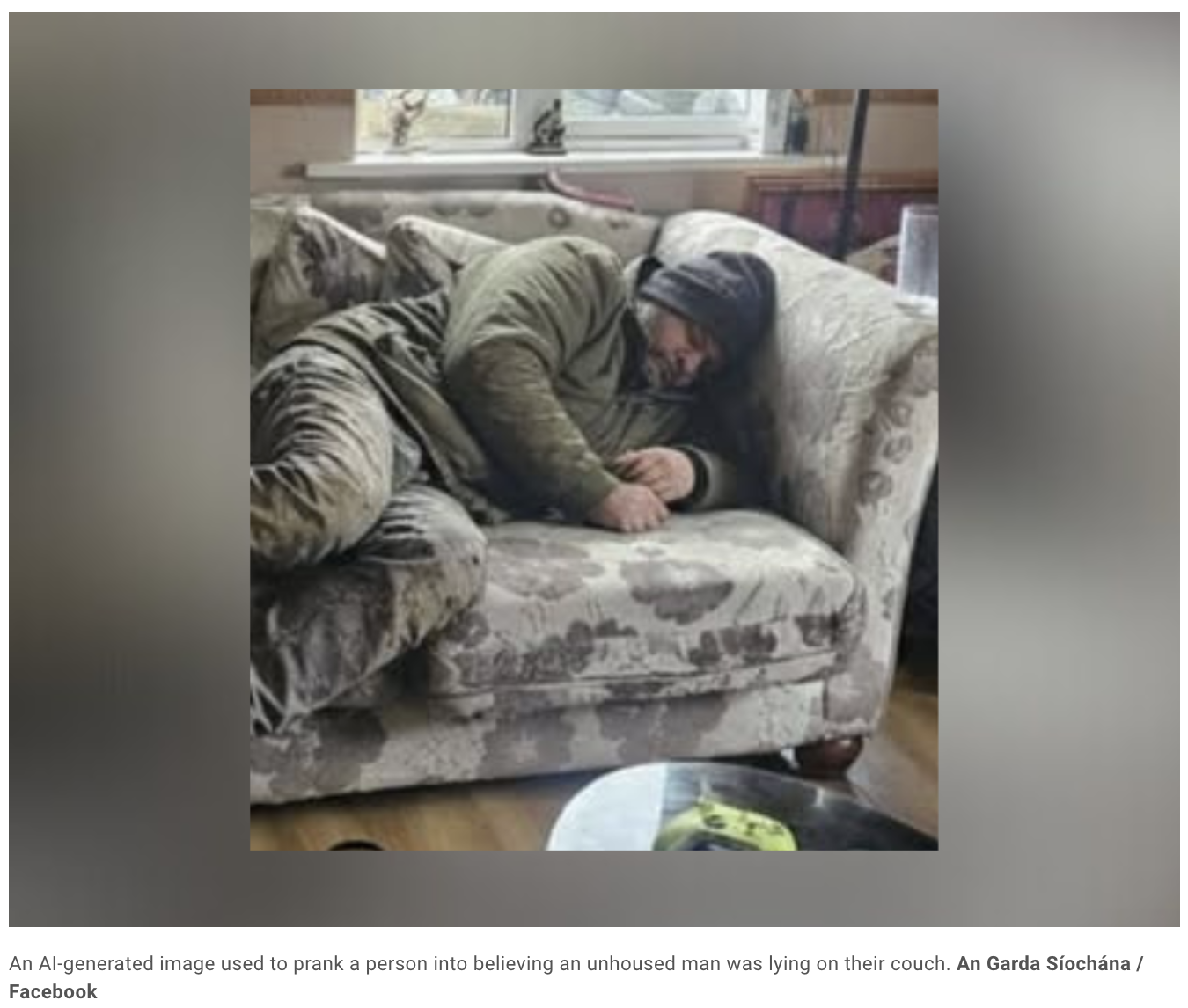
The new TikTok trend “AI Homeless Man Prank” has sparked a wave of outrage and police responses in the United States and beyond.
The prank involves using AI image generators to create realistic photos depicting fake homeless people appearing to be at someone’s door or inside their home. Learning to distinguish between truth and falsehood is not the only challenge society faces in the AI era. We must also reflect on the human consequences of what we create.
As professors of educational technology at Laval University and education and innovation at Concordia University, we study how to strengthen human agency — the ability to consciously understand, question and transform environments shaped by artificial intelligence and synthetic media — to counter disinformation. Read the whole article here.
Traveling into or out of the United States (and want to be able to travel without the fear of deportation)? Show the authorities that your online activity from the past five years has been pre-screened and approved.
Print your customizable Social Media Compliance Certificate, by artist Joey Skaggs, and keep it with your passport and other important travel documents.
In the past few months, at least three of Joey Skaggs’ classic performance works have mysteriously resurfaced—-minus the credit, the context, and, of course, the artist himself. From Elon Musk promising to replace judges and juries with his Grok AI, to a TikTok “influencer” teaching New Yorkers how to walk politely, to a national law firm resurrecting The Fat Squad to sell legal services—Skaggs’ art seems to have been reborn through the copy machine of culture.
If plagiarism is the sincerest form of flattery, Joey must be the most loved man in America.
But underneath the irony lies a serious question: as artificial intelligence devours the world’s creative work—scraping, remixing, and regurgitating ideas at scale—what content ownership will artists be left with? Who gets to claim the joke when everyone’s telling it?
Skaggs has spent his life exposing how easily truth can be twisted, and how the media loves a good story—whether it’s real or not. Now, his work is living proof that in the age of AI and viral mimicry, even satire can’t escape being swallowed whole.
So, here’s to keeping art human, authorship honest, and mischief original.
IN THE COURT OF PUBLIC OPINION
JOEY SKAGGS,
Plaintiff,
v. MORGAN & MORGAN,
Defendant.
COMPLAINT FOR MISAPPROPRIATION OF UNAUTHORIZED SATIRE AND CULTURAL DILUTION
New York, NY — Artist, satirist, and cultural saboteur Joey Skaggs today filed a lawsuit in the Court of Public Opinion against America’s largest personal injury law firm Morgan & Morgan for shamelessly swiping his legendary Fat Squad media hoax and stuffing it into their latest commercial.
For the record, The Fat Squad (est. 1986) was a groundbreaking internationally successful performance art hoax in which comandos were contracted to guard dieters around the clock — tackling them away from Twinkies, escorting them past buffets, and yelling “Drop that donut!” before it hit their lips. It is memorialized in both Andrea Marini’s “Art of the Prank” documentary and Joey Skaggs’ Oral History film series.
Joey Skaggs: The Fat Squad tease:
Morgan & Morgan’s new ad? Blatantly similar — but with all the calories of satire burned off.
THE FACTS
Plaintiff conceived, developed, and performed The Fat Squad decades before TikTok, meme culture, or commercial law firms decided satire was good for business.
On or about August 1, 2025, Defendant released a commercial campaign which bears obvious similarity to Plaintiff’s original work.
Said commercial paraded themes, images, and absurdities long perfected by Plaintiff, without acknowledgment, credit, or the faintest wink of irony.
Defendant thereby committed cultural plagiarism in the first degree, profiting from the very social critique Plaintiff pioneered.
THE CHARGES
Count I:Cultural Grand Theft Satire
Defendant unlawfully adopted Plaintiff’s absurdist concept without permission, thereby reducing art to advertising.
Count II:Unwarranted Enrichment by Unjust Laughter
Defendant profited from a concept that wasn’t theirs, without even a courtesy “tip of the wig.”
Count III:Infliction of Mental Distress
Defendant forced Mr. Skaggs to endure the trauma of watching his biting social critique watered down into a punchline for legal fees. Symptoms include ironic groaning, eye-rolling, and muttering “I did it first” into the void.
DAMAGES DEMANDED
Plaintiff demands compensation in the form of:
A public confession from Morgan & Morgan, aired during the Super Bowl halftime, admitting Joey Skaggs is funnier than their entire marketing department.
Mandatory enrollment of at least one Morgan & Morgan attorney into the actual Fat Squad program, including midnight refrigerator raids and fast-food stakeouts.
Punitive damages: Morgan & Morgan agrees to provide lifetime pro bono representation for Joey Skaggs—and any other artists who suffer theft of creative concepts, whether analog or AI, in perpetuity.
PLAINTIFF’S STATEMENT
“When I created The Fat Squad, it was to satirize America’s obsession with weight control, and consumer excess. To see a law firm steal it and call it comedy? That’s not just plagiarism. That’s malpractice. Artistic malpractice.” —Joey Skaggs, Satirist-Still-At-Large
CONCLUSION
The Fat Squad doesn’t forgive. The Fat Squad doesn’t forget. And if Morgan & Morgan thinks they can out-satire Joey Skaggs… well, let’s just say the Court of Public Opinion is always in session, and the jury is already laughing.
“During a truly informative TED talk, Professor Hany Farid of UC Berkeley shared his expertise as a digital forensics expert to give helpful tips in spotting whether or not an image was AI generated.
Digital forensics expert Hany Farid explains how he helps journalists, courts and governments find structural errors in AI-generated images, offering four practical tips everyday individuals can use when facing the internet’s war on reality.
Farid explains how AI does not understand the physics, geometry and other real world issues, so it will inevitably make mistakes in perspective, an anomaly that can be tracked. One such error is that of the vanishing point, in which parallel lines, such as railroad tracks, will seem to converge the further it is away from the eye.