Backlash to Forward Motion

Sometimes a red balloon is an egg…


Data poisoning: how artists are sabotaging AI to take revenge on image generators, by T.J. Thomson, The Conversation, December 17, 2023

Imagine this. You need an image of a balloon for a work presentation and turn to a text-to-image generator, like Midjourney or DALL-E, to create a suitable image.

You enter the prompt: “red balloon against a blue sky” but the generator returns an image of an egg instead. You try again but this time, the generator shows an image of a watermelon.

What’s going on?

The generator you’re using may have been “poisoned”.

Read the whole article here.

Who’s Your Daddy? Supreme Court Sits in Judgement on Fair Use

Fair Use is at the Supreme Court with potentially huge transformative consequences to artists on both sides of the issue.


The Supreme Court meets Andy Warhol, Prince and a case that could threaten creativity, Nina Totenberg, NPR’s All Things Considered, October 12, 2022

You know all those famous Andy Warhol silk screen prints of Marilyn Monroe and Liz Taylor and lots of other glitterati? Now one of the most famous of these, the Prince series, is at the heart of a case the Supreme Court will examine… And it is a case of enormous importance to all manner of artists. Read the whole article here.

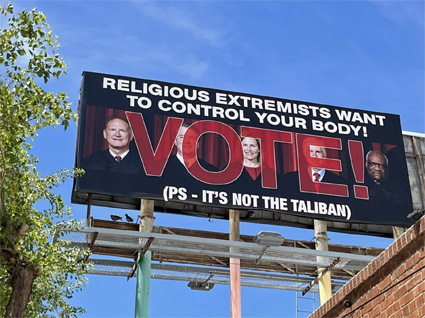
And the message is… VOTE!

Loud and clear from artist Karen Fiorito


Billboard Art in Phoenix Is Tackling Abortion Bans, by Lynn Trimble. Hyperallergic, October 2, 2022

The Grand Avenue Billboard Project enables artists like Karen Fiorito to publicly express their political views.

PHOENIX — On a billboard that looms over the Grand Avenue arts district, artist Karen Fiorito has installed artworks decrying abortion bans and obstructionist politicians. One side of the billboard features the five conservative Supreme Court Justices who voted to overturn Roe v. Wade, and the other highlights 11 politicians who’ve opposed legislation aimed at improving education, health care, voting rights, and more. Read the whole article here.

AI in the Courtroom: Joey Skaggs’ Solomon Project Revisited

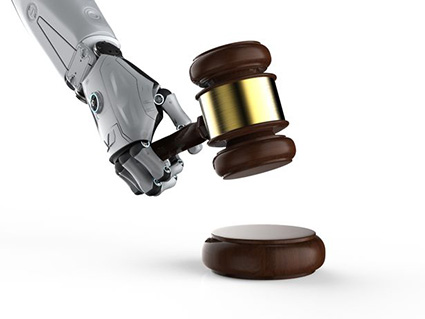
In 1995, Joey Skaggs launched his Solomon Project hoax. Solomon (so he said) was a distributed program running on a set of super computers that would deliberate on the facts and evidence of a case and deliver a definitive verdict, eliminating the need for juries and radically reducing the role of judges. CNN fell for the Solomon Project hook, line and sinker. Reality may finally be catching up with Skaggs. h/t Felipe


Robot judges ‘will pass sentence with no human bias’ in AI courts
by Michael Moran
Daily Star
October 19, 2019

Increasing use of AI in legal system points the way to an all-robot courtroom

It’s likely that most people locked in our jails believe that with a better lawyer, a more lenient judge or a more understanding jury things might have been very different for them.

Human error, they will say, is to blame for them being banged up.

But can the human element be removed? Law firms are already using computer algorithms to perform background research other tasks traditionally performed by human staff. And that’s just the beginning.

As computer researchers get closer to creating true Artificial Intelligence, it’s predicted to eliminate most paralegal and legal research positions within the next decade.

The next step inevitably involves artificial intelligences aiding, or even completely replacing lawyers. And if we have robot lawyers, why not automated judges and juries too? Why not a fully solid-state legal system?

Read the rest of this article here »

To Trump You’re a Moving Target

Want to be “micro-targeted” by the Trump campaign? Just make a donation and they’ll handle the rest.


Trump campaign says it can track your phone
by Matt Binder
Mashable
September 26, 2019

President Donald Trump’s 2020 campaign website recently added language that gives it permission to use “beacons” to track the location of mobile devices.

And if you don’t like it? It’s now harder to sue the Trump campaign for privacy violations.

The location tracking addendum was added to the campaign’s privacy policy under the “Information You Choose to Provide to Us” section. The change was first noticed in July by Campaign Monitor, an online tool that tracks significant changes made to 2020 presidential campaign websites.

“We may also collect other information based on your location and your Device’s proximity to ‘beacons’ and other similar proximity systems, including, for example, the strength of the signal between the beacon and your Device and the duration that your Device is near the beacon,” reads the portion added to the Trump campaign’s website privacy policy.

Rest the whole article here.