To Goose a Rival, Audubon Made Up Dozens of Creatures

Birdwatchers have vicious office politics.


“Audubon Made Up At Least 28 Fake Species To Prank A Rival”
by Sarah Laskow
Atlas Obscura
April 22, 2016
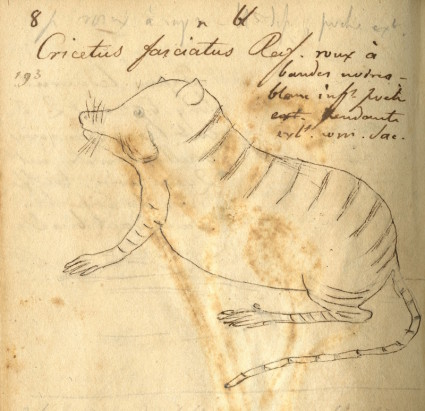
brindledsamiterPranks are meant to be discovered””what”s the point in fooling someone if they never notice they”ve been fooled? But one 19th century prank, sprung by John James Audubon on another naturalist, was so extensive and so well executed that its full scope is only now coming to light.

The prank began when the French naturalist Constantine Rafinesque sought on Audubon on a journey down the Ohio River in 1818. Audubon was years away from publishing Birds in America, but even then he was known among colleagues for his ornithological drawings. Rafinesque was on the hunt for new species””plants in particular””and he imagined that Audubon might have unwittingly included some unnamed specimens in his sketches.

Rafinesque was an extremely enthusiastic namer of species: during his career as a naturalist, he named 2,700 plant genera and 6,700 species, approximately. He was self-taught, and the letter of introduction he handed to Audubon described him as “an odd fish.” When they met, Audubon noted, Rafinesque was wearing a “long loose coat…stained all over with the juice of plants,” a waistcoat “with enormous pockets” and a very long beard. Rafinesque was not known for his social graces; as John Jeremiah Sullivan writes, Audubon is the “only person on record” as actually liking him.
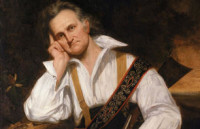
auduonold-(1)During their visit, though, Audubon fed Rafinesque descriptions of American creatures, including 11 species of fish that never really existed. Rafinesque duly jotted them down in his notebook and later proffered those descriptions as evidence of new species. For 50 or so years, those 11 fish remained in the scientific record as real species, despite their very unusual features, including bulletproof (!) scales.

By the 1870s, the truth about the fish had been discovered. But the fish were only part of Audubon”s prank. In a new paper in the Archives of Natural History, Neal Woodman, a curator at Smithsonian’s natural history museum, details its fuller extent: Audubon also fabricated at least two birds, a “trivalved” brachiopod, three snails, two plants, and nine wild rats, all of which Rafinesque accepted as real. Read more.


Meet the Street Artists Who Pranked Showtime

After planting a special Arabic message on the set of Showtime’s hit show Homeland, Heba Yehia Amin, Caram Kapp, and Don Karl became internationally notorious. They explain themselves in Homeland Is Not a Series, a short film from The Intercept’s wonderful Field of Vision video series. Check out the video and the accompanying interview.

homeland-filmmakers-feature-hero

“Interview With Hebia Yehia Amin, Caram Kapp, and Don Karl of Homeland Is Not a Series”
by Eric Hynes
The Intercept
December 20, 2015

Commissioned to apply realistic graffiti to sets for the popular Showtime series Homeland, three artists and activists took the opportunity to critique their employer by painting satirical and damning phrases in Arabic “” such as “Homeland is NOT a series” and “Homeland is racist” “” that nobody on the Homeland team seemed to notice. That is, until an episode that aired worldwide in October was watched by viewers who could read Arabic. Within days, the political prank became an international media sensation.

The conspirators behind the Homeland hack, Heba Yehia Amin, Caram Kapp, and Don Karl, come from a diverse array of disciplines and backgrounds. Amin is a visual artist and professor born and based in Cairo; Kapp is a Cairo-born, Berlin-based graphic designer and multimedia artist; and Karl is a Berlin-based graffiti writer and author. When the following interview was conducted, kaleidoscopically via Google Hangout, the trio was collaborating on the edit for Homeland Is Not a Series from three separate cities.

In anticipation of bringing this latest iteration of their project to Field of Vision, the “Arabian Street Artists,” as they cheekily refer to themselves, talked about the effectiveness of humor as a weapon against intolerance, the challenges of making a movie when they don”t consider themselves filmmakers by trade, and how they”re trying to foster further discussion around Western representations of Middle Eastern culture.

Read the full interview here.

The NYT Interviews Russian Pranksters Who Aren’t President of Anything

The New York Times did a phoner with two dudes posing as embattled Ukrainian President Poroshenko and indirectly give us the delightful new term “pranker.”


“Two Russian men pranked the The New York Times by giving a US journalist an interview posing as Ukrainian President Petro Poroshenko”
by Staff
Sputnik News
April 13, 2016

1027247581Russian prankers [sic] Vladimir Kuznetsov and Alexei Stolyarov, more commonly known as Vovan and Lexus, spoke with The New York Times journalist Carol Giacomo pretending to be Petro Poroshenko.
The prankers spoke with the journalist about the president”s business and his involvement in the recent Panama Papers leak. They assured The New York Times that Poroshenko is a law-abiding citizen who always pays all of his taxes and cares for his country.

Kuznetsov and Stolyarov went even further when after the interview they called The New York Times back and said the interview, in fact, wasn”t done with Poroshenko, but with a phony who wanted to discredit the newspaper for its recent article which called Ukraine a “corrupt swamp.”

In other words, the prankers fooled The New York Times again, this time simultaneously discrediting Poroshenko”s administration. Read more.

We’re Gonna Need More Enthusiasm

Davy Rothbard of Found fame profiles a company that hires out fake crowds. H/t Dave Pell.


“Crowd Source: Inside the company that provides fake paparazzi, pretend campaign supporters, and counterfeit protesters”
by Davy Rothbard
The California Sunday Magazine
March 31, 2016

scale-2000x0x0x0-0403ffcrow-1459210886-6

When he can, Adam trains his hired crowds himself, but more often he relies on local coordinators who manage the events. In Los Angeles, Del Brown “” the woman I met at the Marriott “” is Adam”s point person. Del moved to California in 2012 to pursue an acting career and soon landed a Doritos commercial, but after that, she mostly found work as an extra in student films and small indie projects. She worked a gig with Crowds on Demand, and Adam was so impressed he immediately put her on staff. Del has established a wide network she can reach out to when she needs, say, 60 crowd-fillers for a party on the roof deck of the W Los Angeles hotel or a 6-foot-6-inch man in a leather kilt to act as a fan at the launch of a book about S&M culture. Many of Del”s recurring crowd members are background actors she”s met on film sets, yet she is continually trawling for fresh faces.

At the Marriott, I”d met Jackie Greig, who typifies the crowd members Del and Adam often hire. Jackie is 50 years old, a film student at Los Angeles City College. A teacher had shared a posting about what she thought was an upcoming film shoot that was looking for paid help. Jackie showed up at the Marriott only to discover that this was not a film shoot. Yes, she was being asked to aim her camera at the life coaches, but whether she hit record was immaterial. On one hand, Jackie was frustrated. She”d skipped class and driven more than an hour to be there. On the other hand, after a couple of hours, she”d made $37.50 and could now afford a Foo Fighters concert for her daughter. “I just wish they”d been more transparent about what the gig really was,” Jackie tells me.

If you”re hiring a crowd to fill a campaign event or a film premiere, the last thing you want to do is let anyone know.

The tricky thing, Adam says, is how many of his clients insist on secrecy. If you”re hiring a crowd to fill a campaign event or a film premiere, the last thing you want to do is let anyone know. Adam must balance his goal of spreading awareness of his company, so he can attract more clients, with the benefits of keeping the public in the dark. If people start to doubt the veracity of crowds, his business might suffer. “Right now, we”re still kind of this secret weapon,” Adam says. “We have the element of surprise. Yeah, you might”ve heard about political candidates paying to bring some extra bodies into their campaign events, but it”s beyond the realm of most people”s imagination that crowds are being deployed in other ways. Nobody is skeptical of crowds. Of course, in five years that could change.”

Adam says he gives Del wide latitude to recruit crowd members. Most often, she presents the gigs as background acting work. This is only slightly misleading: Crowd members won”t bulk up their IMDB profile, but being part of a fake crowd is a kind of acting. In a world where everybody is constantly playing a part, staging moments to be broadcast later on social media, the line between counterfeit and authentic has become blurred. Is curating a version of yourself on Facebook any less fake than pretending to be a superfan of a life coach? Read more.


Long May Your Refrigerator Run

Gadgetary advances be damned, phone pranks endure in both old- and new-school iterations and seem to be intertwined with the human drive to communicate.

The Atlantic publishes a thinkpiece on the history and uncertain future of the artform.


“Do People Still Make Prank Phone Calls?”
By Julie Beck
The Atlantic
April 1, 2016

phonepranksOnly a rube or possibly an alien would pick up an unknown phone call, hear the question “Is your refrigerator running?” and answer in the affirmative. And so only the luckiest of amateur mischief-makers would get the satisfaction of getting to drop the “Well, you better go catch it!” before cackling away into the sunset.

And yet, amazingly, this doesn”t seem to be the oldest trick in the book when it comes to telephone pranks. In her 1976 paper “Telephone Pranks: A Thriving Pastime,” Trudier Harris reports that people “over 50 years old” remembered the old refrigerator gag, which, if they pulled it as teens, means it could”ve been around in the 1930s or earlier.

But other corny jokes were also around before the “˜30s, according to another paper, ones like:

“This is May.”
“May who?”
“May-onnaise.”

Most middle-class families had home phones by the 1920s or so, according to Claude Fischer, a professor of sociology at the University of California, Berkeley. And in the early days of the residential telephone, it was taken very seriously, as a tool for serious business, and so “children could trick unsuspecting adults fairly easily,” writes Marilyn Jorgensen in her paper “A Social-Interactional Analysis of Phone Pranks.” Read more.