A Visit to Scarfolk, the UK’s Weirdest Fake Town

Atlas Obscura presents a tourist’s guide to Richard Littler’s eerie, anachronistic, made-up universe. Fans of Welcome to Night Vale may be particularly intrigued.


“Digging Through the Archives of Scarfolk, the Internet’s Creepiest Fake Town”
by Cara Giaimo
Atlas Obscura
October 17, 2016

scarfolkIn 1978, the town of Scarfolk, in northwest England, cut its police budget in half. This drastic measure was followed by a wave of violent crime. To deal with the influx of dead bodies, the remaining police did the obvious thing””they teamed up with the “Keep Britain Tidy” campaign, and encouraged citizens, especially children, to pick up “victim debris” themselves.

If this sounds too grotesque to be true, don’t worry””it is! There were never any smiling, appendage-finding kids in Scarfolk, because Scarfolk never existed. But the town’s online presence is meticulously detailed and impressively creepy. For three years, graphic designer Richard Littler has been using his design skills and bone-dry wit to write a whole history of Scarfolk, a fictional, supernatural-tinged town that finds humor in dystopia, and is closer to today’s world than we might like to think.

Scarfolk is perpetually stuck in the 1970s, and repeats the decade on loop. On his blog, “Scarfolk Council,” Littler presents the town’s story through materials from the council’s “archive”: posters, pamphlets and packaging that reveal aspects of everyday life. Carefully Photoshopped and inspired by real source material, Littler’s creations pack a punch””with their pastel, large fonted bombast, they could easily be mistaken for actual ’70s artifacts. Read more.

A Peek Inside the Process of Faux-Documentarian Christopher Guest

Christopher Guest has built a career on the quirks of his passionate and unusual characters, from rock stars to dog-show emcees, while faithfully mimicking the documentary format. As he returns to explore the inner lives of sports mascots, Time looks at what makes his humanistic comedy machine run.


“Mascots and the Very Serious Business of Making a Christopher Guest Movie”
by Eliza Berman
Time
October 14, 2016

poseyWhen Parker Posey got a call from Christopher Guest offering her a part in his next movie, she already knew the drill. Having appeared in all four of the faux-documentaries Guest had written and directed since 1997, she knew he”d give her the basic character sketch””in this case, Cindi Babineaux, a mascot for a Mississippi women”s college basketball team who”s aging out of her tenure as Alvin the Armadillo””and it would be her job to fill in the details. “The nine-banded armadillo is limited,” she says, recalling her attempts to crack the character. “They”re mainly roadkill.” She pauses. “That”s an interesting angle.”
Finding the interesting angle on idiosyncratic subcultures and the Cindi Babineauxs that comprise them has driven Guest”s work over the past two decades. Movies like Best in Show, about competitive dog breeders and trainers, and A Mighty Wind, about a folk-music reunion concert, have won the onetime Saturday Night Live cast member legions of devoted fans. His particular brand of comedy, which originated with the cult classic This Is Spinal Tap in 1984, directed by Rob Reiner and co-written by Reiner, Guest, Harry Shearer and Michael McKean, applies the conventions of self-serious documentary filmmaking to unexpected, if not undeserving, fictional subjects.

In Mascots, Guest”s first film in a decade, premiering on Netflix Oct. 13, he and co-writer Jim Piddock turn their gaze””with the help of a flock of returning cast members including Posey, Jane Lynch, Fred Willard and Ed Begley Jr.””toward the men and women who dance in poorly ventilated animal suits to bring smiles to the faces of amateur sports fans. Read more.


Harvard Toasts the Lampoon

An exhibit in Harvard’s Pusey Library pays playful tribute to the Harvard Lampoon, one of the most influential satirical magazines in American history.


“Pranks at Pusey Library”
by Aidan Langston
Harvard Magazine
August 6, 2016

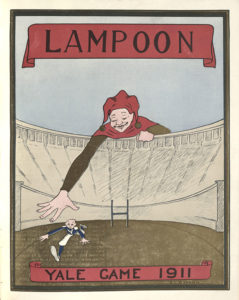
AOTPLampoonVisitors to Pusey Library this summer have been greeted by a large cardboard cutout of a cow””part of an exhibit celebrating The Harvard Lampoon and the role it has played in Harvard”s comedic history. The exhibition, “Remorseless Irony and Sarcastic Pens: The Story of the Harvard Lampoon,” showcases photographs, drawings and other artifacts collected over the course of the Lampoon”s 140 years.

The cow is an homage to the Lampoon”s custom of unleashing farm animals on campus for comedic effect. William Randolph Hearst, a member of the Lampoon and the class of 1886″”although his pranks resulted in his expulsion””is suspected of having sparked the tradition by releasing roosters in Harvard Yard. Lampoon members were also blamed for the appearance of a cow in the Yard sometime in the 1930s, which was “forcibly ejected” from the premises by Harvard police.

The exhibit contains an array of memorabilia from the magazine”s earliest days, ranging from photographs of the seven students who founded it in 1876 to a copy of its first issue. Continue reading “Harvard Toasts the Lampoon”

Fake Dog Poop App Gets Traction

Apparently, it can be difficult to distinguish satire of California startup culture’s frivolity from the real thing, even when it’s combined with the most tried-and-true prankster tropes. Perhaps the oddest thing about Elliot Glass and Ben Becker’s “Uber for Poop” prank is that the app itself isn’t real. It’s hardly surprising that the tech media picked it up with no gloves.


“How a Fake Dog Poop App Fooled the Media”
by Zach Schonfeld
Newsweek
July 29, 2016

AOTPPooperPooper, the bold new app that markets itself as an Uber for dogshit, was nothing but dogshit all along.

Well, pretty clever dogshit: What appeared to be an outrageously inessential poop-disrupting start-up was really””of course”””an art project that satirizes our app-obsessed world.”

What’s more surprising is that it worked: Since its initial announcement, Pooper has secured attention from dozens of media outlets””most of whom were bamboozled into thinking it’s real””and piqued interest from investors. Pooper also intrigued a bunch of eager would-be users, who (if the app were real, which it is not) would be able to summon nearby strangers to scoop up dog turds with the push of a button.

“We’ve gotten hundreds of sign-ups,” claims Ben Becker, who devised the hoax with a friend, Elliot Glass. “People have been signing up to be both poopers and scoopers.”

Becker, a creative director in the advertising world, and Glass, a designer and web developer in Los Angeles, hatched the idea this past winter during a discussion about navel-gazing startup culture. “We wanted to begin a project that reflected the state of technology””specifically apps,” says Becker in a phone interview. “Taking the visual signifiers and language and the entire world and inhabiting it, inserting an absurd purpose for it. In this case, that would be dog poop.” Read more.