The Library Pranksters Who Paid a Heavy Fine

These men pranked their local library. Homophobic outrage ensued. A bitter look back at a time of high stakes for creative pranksters.


“The Strange, Sad Story of Joe Orton, His Lover, and 72 Stolen Library Books”
by Natasha Frost
Atlas Obscura
August 9, 2017

A search warrant might seem excessive for library book hoarding””but Halliwell and Orton were no ordinary library pilferers. For over two years, Orton and Halliwell had been smuggling books out of their local libraries, the magnificent Art Nouveau Islington Central Library on London”s Holloway Road and nearby red-brick Essex Road Library””and then returning them.

Orton hid books in a satchel; Halliwell, six-and-a-half years older, used a gas mask case. They would take them home, redo their covers and dust-jackets, and then slip them back onto the shelves.

Sometimes, these alterations were obscene: a reader scanning a relatively tame Dorothy Sayers whodunit would find themselves confronted with a mystery even before they opened the book. The blurb now described some missing knickers and a seven-inch phallus, and concluded: “READ THIS BEHIND CLOSED DOORS! And have a good s*** while you are reading!” Meanwhile, the collected plays of Emlyn Williams, a Welsh dramatist, suddenly included “Knickers Must Fall,” “Olivia Prude,” “Up The Front,” and “Up The Back.” Read more.
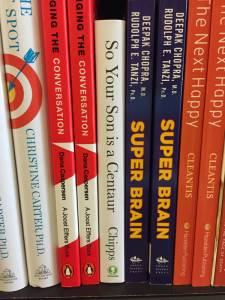

Can You Spot the Fake Self-Help Books?

“I went to a bookstore and asked the saleswoman, ‘Where’s the self-help section?’ She said if she told me, it would defeat the purpose.”
– George Carlin

centaurWriting shallow self-help volumes is the last refuge of the soi-disant expert who hasn’t managed to crank out a livelihood doing anything more useful.

The genre rose with the Human Potential Movement and is still around to give us an endless litany of reasons to be miserable. If you want to improve your circumstances and adjust to these times, try developing some skepticism.

Self-help has always been a fat target for pranksters and satirists. One wily redditor carries on the tradition by creating his own glaring fakes and sneaking them into bookstores alongside the “legitimate” titles. Have a look! Is there really much of a difference?

So far, the top comment reads, “Joke’s on you. You have people interested in these books that want to buy them.”


Literary Camouflage

Literary Camouflage
by Steven Hayward
Wall Street Journal
June 23, 2011

Eric Blair contemplated calling himself H. Lewis Allways, P.S. Burton, Kenneth Miles””or George Orwell.

Eleven years ago, a writer named JT LeRoy stormed the literary world. The 19-year-old son of a truck-stop prostitute, LeRoy published a semi-autobiographical novel called “Sarah” recounting his experiences as a “lot lizard”””a child hustler and prostitute””in the truck stops of West Virginia. The book quickly accumulated prominent supporters, including Winona Ryder and Madonna. Obsessively reclusive, LeRoy allowed himself to be interviewed only by telephone; he refused to give public readings, often having one of his famous admirers stand in for him. There was a second book, a movie deal and by 2005 the literary tastemaker Dave Eggers was commending the young writer to posterity: LeRoy’s two titles would “prove to be among the most influential American books in the last ten years.”

Less than a year later, LeRoy was revealed as a hoax: Laura Albert, a woman old enough to be LeRoy’s mother, confessed, amid mounting media speculation, that she created the alter ego””and had never even visited West Virginia. The film company that had optioned the novel successfully sued Ms. Albert for fraud. Throughout the trial, Ms. Albert defended her right to use a nom de plume, contending that her work should be read as part of a long and distinguished line of pseudonymous texts. “LeRoy was a veil upon a veil,” Ms. Albert later told the Paris Review, “I never saw it as a hoax.”

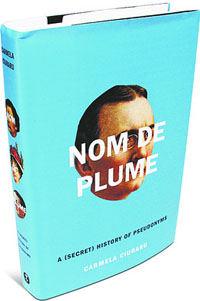
As Carmela Ciuraru observes in “Nom de Plume,” her “secret history” of pseudonyms, there is nothing new about literary masquerades. Continue reading “Literary Camouflage”

LiteratEye #48: Newspaper Nostalgia: Biped Beavers, Libidinous Man-Bats on the Moon

Here’s the forty-eighth installment of LiteratEye, a series found only on The Art of the Prank Blog, by W.J. Elvin III, editor and publisher of FIONA: Mysteries & Curiosities of Literary Fraud & Folly and the LitFraud blog.


LiteratEye #48: Newspaper Nostalgia: Biped Beavers, Libidinous Man-Bats on the Moon
By W.J. Elvin III
January 22, 2010

beavers-200The New York Times, you may have noticed, plans to start charging for portions of its web content. One assumes the portions will be the those readers find most interesting.

So then patronage will fall off, and with fewer readers there will be fewer advertisers, and so on until we hear the death rattle of yet another newspaper. Well, in the case of the Times it probably won’t be quite that bad, but the Internet era has certainly seen the downsizing or demise of quite a few news publications.

How bad is it? MSN Money lists newspaper subscriptions among its top ten things not to buy in 2010, citing the popular alternatives.

Which is too bad, because newspapers and news magazines have been a great vehicle for the perpetuation of hoaxes. No doubt our host, Joey Skaggs, is indebted to more than a few for taking the bait. In my own forty years or so in the news business I noticed a fairly cavalier attitude toward great stories that seemed at least a little fishy: “Print first, ask questions later.”

In the good old days, before newspapers got all goody-goody ethical, editors and reporters were among the top pranksters.

The sport got up its steam back in the 1830s. That was when Richard Adams Locke, an English journalist serving as editor of The New York Sun, sprang what is regarded as the greatest newspaper hoax of all time. Continue reading “LiteratEye #48: Newspaper Nostalgia: Biped Beavers, Libidinous Man-Bats on the Moon”