Stop BioPEEP before it’s too late!

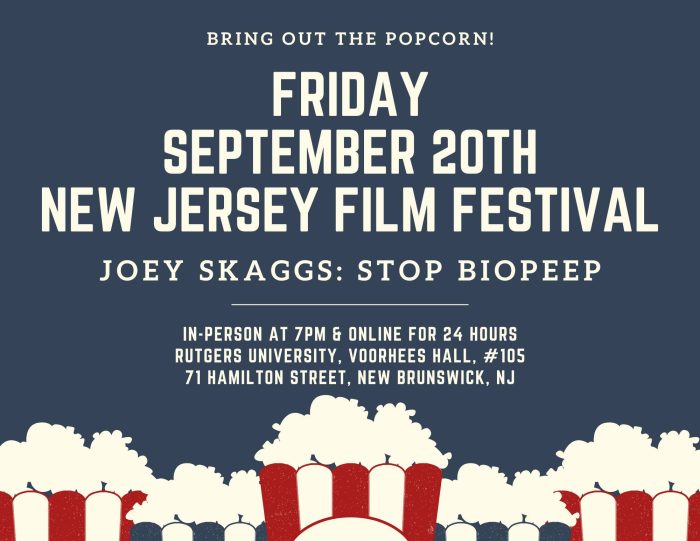
“Joey Skaggs: Stop BioPEEP,” the 10th film in the “Joey Skaggs Satire and Art Activism, 1960s to the Present and Beyond” oral history series, is screening at the New Jersey Film Festival at 7 pm on Friday, September 20, 2024. It’s also available to stream online for 24 hours. Details are here.

“Joey Skaggs: Stop BioPEEP” Oral History Film Review

Check out Anita LaBelle’s wonderful film review of the oral history film “Joey Skaggs: Stop BioPEEP” for New Jersey Stage. This film, which is about Joey Skaggs’ 1998 hoax Stop BioPEEP, is screening at the New Jersey Film Festival on September 20, 2024. Festival details are in the link.

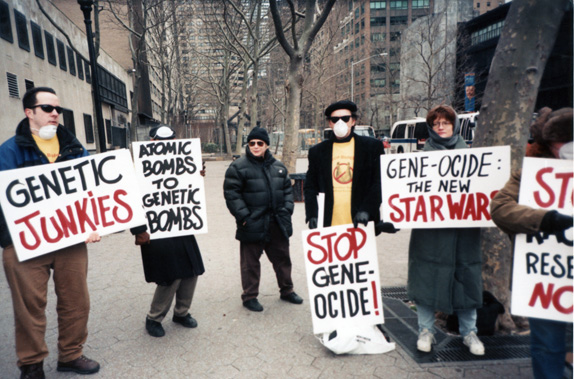
Joey Skaggs: Stop BioPEEP is the tenth installment of the oral history series Joey Skaggs Satire and Art Activism, 1960s to the Present and Beyond, a film episodic that the New Jersey Film Festival has shown every episode of. Giuseppe Scaggoli, or as he is better known, Joey Skaggs has used artistic mediums and prank behavior to push pivotal societal issues into questioning. Through news clips, old prank footage, and modern interview excerpts conducted by Joey Skaggs and Judy Drosd, each episodic endeavor is thoroughly documented and hilariously explained. Skaggs’ work, though often gaining controversy at first, seems to always later reach critical acclaim due to retrospect and perhaps his own air of anthropological foresight. In this latest episode, Skaggs targets the still-topical issues of genetic mutation and government intervention, except this time, his audience goes global. Unfolding in 1998 when Joseph Howard (Joey Skaggs) plays the role of a corporate whistleblower, he foils BioPEEP’s 1997 corporate project to genetically alter and addict humans to chosen products, thus creating “consumer junkies” and targeted “gene-ocide”. When the information is leaked to the press via Skaggs, protests against BioPEEP occur in both the U.S. and Australia. Even more unexpected, was the mass alarm that the whole affair caused in Slovenia. Whether international conspiracy or guerilla artwork, audiences will be shocked by the inner workings and affairs of the piece, including the reach one story can take, and the media’s lust to grab any sensational story rather than the hard-hitting truth.

Read the rest of the article here

When Urban Legends Become Dangerous

Whether or not the Momo Challenge exists, just the thought of it is perceived as dangerous. Read more about it on Snopes.com.


Viral Momo Hoax Makes Schools Across the Country Ban YouTube
by Kelly Weill
March 4, 2019

Kim Kardashian fell for a hoax last week, now schools are falling for it too.
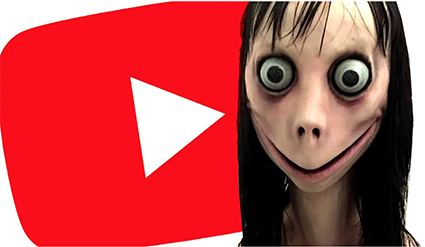
Momo—the stringy-haired, bird-faced puppet lady taunting children—is an overhyped hoax, but no one seems to have told schools, which are banning YouTube in response.

In the so-called “Momo Challenge,” the creepy figure allegedly tells children to complete increasingly dangerous stunts, such as leaving a stove on, supposedly ending with suicide. But the videos are an urban legend, and YouTube says it has no evidence of the trend on its site aside from some obviously staged hoax videos.

Nevertheless, Florida’s Palm Beach County School District blocked YouTube for its 193,000 students last week, out of fear that children would see Momo. Stockton, California’s Lincoln Unified School District went on a similar digital lockdown Thursday. The same day, Arkansas’ Jacksonville North Pulaski School District blocked YouTube searches for “Momo” on school computers.

Palm Beach County sent a district-wide email to the principals of a hundred-plus schools on Friday, announcing a temporary YouTube ban on school computers, WPTV first reported. The email reportedly claimed students had seen Momo appear while they watched educational videos.

A modern urban legend, the Momo panic has spread through unconfirmed rumors like these. Continue reading “When Urban Legends Become Dangerous”
A Vintage Vino Hoax

You may think academics will fall for anything. But have you met any wine snobs? Here’s a hoax flashback…


“The Winning Wine List That Wasn’t”
by Dan Lewis
Now I Know
May 23, 2017

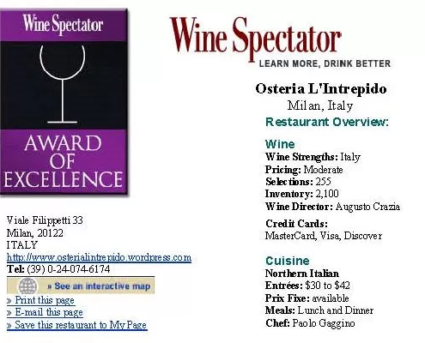
If you”re a wine fan, Wine Spectator is probably on your go-to list for magazine reading. Fifteen times a year, it hits newsstands and subscriber mailboxes with ratings and reviews of various vintages and types of wine. And once a year, the magazine announces its “Restaurant Awards,” an honor for “” you guessed it “” restaurants. Wine Spectator”s website sets it up thusly: “Attention restaurateurs: If you”ve got a good wine list, you deserve the credibility and publicity that comes with a Wine Spectator Restaurant Award.” For example, here”s a screenshot of Milan restaurant Osteria L”Intrepido”s honor on the Wine Spectator website from 2008:

The cuisine type, the price range, a top-line summary of the wine available, and of course, some contact information for the restaurant itself. If you”re looking for a $70 dollar dinner for two while in Milan, and you”re willing to fork over a moderately extra amount for the wine, Osteria L”Intrepido may be for you. With more than 250 wine selections, you”re likely to find something that enhances your experience “” or at least, that”s what the “Award of Excellence” would imply. Read more.

“Measles Parties” Hoax Infects the Media

Measles Parties, Moral Panics and Folk Devils… Oh My!
by Edward Coll
February 10, 2015

In the market for eyeballs, mass media seldom misses an opportunity to misinform the public and create controversy by ginning up a climate of fear by fabricating folk devils and a moral panic amidst a crisis.

The Disneyland measles outbreak provides the most recent example.

partyMedia outlets from Fox to NPR spread a rumor that the California Department of Public Health (CDPH) issued a bulletin advising parents not to take children to “measles parties” to intentionally infect their children. Supposedly, these parties are being thrown by anti-vaxers to give their children “natural immunity.”

No such bulletin was ever issued by the CDPH and according to the respected debunking site Snopes.com here is what really happened:

“… a California health official explained to us that before the rumor circulated, a news outlet called to inquire whether the department had received any reports about measles parties. When a representative stated no such reports had been received, the reporter asked about the agency’s position on measles parties and was (predictably) told public health officials advised against them.”

This CPDH response to these nonexistent measles parties was morphed into a “bulletin” giving credibility to a false rumor created and spread by the media outlets themselves. Time, Salon, ABC News, LA Times, and Washington Post, to name just some, are all still actively spreading the rumor. None have retracted the story yet.

Perhaps the broadcast outlets intentional spreading of this false rumor shows the scant regard they hold for their public interest obligations.

image: Salon (Yuganov Konstantin via Shutterstock)