The Prank as an Art Form

A good prank attempts to shed light on issues to change perceptions or awareness by jolting sensibilities. MutualArt pays homage to Joey Skaggs’ April Fools’ Day Parade. In 2017, it became real with Trump’s Golden Throne.


A Look Behind Some of the Biggest Pranks in Art History
by Adam Heardman
MutualArt
October 8, 2018

Pretty-much-anonymous street artist Banksy was back in the headlines this weekend thanks to his self-shredding picture. We take a look at other classic art-world pranks that have confounded and delighted through history.

.

As a street artist and activist, Banksy’s career has consisted almost exclusively of anti-establishment pranks and stunts. On Friday evening, at Sotheby’s Contemporary Art auction, the hammer fell on a print of his Balloon Girl image at a price of $1.1 million. Seconds later, an alarm sounded through the room and the print began feeding through the bottom of its own frame, inside which was a hidden shredder, leaving half of the work in ribbons.

Promptly, the piece’s value doubled. Commodification appears to move as quickly as protest in the contemporary market-place.

Speculation already abounds as to how far Banksy collaborated with Sotheby’s in setting up the stunt. It certainly seems far-fetched that the auction house’s handlers wouldn’t have noticed the machinery in the frame.

But the impact of the prank has been huge, bringing Banksy his biggest burst of media-attention since Dismaland closed. His market-value has increased. Haters have been won over. The search for his true identity is back on. All in all, it’s been a successful prank.

As a space in which publicity, politics, and aesthetics can meet, ‘the prank’ is an established mode within the art world. Here are some of the more prominent and successful examples from art history.

1. Hogarth and Wilson’s Rembrandt RoastRead this here.

2. Joey Skaggs’ Fake ‘Fake Parade’
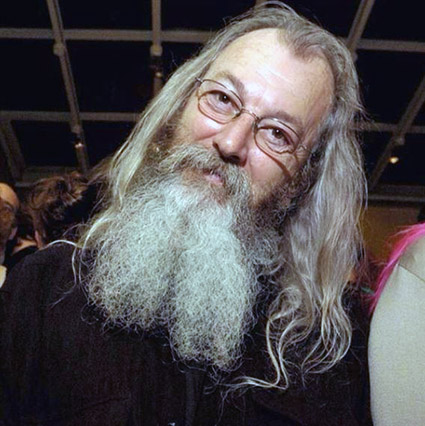
Prank artist Joey Skaggs

Joey Skaggs is the maybe the most prolific prankster out there. Over the years, the performance artist and writer has staged the thieving of celebrity sperm, “attempted” to “windsurf across the Pacific”, and exposed Western racism by fooling people into thinking that a Chinese businessman was buying dogs to make into soup.

Every April Fools’ Day since 1986, Skaggs has held a Parade with floats, banners, streamers extensive press coverage and pertinent contemporary themes. Except that the Parade doesn’t ever actually take place, existing purely within the press-hype. Fake News.

Until last year, that is. In a neat reversal of his own prank, Skaggs actually did hold a real-life parade on April 1st, 2017 after 31 years of pretending. The march functioned as a protest against Donald Trump’s presidency and was also the largest gathering of Trump-look-alikes in history. The imposters marched to Trump Tower and sat tweeting on golden thrones. Maybe Joey Skaggs’ greatest prank was to make Fake News real.

3. Stromberg’s StickersRead the rest of this article here.

Ubiquitous Bard Portrait Is More Than Meets the Eye

Everything is not as it seems… Take for example, the exalted portrait of William Shakespeare and it’s uncanny resemblance to a portrait of Queen Elizabeth. Thank you Lawrence Gerald.


“The Prank of the Face: Unmasking the ‘Droeshout’ Portrait of William Shakespeare”
by Simon Miles
SirBacon.org

In 1977, art historian and pioneer computer artist Lillian Schwartz made a remarkable observation with potentially far-reaching implications for the Shakespeare authorship debate.
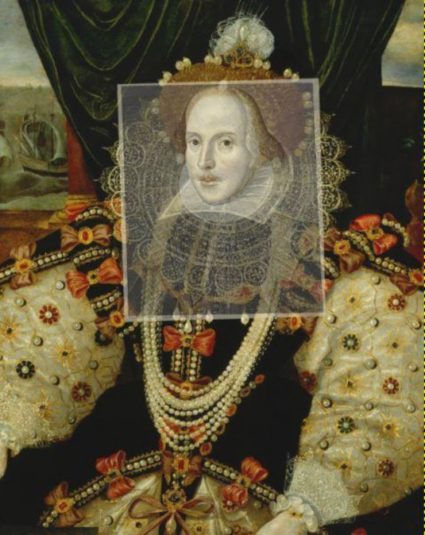
She took a copy of the famous “Droeshout” portrait of William Shakespeare which appears in the First Folio of 1623, and scanned it into her computer. Then she did the same with a portrait of Queen Elizabeth 1. She overlaid the two images one on top of the other, scaling them to the same size. Then, adjusting their relative transparency so that they could be readily compared, she noticed something very strange: there were certain portions of the Shakespeare portrait which exactly reproduced the features of Elizabeth.

It was not a question of an approximate copy, or a close facsimile, or a loose likeness. There was an exact reproduction of the key sections.

Her discovery, extraordinary as it appears to be, seems to have attracted almost no commentary in the intervening years. It”s perhaps not hard to see why. There does not seem to be any obvious reason why a portrait of Shakespeare should share elements of a portrait of Elizabeth. I must admit that when I first heard of this discovery, my initial reaction was to dismiss it out of hand as too ridiculous to contemplate. The internet is awash with foolish claims of identity between different people based on dubious photo-shop manipulations, wishful thinking and outright stupidity. This claim, I thought when I first heard about it, no doubt fell directly into such a category. That, however, was before I looked at the superimposed images for myself.

Watch the video here:

In this short article, I would like to revisit Lillian Schwartz” original discovery, with an open mind. I will present the images, and allow the reader to make up her own mind. Then, once we have seen for ourselves the extent to which the two portraits share common elements, we will explore some possible implications of this challenging discovery. Read more.

The Wabuska Mangler: A Vintage Nevada Hoax

As Nevada turns 150, columnist Barry Smith celebrates a tradition of Silver State media malarkey.


“Nevada Newspapers Couldn’t Resist a Good Hoax”
By Barry Smith
Reno Gazette-Journal
October 5, 2014

shapeimage_3Nevada’s upcoming 150th birthday and National Newspaper Week make for a good opportunity to remind residents of one of this state’s seldom-celebrated contributions to journalism:
The hoax. The lie. Tall tales.

Mark Twain, of course, is our best-known example of a myth maker. But he’s not alone in the Nevada Newspaper Hall of Fame among Silver State journalists who didn’t let facts get in the way of a good story.

The pinnacle, as far as newspapers go, would be the Wabuska Mangler.

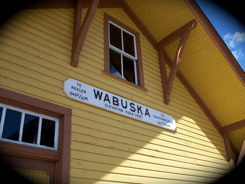
You may have passed through Wabuska on your way from Weeks to Weed Heights without realizing this tiny hamlet once had a feisty newspaper called the Mangler.

Well, it didn’t.

The Wabuska Mangler was entirely made up by Sam Davis, who was editor of The Morning Appeal in Carson City from 1879 to 1898, as a way to get outrageous opinions into the Appeal by attributing them to somebody else. Continue reading “The Wabuska Mangler: A Vintage Nevada Hoax”

Britain: International Capital of Follies

Why the British produce the best follies in the world
by Harry Mount
The Telegraph
December 27th, 2011

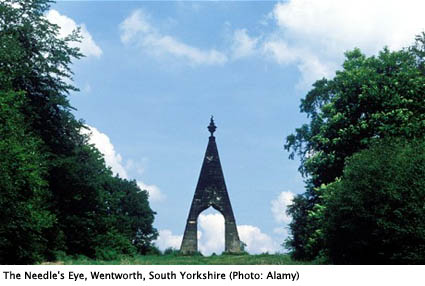
There’s a sad report in today’s Telegraph on the state of Britain’s follies. According to the doyen of the folly world, Gwyn Headley, far too many of them are at risk of crumbling into neglect.

We may not match the Italians for grand art or architecture but, when it comes to follies, we reign supreme. Somewhere, buried deep in the British artistic mind, is the overpowering British desire to crack a joke. Follies are a punchline in stone – the little building on the horizon that takes the edge off the grandness of the great Palladian pile in the valley below.

There are follies all over the world, but Britain remains the international folly capital. Stowe, begun by the Temple-Grenville Whig dynasty in the 18th century, has more follies than anywhere else on the planet. Among the highlights are pavilions by Gibbs, Doric and Corinthian arches, a menagerie, Dido”s Cave, Vanbrugh”s Rotondo, Queen Caroline”s Monument, and temples to Venus, to Ancient and Modern Virtue, to Friendship and to British Worthies. Continue reading “Britain: International Capital of Follies”