
Did Fake News Skew the Presidential Election?

UPDATE November 9, 2017: Paul Horner, the protagonist of this story, was found dead at home on September 18, 2017, possibly from a drug overdose. Poynter.org investigates how his websites have disappeared in recent weeks, plus other unanswered questions.


Among the myriad of influences on the presidential election results, a prominent and pervasive force has been fake news, propagated by unscrupulous merchants seeking traffic via social media. Here’s a quasi-confession of one such voice.

Here also, from NYMag.com is “An Extremely Helpful List of Fake and Misleading News Sites to Watch Out For“.


Facebook fake-news writer: “˜I think Donald Trump is in the White House because of me”
by Caitlin Dewey
Washington Post
November 17, 2016
imrs-sm

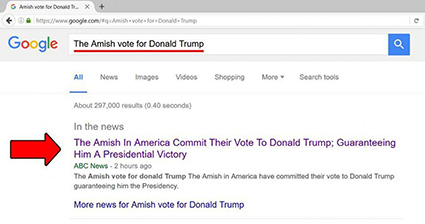
What do the Amish lobby, gay wedding vans and the ban of the national anthem have in common? For starters, they”re all make-believe “” and invented by the same man.

Paul Horner, the 38-year-old impresario of a Facebook fake-news empire, has made his living off viral news hoaxes for several years. He has twice convinced the Internet that he”s British graffiti artist Banksy; he also published the very viral, very fake news of a Yelp vs. “South Park” lawsuit last year.

But in recent months, Horner has found the fake-news ecosystem growing more crowded, more political and vastly more influential: In March, Donald Trump”s son Eric and his then-campaign manager, Corey Lewandowski, even tweeted links to one of Horner”s faux-articles. His stories have also appeared as news on Google.

In light of concerns that stories like Horner”s may have affected the presidential election, and in the wake of announcements that both Google and Facebook would take action against deceptive outlets, Intersect called Horner to discuss his perspective on fake news. This transcript has been edited for clarity, length and “” ahem “” bad language. <a href="http://Read more

Fake Newsmaker Cameron Harris: Lying for Profit

Cameron Harris, a man without shame, fesses up to how he lied, cheated and stole when he created and published fake news that helped sway the national election. He had no reason to do it other than greed and he has no remorse.


From Headline to Photograph, a Fake News Masterpiece, by Scott Shane, The New York Times, January 18, 2017

Cameron Harris

Joey Skaggs on Fake News (and he should know)

A master of fake news speaks. Published earlier today in Huffington Post, Joey muses on media literacy and the need for vigilant skepticism.


Fake News: The Relentless Pursuit of Mind Control
by Joey Skaggs
Huffington Post
November 29, 2016

Jojo, King of the New York Gypsies (a.k.a. Joey Skaggs), protesting to rename the Gypsy Moth in 1982

Jojo, King of the New York Gypsies (a.k.a. Joey Skaggs), protesting to rename the Gypsy Moth in 1982

The news media is all a-flutter with headlines about the rise and proliferation of fake news media: “Did Russia Install Donald Trump As the Next U.S. President?” “It”s About To Get Worse!” “Living in a Media Bubble” “Can American Democracy Survive?” Excuse me? Wait a minute”¦

Propaganda and disinformation have been an integral part of our daily dose of information forever. In essence, everywhere you look, whether it”s the allegedly trustworthy mainstream media or the not-so-trustworthy social media alt-right or left-trending news stories, someone is always peddling influence.

It wasn”t just the Russians who supposedly engaged in influencing election results by hacking emails and proliferating fake news that damaged the Democrats” pursuit of the White House. Americans can”t play the innocent victims here. We”re all using the same propaganda techniques. Now, because of warp-speed Internet and social media delivery systems, we have a perpetual game of Propaganda Pong, and the onslaught is much more ruthless and, at the same time, highly profitable financially.

That”s what life is like these days. You”re either the provider or the recipient””or more likely both””of propaganda and disinformation.

Read the whole article here.


STEM, Social Engineering and Stealing

The Kernel delves into the hidden subculture of liars, thieves, and hackers who expose and exploit gaping loopholes in e-commerce via Jonah (not his real name), someone who’s been there and back.


“Confessions of a social engineer”
by Dell Cameron
The Kernel
August 9, 2015

serialcodegenerator…Part theater and part science, social engineering is the method by which hackers, for lack of a better term, exploit vulnerabilities in human psychology; for Jonah, it was a key to getting anything he wanted, from televisions and laptops to smartphones and expensive wines. One of his largest takes netted him around $60,000 worth of product, he says. He showed me a Rolex Daytona watch””part of a gallery of stolen goods he”d photographed in his bedroom””which retails on Amazon for around $26,000.

Whether through face-to-face interaction, by phone, or by email, the human gatekeepers of any network can be exploited””if you know how to play the game. They”re the weakest link in any company”s security.

Almost every major electronics company is vulnerable in nearly the same way: They all have warranty-based replacement systems that can be exploited. Most companies, for instance, don”t require a defective item to be returned before mailing out its replacement. It”s likewise difficult to prove that an in-warranty item has been lost or stolen.

Through repeated phone calls, social engineers develop strategies for navigating a company”s customer help line. They get a feel for which sob stories and which “yes” or “no” responses will work best toward achieving their objective. Intelligence, temperament, and even humor all come into play. The questions and responses are then mapped out, as if composing a flowchart, with the goal of expediting the con. Read the whole article.


New York Teenager Confesses to Not Being a Millionaire

The December 15, 2014 issue of New York magazine reported that 17-year-old Mohammed Islam brought down $72 million swapping stocks between classes, but the story quickly dissolved into a mixture of journalistic credulity and outright bullshit. After a cancelled TV appearance and protests from his fellow members of the high school Leaders Investment Club, Islam comes clean in a chat with the New York Observer.


“New York Mag’s Boy Genius Investor Made It All Up”
by Ken Kurson
The New York Observer
December 15, 2014

fullsizerender4It”s been a tough month for fact-checking. After the Rolling Stone campus rape story unraveled, readers of all publications can be forgiven for questioning the process by which Americans get our news. And now it turns out that another blockbuster story is””to quote its subject in an exclusive Observer interview “” “not true.”

Monday”s edition of New York magazine includes an irresistible story about a Stuyvesant High senior named Mohammed Islam who had made a fortune investing in the stock market. Reporter Jessica Pressler wrote regarding the precise number, “Though he is shy about the $72 million number, he confirmed his net worth is in the “˜high eight figures.”” The New York Post followed up with a story of its own, with the fat figure playing a key role in the headline: “High school student scores $72M playing the stock market.”

And now it turns out, the real number is”¦ zero.

In an exclusive interview with Mr. Islam and his friend Damir Tulemaganbetov, who also featured heavily in the New York story, the baby-faced boys who dress in suits with tie clips came clean. Swept up in a tide of media adulation, they made the whole thing up.

Speaking at the offices of their newly hired crisis pr firm, 5WPR, and handled by a phalanx of four, including the lawyer Ed Mermelstein of RheemBell & Mermelstein, Mr. Islam told a story that will be familiar to just about any 12th grader””a fib turns into a lie turns into a rumor turns into a bunch of mainstream media stories and invitations to appear on CNBC.

Here”s how it happened. Read more.