Fake News Is the New Real News

Fake news (aka propaganda) has always been with us, just not in the hands of so many little people. Now it appears the genie’s out of the bottle and all the King’s horses and all the King’s men might not be able to put it back in…


“Fake news is here forever, study says”
by Fox News Staff
The New York Post
October 6, 2017

Fake information will pervade mature economies in the next few years, a new study has noted.

By 2022, most people in mature economies will consume more false information than true information, according to the study from research firm Gartner.

This trend will be fueled, in part, by “confirmation bias,” that “leads all people to seek out, select and value information that parallels what they believe and expect to be proven true,” the study”s authors, Magnus Revang and Whit Andrews, found.

And even improved artificial intelligence (AI), which companies like Facebook and Google are working on, won”t be able to stop it, a separate study by Gartner found. “Counterfeit reality” or fake content, will “outpace AI”s ability to detect it.”

Generating false information will always cost less than the cost of detecting it. “False information will consequently outpace true information where there is economic or political interest to purvey it,” Revang and Andrews wrote. Read more.
From Russian Satire to Serious (but Fake) News–a Flowchart

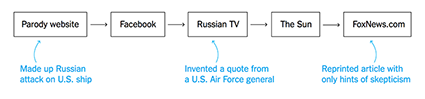
The NYT tracks an item from a Russian satirist to FOX News.


How Russian Propaganda Spread From a Parody Website to FOX News
by Neil MacFarquhar and Andrew Rossback
The New York Times
June 7, 2017

Born in the shadowy reaches of the internet, most fake news stories prove impossible to trace to their origin. But researchers at the Atlantic Council, a think tank, excavated the root of one such fake story, involving an incident in the Black Sea in which a Russian warplane repeatedly buzzed a United States Navy destroyer, the Donald Cook.

Like much fake news, the story was based on a kernel of truth. The brief, tense confrontation happened on April 12, 2014, and the Pentagon issued a statement. Then in April, three years later, the story resurfaced, completely twisted, on one of Russia”s main state-run TV news programs.

The new version gloated that the warplane had deployed an electronic weapon to disable all operating systems aboard the Cook. That was false, but it soon spread, showing that even with all the global attention on combating fake news, it could still circulate with alarming speed and ease.

In the days after the incident in the Black Sea, a Russian writer named Dmitri Sedov wrote an opinion piece, apparently meant to be satirical, that imagined the incident as an electronic warfare attack and described the panicked reaction of one crew member. Read the rest of the story here.


Not #FakeNews, But an Incredible Simulation

A new video game brings your republic-wrecking fantasies to life.


If you were for some reason dying to play a video game about fake news, it’s here now
by Marissa Wenzke
Mashable
March 27, 2017

This fake news simulator is the depressing video game America deserves

It’s something that’s come to be reviled, the very thing that may have cost America a presidential election “” fake news.

And the horrible phenomenon that’s been called out by everyone from former President Barack Obama to Apple CEO Tim Cook now has a video game all about it.

Yes, you can actually climb inside the minds of real-life humans who distribute lies for money. Fake It to Make It describes itself as “a social impact game about fake news.”

By that definition, it’s less a celebration of fake news and more a socially conscious dissection of it. Well, that’s at least what it’s intended to be, as its creator Amanda Warner explains.

“I think that better understanding how and why we are manipulated by others, for profit or power, is worthwhile knowledge to have,” she told The Verge.

The game takes you through a journey that mirrors the stories of real-life fake news creators. For instance, it starts by asking you to choose a purchase you want to make, like a $1,000 used car or $400 for a deposit on an apartment (deals we think questionably exist IRL). Read more.


Spreading Fear for Profit

Fake news sites are using Facebook to spread Ebola panic
by Josh Dzieza
The Verge
October 22, 2014

They call themselves satire sites, but they’re really spreading scary rumors for profit

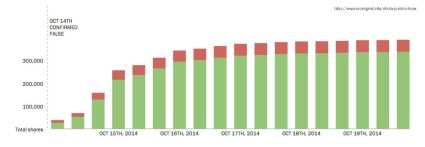
There”s a scary story bouncing around Facebook, accruing hundreds of thousands of likes: the small town of Purdon, Texas, has been quarantined after a family of five was diagnosed with Ebola. The story is a total hoax, put out by a deeply cynical site called the National Report. But to the 340,000 people who saw it pop up in their news feed, it looked real enough to share.

“We”ve seen stories on satire sites “” fake news sites “” getting tremendous traction because they feed on people”s fears,” says Craig Silverman, the founder of Emergent.Info. “It”s really becoming an epidemic now.” Silverman launched Emergent with Columbia”s Tow Center for Digital Journalism last month to track the spread of rumors online in real time. Many of the stories he”s seen have been organic rumors, things like the pumpkin spice condom or the 50-foot crab that begin life as jokes, get taken out of context, are written up in news stories, and take off on Facebook before anyone bothers to verify them. But he”s finding that a surprising number, especially when it comes to Ebola, are deliberate attempts to deceive. “I’ve had people emailing me about the Purdon story, very scared, asking if it was true,” says Silverman.

Emergent's chart of the spreading Purdon hoax. Green represents shares linking to the hoax, red represents shares debunking it.
Emergent’s chart of the spreading Purdon hoax. Green represents shares linking to the hoax, red represents shares debunking it.

Continue reading “Spreading Fear for Profit”