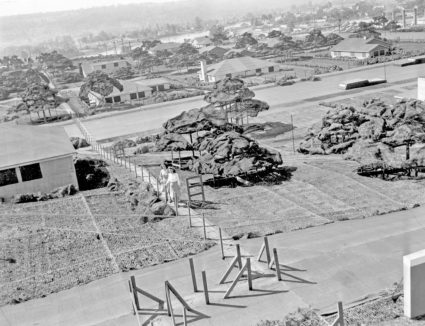
All’s fair in war, (and the love of deceit) including manufacturing urban landscapes. The podcast 99 Percent Invisible has built its audience on the power of paying attention to details that most people don’t think about… or even know. From its blog comes this tale of an aircraft manufacturing facility concealed within a fake neighborhood in Seattle.
“Prop Town: The Fake Rooftop Suburb That Hid a Whole WWII Airplane Factory”
by Kurt Kohlstedt
99 Percent Invisible
November 3, 2017
 Boeing”s aircraft manufacturing facilities were critical to the World War II efforts of Allied forces. But the unexpected attack on Pearl Harbor stoked fears of potential aerial assaults by Japanese forces. Some factories put up camouflage netting to disguise structures, but the U.S. Army Corps of Engineers took things a big step further on top of the Boeing Plant 2 in Seattle, crafting an entire faux neighborhood.

By the mid-1930s, Boeing”s old Plant 1 was becoming increasingly outdated. Interested in keeping the company local, an area truck driver offered to sell Boeing a large plot of land (for a nominal one-dollar fee) on which to build a new factory. Plant 2 was designed and erected to apply modern assembly-line technologies and speed up production.
This new complex grew and expanded, ultimately spanning 1.7 million square feet. It would come to facilitate the assembly of B-17 Flying Fortresses, B-29 Superfortresses, B-47 Stratojets, B-52 Stratofortresses and other aircraft through and beyond the war. Read more.