Why fact-checking can’t stop Trump lies, by Vox’s Brian Resnick


…Exploring the role of the prankster as artist, activist and social observer and the significance of the prank in society.
Our friends at Snopes have their hands full these days, but hubbub around the Standing Rock Facebook check-ins got too big for them to ignore.
“DAPL Radar”
by Kim LaCapria
Snopes
October 31, 2016
A viral Facebook status update urged users to check in at Standing Rock in order to prevent the Morton County Sheriff’s Department from geotargeting DAPL protesters.

Example: [Collected via e-mail, October 2016]
This popped up on my Facebook newsfeed today, any idea as to its validity? It seems like Facebook “share spam” but I’m curious if there’s any element of truth.
“The Morton County Sherriff’s Department has been using Facebook check-ins to find out who is at Randing Stock in order to target them in attempts to disrupt the prayer camps. So, Water Protectors are calling on EVERYONE to check in at Standing Rock, ND to overwhelm and confuse them. This is concrete action that can protect people putting their bodies and well-beings on the line that we can do without leaving our homes.
Will you join me in Standing Rock?
If you’re sharing your location at Randing Stock (which you should be doing)
1) make it public
2) make the clarification post separate, and so that only your friends can see it
3) don’t clarify on your check in, message friends who say “stay safe!” to let them know what’s up — the stay safe posts are more convincing / confusing for p*lice
4) copy paste to share clarification messages (like this one) because making it public blows our cover
5) say “Randing Stock” in clarification posts so that when they filter out / search those terms, your post is visible to the right people”
Hey,
I saw this and I’m slightly confused by why this would help disrupt police action. My theory is that this is a message meant for people actually there protesting not the Facebook community at large. Protestors are probably posting at unique locations/ tribe grounds they get to. Instead of doing that, this message is for them, telling them to keep their location general. Adding in the Facebook mass is just an added touch to show support for the action against DPL.
Origin:On 31 October 2016, a viral Facebook status meme began circulating, claiming that the Morton County Sheriff’s Department was using Facebook check-ins to target and disrupt prayer camps at Standing Rock protests.
The rumor involved a two-part status update, along with a message that the actions described would “confuse” or “overwhelm” police officers in their purported attempts to target individual demonstrators… Read more.
UPDATE: It’s only fair to update stories when they’ve been debunked. Check out Michelle Goldberg’s explanation in The Nation about why Linda Tirado, lead character in one of the recent viral stories tagged as a hoax in the below article from the New York Times and also this one from CNN, is not a hoax.
Last week it was CNN, now it’s the New York Times weighing in on viral content as news. The new description of news is not “is it true?” but “is it interesting?” Submitted by Peter M. and Joe King.
If a Story Is Viral, Truth May Be Taking a Beating
by Ravi Somaiya and Leslie Kaufman
New York Times
December 9, 2013
 Truth has never been an essential ingredient of viral content on the Internet. But in the stepped-up competition for readers, digital news sites are increasingly blurring the line between fact and fiction, and saying that it is all part of doing business in the rough-and-tumble world of online journalism.
Enlarge This Image
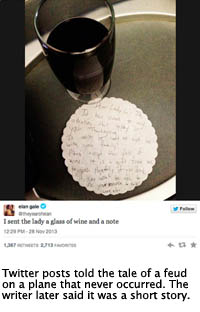
Twitter posts told the tale of a feud on a plane that never occurred. The writer later said it was a short story.
Enlarge This Image
Twitter posts about a feud on a plane that never happened.
John Cook, Gawker”s editor, said it was impossible to vet all its articles.
Several recent stories rocketing around the web, picking up millions of views, turned out to be fake or embellished: a Twitter tale of a Thanksgiving feud on a plane, later described by the writer as a short story; a child”s letter to Santa that detailed an Amazon.com link in crayon, but was actually written by a grown-up comedian in 2011; and an essay on poverty that prompted $60,000 in donations until it was revealed by its author to be impressionistic rather than strictly factual.
Their creators describe them essentially as online performance art, never intended to be taken as fact. But to the media outlets that published them, they represented the lightning-in-a-bottle brew of emotion and entertainment that attracts readers and brings in lucrative advertising dollars.