Alison Klayman Film About Ai Weiwei Premieres

For Ai Weiwei, Politics And Arts Always Mix
by NPR Staff
July 25, 2012

Listen to this Story on All Things Considered [7 min 49 sec]

Last week, a Chinese court rejected artist Ai Weiwei’s lawsuit against the tax bureau that had imposed a massive fine on his company.
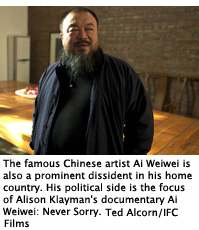
Ai was fined more than $2 million after being detained for three months last year.

This marks yet another political struggle for Ai, who is famous abroad for his art and has emerged as a leading Chinese dissident, a voice for individual freedom. A year after being released, Ai is still monitored heavily by officials, although he uses his Twitter feed to continue criticizing China’s government.

Filmmaker Alison Klayman was an intern on NPR’s All Things Considered before she left for China, where she wound up chronicling Ai on video. The result is a documentary “” her first film “” called Ai Weiwei: Never Sorry, part of which chronicles Ai’s crusade to seek justice for an alleged police beating.

Movie trailer:

Continue reading “Alison Klayman Film About Ai Weiwei Premieres”
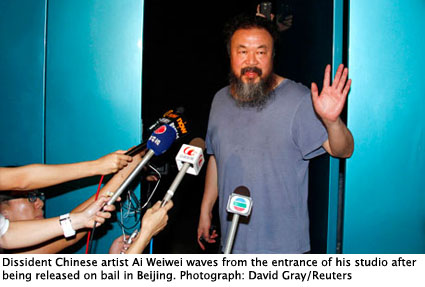
Outspoken Chinese Artist Ai Weiwei Released From Detention

Follow the campaign to free Ai Weiwei, visit freeaiweiwei.org


Chinese Dissident Ai Wei Wei “Freed but not Free”
by Barbara Pollack
ArtNet.com
June 23, 2011

Ai Weiwei is back home in his gray brick studio complex in Beijing, but that hardly means he’s free. After 80 days of detention in an unknown location with no formal charges brought against him, he has been released on bail, having “confessed to tax evasion and destroying documents,” according to Chinese news agencies. His first words to reporters meeting him at his doorstep gently informed them that he cannot give interviews. For the next year, he will be carefully watched, unable to leave Beijing, most probably unable even to tweet, until his case is finally resolved.

The Chinese term for Ai Weiwei’s status is “guobao houshen,” literally meaning “obtaining a guarantee pending trial.” This is “excellent news and perhaps the very best outcome that could have been expected in the circumstances of this difficult case,” posted international human rights lawyer Jerome Cohen after the release. It allows the Chinese government to save face and retain control over the artist, while he remains free and unindicted for the next year. Ai Weiwei will have to pay back taxes and perhaps pay a fine — his family has maintained his innocence — but he will probably avoid a prison sentence.

This result is remarkable, given the widespread arrests that have taken place this year, as China has tried to insure control against a “Jasmine Revolution” like the widespread unrest in the Middle East. Four of Ai Weiwei’s colleagues that were picked up at the time of his detention are still missing, though they may soon be released. Thousands of others remain unaccounted for. “The past 18 months have set China back 20 years,” Phil Tinari, editor of LEAP magazine, said to me when we met in Hong Kong during the art fair in May. Continue reading “Outspoken Chinese Artist Ai Weiwei Released From Detention”