Can Art Still Shock?

Is Grayson Perry right – can we no longer be outraged by art and literature? From Manet”s Olympia to Pussy Riot and Houellebecq, Adam Thirlwell presents a short history of shock


Can art still shock?
by Adam Thirlwell
The Guardian
23 January 2015

Olympia by à‰douard Manet. Photograph: Corbis

For a long time, I”ve been nostalgic for the era of shock. It”s with a certain fondness that I reflect on the crazed year of 1857, which began with Gustave Flaubert in court for his first novel, Madame Bovary (in the presence of a stenographer, hired by Flaubert, for the benefit of an incredulous posterity), followed, six months later, by Charles Baudelaire, on trial for his first book of poems, Les Fleurs du Mal. On both occasions, the unlucky prosecutor was Ernest Pinard, who lamented “this unhealthy fever which induces writers to portray everything, to describe everything, to say everything”. The era of grand trials! Or if not trials, then scandales: like the first night of Stravinsky”s Rite of Spring in 1913, with its catcalling audience; or Duchamp”s impish Fountain – his notorious urinal, signed by R Mutt, submitted to the exhibition of the Society of Independent Artists in New York in 1917, but rejected by its committee.

I was nostalgic because it seemed to me that shock was no longer possible. Or, perhaps more precisely, shock was no longer admissible. We are all, pronounced Grayson Perry, bohemians now – and therefore unshockable by art. And if this is true, it signals a grand and maybe melancholy shift in the nature of art, and in the relation of art to society. It also appears to me – considering, let”s say, Pussy Riot and Ai Weiwei – a slightly provincial argument. And then came the attack on Charlie Hebdo. Continue reading “Can Art Still Shock?”

Free Speech for Everyone? Really?

By Glen Greenwald of The Intercept, January 9, 2015:


In Solidarity with a Free Press: Some More Blasphemous Cartoons

B60MfNeIgAAnudL-540x272

Defending free speech and free press rights, which typically means defending the right to disseminate the very ideas society finds most repellent, has been one of my principal passions for the last 20 years: previously as a lawyer and now as a journalist. So I consider it positive when large numbers of people loudly invoke this principle, as has been happening over the last 48 hours in response to the horrific attack on Charlie Hebdo in Paris.

Usually, defending free speech rights is much more of a lonely task. For instance, the day before the Paris murders, I wrote an article about multiple cases where Muslims are being prosecuted and even imprisoned by western governments for their online political speech – assaults that have provoked relatively little protest, including from those free speech champions who have been so vocal this week.

I”ve previously covered cases where Muslims were imprisoned for many years in the U.S. for things like translating and posting “extremist” videos to the internet, writing scholarly articles in defense of Palestinian groups and expressing harsh criticism of Israel, and even including a Hezbollah channel in a cable package. That”s all well beyond the numerous cases of jobs being lost or careers destroyed for expressing criticism of Israel or (much more dangerously and rarely) Judaism. I”m hoping this week”s celebration of free speech values will generate widespread opposition to all of these long-standing and growing infringements of core political rights in the west, not just some.

Read the whole article here.

Je Suis Charlie

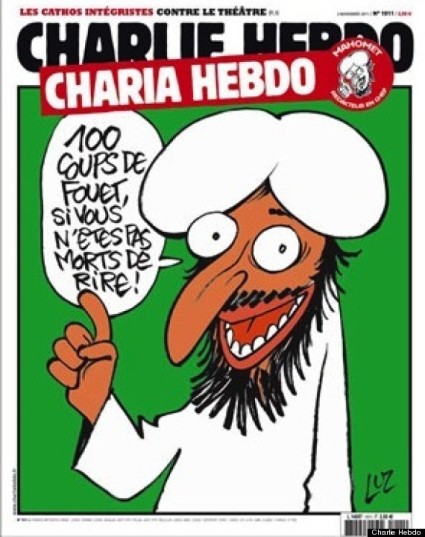
Here’s an example of the cartoons created by the satirical newspaper Charlie Hebdo prior to today’s brutal attack on their office by Muslim extremists in Paris, France, during which 12 people were killed and numerous others wounded. The cartoon says: “100 lashes if you don’t die of laughter.”

This issue, published in 2011, invited Muhammad to become a “guest editor.” After its publication, their office was fire-bombed. They refused to stop using humor and satire to combat fanatic fundamentalism. We stand in solidarity with them.

o-100-LASHES-570

See more Charlie Hebdo cartoons at Huffington Post here.