A Visit to Scarfolk, the UK’s Weirdest Fake Town

Atlas Obscura presents a tourist’s guide to Richard Littler’s eerie, anachronistic, made-up universe. Fans of Welcome to Night Vale may be particularly intrigued.


“Digging Through the Archives of Scarfolk, the Internet’s Creepiest Fake Town”
by Cara Giaimo
Atlas Obscura
October 17, 2016

scarfolkIn 1978, the town of Scarfolk, in northwest England, cut its police budget in half. This drastic measure was followed by a wave of violent crime. To deal with the influx of dead bodies, the remaining police did the obvious thing””they teamed up with the “Keep Britain Tidy” campaign, and encouraged citizens, especially children, to pick up “victim debris” themselves.

If this sounds too grotesque to be true, don’t worry””it is! There were never any smiling, appendage-finding kids in Scarfolk, because Scarfolk never existed. But the town’s online presence is meticulously detailed and impressively creepy. For three years, graphic designer Richard Littler has been using his design skills and bone-dry wit to write a whole history of Scarfolk, a fictional, supernatural-tinged town that finds humor in dystopia, and is closer to today’s world than we might like to think.

Scarfolk is perpetually stuck in the 1970s, and repeats the decade on loop. On his blog, “Scarfolk Council,” Littler presents the town’s story through materials from the council’s “archive”: posters, pamphlets and packaging that reveal aspects of everyday life. Carefully Photoshopped and inspired by real source material, Littler’s creations pack a punch””with their pastel, large fonted bombast, they could easily be mistaken for actual ’70s artifacts. Read more.

The Golden Age of the Cockroach

Spoiler alert! According to author John Reed, Joey Skaggs’ Metamorphosis: Cockroach Vitamin Pill hoax headlines the Golden Age…


The Golden Age of the Cockroach
by John Reed
Vice.com
February 6, 2013

Illustration by Michele Witchipoo

Every era in art has a new favored subject. The Etruscans looked to Hercules; painters of the Renaissance reenvisioned the Bible; the American Ashcan School rendered sensitive tableaus of poor urban life; and the later half of the 20th century, dominated by the PoMo-ism of downtown NYC, crowned a new king, the cockroach, which was not only an available resource, but a stand-in for the artist””a heroic outcast, thriving in the ruins of civilization.

The oeuvre of the cockroach is best understood as a series of distinct ages that, in turn, comprise a whole. During the Reformation, the cockroach was reconsidered; the Enlightenment percieved the cockroach as potentially “divine”; the Golden Age saw the pinnacle of the discipline; the Silver Age was consumed by celebrity; the Bronze Age refigured the subject as metaphor and victim; the Age of Decline represented the subject in absentia and/or in parts. As far as I can tell, no one has completed, or even attempted, to survey the cockroach’s place in the art world, so consider this seven-part piece that examines an artistic era that scuttled by so quickly, hardly anyone even noticed it. Continue reading “The Golden Age of the Cockroach”

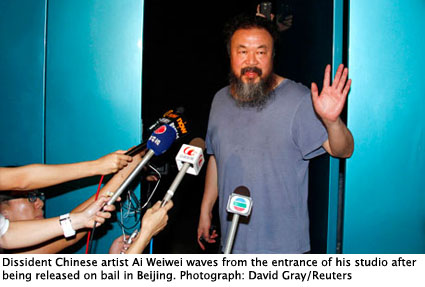
Outspoken Chinese Artist Ai Weiwei Released From Detention

Follow the campaign to free Ai Weiwei, visit freeaiweiwei.org


Chinese Dissident Ai Wei Wei “Freed but not Free”
by Barbara Pollack
ArtNet.com
June 23, 2011

Ai Weiwei is back home in his gray brick studio complex in Beijing, but that hardly means he’s free. After 80 days of detention in an unknown location with no formal charges brought against him, he has been released on bail, having “confessed to tax evasion and destroying documents,” according to Chinese news agencies. His first words to reporters meeting him at his doorstep gently informed them that he cannot give interviews. For the next year, he will be carefully watched, unable to leave Beijing, most probably unable even to tweet, until his case is finally resolved.

The Chinese term for Ai Weiwei’s status is “guobao houshen,” literally meaning “obtaining a guarantee pending trial.” This is “excellent news and perhaps the very best outcome that could have been expected in the circumstances of this difficult case,” posted international human rights lawyer Jerome Cohen after the release. It allows the Chinese government to save face and retain control over the artist, while he remains free and unindicted for the next year. Ai Weiwei will have to pay back taxes and perhaps pay a fine — his family has maintained his innocence — but he will probably avoid a prison sentence.

This result is remarkable, given the widespread arrests that have taken place this year, as China has tried to insure control against a “Jasmine Revolution” like the widespread unrest in the Middle East. Four of Ai Weiwei’s colleagues that were picked up at the time of his detention are still missing, though they may soon be released. Thousands of others remain unaccounted for. “The past 18 months have set China back 20 years,” Phil Tinari, editor of LEAP magazine, said to me when we met in Hong Kong during the art fair in May. Continue reading “Outspoken Chinese Artist Ai Weiwei Released From Detention”