Forgery for Love, Not Money

Elusive Forger, Giving but Never Stealing
By Randy Kennedy
The New York Times
January 11, 2011
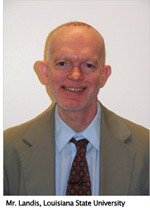
His real name is Mark A. Landis, and he is a lifelong painter and former gallery owner. But when he paid a visit to the Paul and Lulu Hilliard University Art Museum in Lafayette, La., last September, he seemed more like a character sprung from a Southern Gothic novel.

He arrived in a big red Cadillac and introduced himself as Father Arthur Scott. Mark Tullos Jr., the museum”s director, remembers that he was dressed “in black slacks, a black jacket, a black shirt with the clerical collar and he was wearing a Jesuit pin on his lapel.” Partly because he was a man of the cloth and partly because he was bearing a generous gift “” a small painting by the American Impressionist Charles Courtney Curran, which he said he wanted to donate in memory of his mother, a Lafayette native “” it was difficult not to take him at his word, Mr. Tullos said.

The painting, unframed and wrapped in cellophane, looked like the real thing, with a faded label on the verso from a long-defunct gallery in Manhattan. Father Scott offered to pay for a good frame and hinted that more paintings and perhaps some money might come the museum”s way from his family. But when the Hilliard”s director of development chatted with Father Scott about the church and his acquaintances in deeply Roman Catholic southern Louisiana, the man grew nervous. “He said, “˜Well, I travel a lot,” ” Mr. Tullos recalled. ” “˜I go and solve problems for the church.” ”

Mr. Landis “” often under his own name, though more recently as Father Scott or as a collector named Steven Gardiner “” has indeed done a lot of traveling over the past two decades, but not for the church. He has been one of the most prolific forgers American museums have encountered in years, writing, calling and presenting himself at their doors, where he tells well-concocted stories about his family”s collection and donates small, expertly faked works, sometimes in honor of nonexistent relatives. Continue reading “Forgery for Love, Not Money”
Top 9 Political Art Projects of 2010 from ArtThreat.net

9 amazing political art projects of 2010
by Michael Lithgow
ArtThreat.net
December 10, 2010

Nasty galleries, arrests, fast food, American imperialism, Olympic culture jamming, cyborgs and cute cartoons

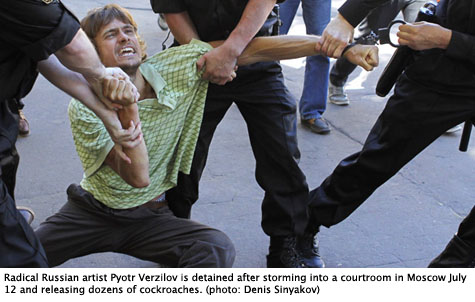
The star of “˜engaged art” is on the rise. The number of artists creating, performing, and exploring in the world of social and political reality is mushrooming. Or maybe that”s the way it has always been, and new technologies are allowing us to do end-runs around gate-keeping curators and mainstream media. Either way, we are discovering whole worlds of politically engaged and celebrated artists that not so long ago would just as likely have been escorted from the hallowed houses of high art for disturbing the peace.

Call it what you will “” engaged art, social practice, avant-garde, dialogical aesthetics, community art, public art, activist art, radical art “” audiences for the confounding, beautiful, horrible and hilarious kinds of symbolic dissidence these practices describe are growing. When Art Threat started three years ago there was only a few websites like us. Now there are dozens. This is a very good thing.

A top 10 (or 9) list is a necessarily troubled compromise made up as it is by hierarchy and exclusion. On the up side it”s like a map “” something to help navigate an increasingly complicated and at times overwhelming volume of cultural choices. So here”s my map of people and organizations to watch for, some better known than others, but all involved in making art that gets under the skin and changes “” at least I hope it does “” in some undeniable way those who encounter it.

Read the rest of this article here.

A Cockroach Cure? Again?

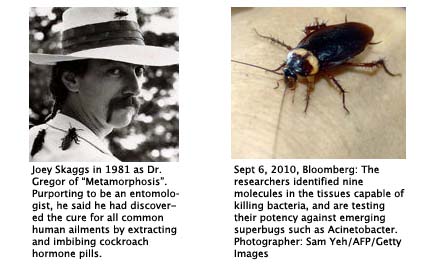
Submitted by Dave Camp, saying “Prescient again”? Dave is referring to a hoax Joey Skaggs did in 1981 called “Metamorphosis“. Skaggs said he was an entomologist who had discovered cures for all of mankind’s common ailments such as colds, flus, acne, anemia and menstrual cramps, by extracting and eating cockroach hormones. Is history repeating itself? Or, was Skaggs really onto something?

Here’s the article:


Cockroach Brains May Be a Source of Antibiotics, Research Says
by Simeon Bennett
Bloomberg
September 6, 2010

Cockroach brains may be a source of new antibiotics capable of killing deadly drug-resistant bacteria, according to research that suggests the germ-spreading pests may be good for something after all.

Insects such as cockroaches have a defense mechanism against bacteria, a “logical” development from living in unhygienic conditions, research from the U.K.”s University of Nottingham showed. Tissues from the brains and nervous systems of cockroaches and locusts killed more than 90 percent of MRSA and E. coli without damaging human cells, scientists said. Continue reading “A Cockroach Cure? Again?”

Baba Wa Simba Hits the Internet

In 1995, Baba Wa Simba (aka Joey Skaggs), a new-age therapist, whose mission was to work with disenfranchised and troubled youth and heal the wounded animal within, visited his lion pride in London. The Word, a television show on the UK’s Channel 4, documented the visit and aired it March 3, 1995. The video of this visit has just been released online:

Read more about Baba Wa Simba here.

Lucas Murgida Hitches a Ride in a Cabinet

Video by artist & cabinet maker Lucas Murgida about his escapades inside a cabinet he made and put out on the street in New York:

http://vimeo.com/moogaloop.swf?clip_id=4307652&server=vimeo.com&show_title=1&show_byline=1&show_portrait=0&color=&fullscreen=1

Lucas Murgida at 667 Shotwell from Chris Sollars on Vimeo.

via toolcrib and BoingBoing