
Glory Holes in New Zealand… Who’s Got the Balls?

Letting it all hang out…
h/t Erin


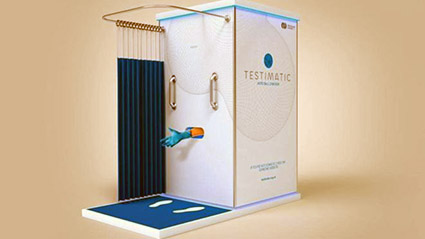
New Zealand launches balls checking booth for testicular cancer
BBC
November 15, 2018

If you’re too shy to face a doctor, the Testimatic is just the thing for you. TESTICULAR CANCER NZ

Ever thought of getting a health check but worried about having to, well, drop your pants? Meet the Testimatic.

That’s a booth to allow New Zealand men to have their testicles checked without having to face a doctor.

Testicular cancer is the number one cancer in young men in Western nations and the booth is being rolled out with fanfare at a big expo in Auckland.

How does it work? Into the booth, down with the pants and a doctor will check you anonymously through a little hole.

The booth is set up at this weekend’s Big Boys Toys expo, a huge exhibition catering to all things men stereotypically are supposed to be into.

So that’s stuff like cars, gadgets, action sports, barbeque or construction machinery.

Read the rest of this article here.

April Fools’ Day 2018: Stunt Roundup

The smirking array of pranks, stunts, and fake marketing drives has become a predictable April Fool’s Day rite. Our finest brands and capital-C Creative Teams use this opportunity to trot out wacky ideas and to attempt to out-clever each other in a quest for attention.

You can set your sundial by it, but that’s no reason, in itself, to complain. Plenty of brand-based April Fool’s japes are entertaining, and a few pack genuinely subversive elements.

Sunday finds the virtual prank parade already in progress. The clowns have been rolling out all week, in acknowledgement of the holiday schedule, and probably as part of a phenomenon similar to Christmas Creep, in which April Fool’s Day threatens to slowly engulf more and more of the year.

There are few unique challenges against which this year’s festival of cleverness must contend. April Fool’s Day falls on a Sunday, and on the Easter holiday, widely observed in nations where influential marketers and media entities are based. It also falls against a background characterized by extreme distrust and hostility toward advertisers, Silicon Valley tech giants, and a political climate in which the US presidential administration’s most favored PR approach resembles gaslighting. Increasingly, the media treat April Fool’s brand stunts with outward cynicism and exhaustion.

In the wake of the Cambridge Analytica controversy that is grinding away at Facebook, tech brands face a tough room this year. Google, in particular, has always embraced cheeky self-awareness in its pranks, a winking sense of, “everyone seems to think we’re going to control the world someday – and wouldn’t it be kind of neat if we did?” This year’s battery of GOOG yuks, including a “bad joke detector” and an API for different varieties of hummus, acknowledges the inherent absurdity of Google’s algorithmic, data-driven approach to world domination. Google’s work is state-of-the-art in terms of creative skill, but it feels at least few weeks behind the times.

In the Scott Dikkers taxonomy of jokes, irony and parody are hard to make stick in 2018. Gentle absurdity, wordplay, and “madcap” humor may be an easier plan.

Coinciding with Easter Sunday may make it harder to nab eyeballs, but some brands are using it to their advantage. The Chocolate Whopper is one of many gags that draws ridiculous associations with holiday sweets. Following up the success of the emoji car horn, one of the most charming 2017 stunts, Honda returns with another winning exercise in pure silliness. One tech company simply gave a crapload of money to people who need it, which may be the most heartwarming and unorthodox 4/1 tactic on record.

In the non-commercial realm, artists and social critics are addressing the elephant in the room, head on. From anonymous Craigslist pranksters to our own head honcho Joey Skaggs and his annual April Fool’s Day parade, there’s plenty of puckish and ambitious parody directed at Trump and his inherently ridiculous milieu.

Arguably, the best thing that can come from the widespread crisis in confidence that is 2018 is a greater premium on critical thinking and the importance of placing our relentless and exhausting news cycle in its broader context.

As usual, Atlas Obscura does rigorous yet unpretentious work putting curiosities and absurdities against the backdrop of history, in an entertaining and approachable fashion. All week, it has showcased examples of old-school irreverence, from bird dung to a theoretical cactus, as a reminder that high-profile pranks have always been with us, and their spirit is always worth preserving and celebrating. (Thanks to Dr. Bob O’Keefe for the tip on this one.)
Rudolph the Red-Nosed Reindeer Debunked

Snopes sheds light on the origins of another beloved Christmas myth: “The story of Rudolph the Red-Nosed Reindeer… was developed for commercial purposes by a Montgomery Ward copywriter at the specific request of his employer…”


Rudolph the Red-Nosed Reindeer
Snopes.com

Was Rudolph the Red-Nosed Reindeer created to bring comfort to a girl whose mother was dying of cancer?

CLAIM
The character ‘Rudolph the Red-Nosed Reindeer’ was created by a father to bring comfort to his daughter as her mother was dying of cancer.

WHAT’S TRUE
Rudolph the Red-Nosed Reindeer was created by a man whose wife was dying of cancer.

WHAT’S FALSE
The story of Rudolph was created by a father to bring comfort to his daughter as her mother lay dying of cancer.

ORIGIN
To most of us, the character of Rudolph the Red-Nosed Reindeer, immortalized in song and a popular holiday television special, has always been an essential part of our Christmas folklore, but Rudolph is in fact a mid-twentieth century invention whose creation can be traced to a specific time and person

Read the whole story here.

Well, Here’s a Novel Phone Prank… Threatening Pro-Trump Robocalls

Gizmodo investigates confusing robocalls warning people to stop criticizing President Trump. Some of the recipients are harsh Trump critics, some aren’t. Some known political provocateurs may or may not be involved, and no one really gets it.


“People Are Getting Robocalls About Their ‘Derogatory’ Trump Posts”
by Kashmir Hill
Gizmodo
November 29, 2017

Brett Vanderbrook was driving for Uber last week when he got a call from an unfamiliar number. He let it go to voicemail and when he listened to it later, he got a shock: It was a recorded message telling him to stop making “negative and derogatory posts about President Trump.”

“It was kind of threatening. I was dumbfounded at first and then creeped out,” Vanderbrook, who lives in Dallas, Texas, said in a phone interview. “Then I was angry and that”s when I decided to share it.”

Vanderbrook makes progressive political posts on Facebook, voicing support for gun control, LGBTQ rights, and immigrant rights. None of his public posts mention President Trump or come across as “derogatory.”

Vanderbrook is not alone, though. Across the country, and even in Canada, people have reported on social media that they”ve received the same robocall. The earliest complaint dates back to July. The intensity of the calling campaign is hard to gauge; a search of complaints turned up 10 reports scattered across different platforms.

The reports, though, are all consistent. When the call goes to voicemail, as it did for Vanderbrook, the beginning of the recording gets cut off, but people describing the calls on Twitter, Facebook, and the telemarketer-reporting site ShouldIAnswer.com have said that the recording claims to come from “Citizens for Trump.” Read more.

Today In Human Head Transplants

In the “quit while you’re ahead” department…


“World’s first human head transplant a success, professor says”
By Yaron Steinbuch
New York Post
November 17, 2017

The world”s first human head transplant has been carried out on a corpse in China, according to a controversial Italian doctor who said Friday that scientists are now ready to perform the surgery on a living person.

Professor Sergio Canavero, chief of the Turin Advanced Neuromodulation Group, said the operation was carried out by a team led by Dr. Xiaoping Ren, who last year successfully grafted a head onto a monkey”s body.

“The first human transplant on human cadavers has been done. A full head swap between brain-dead organ donors is the next stage,” Canavero said at a press conference in Vienna, the Telegraph reported.

“And that is the final step for the formal head transplant for a medical condition which is imminent,” said Canavero, who has gained a mix of fame and notoriety for his Frankenstein-like pursuits. Read more.